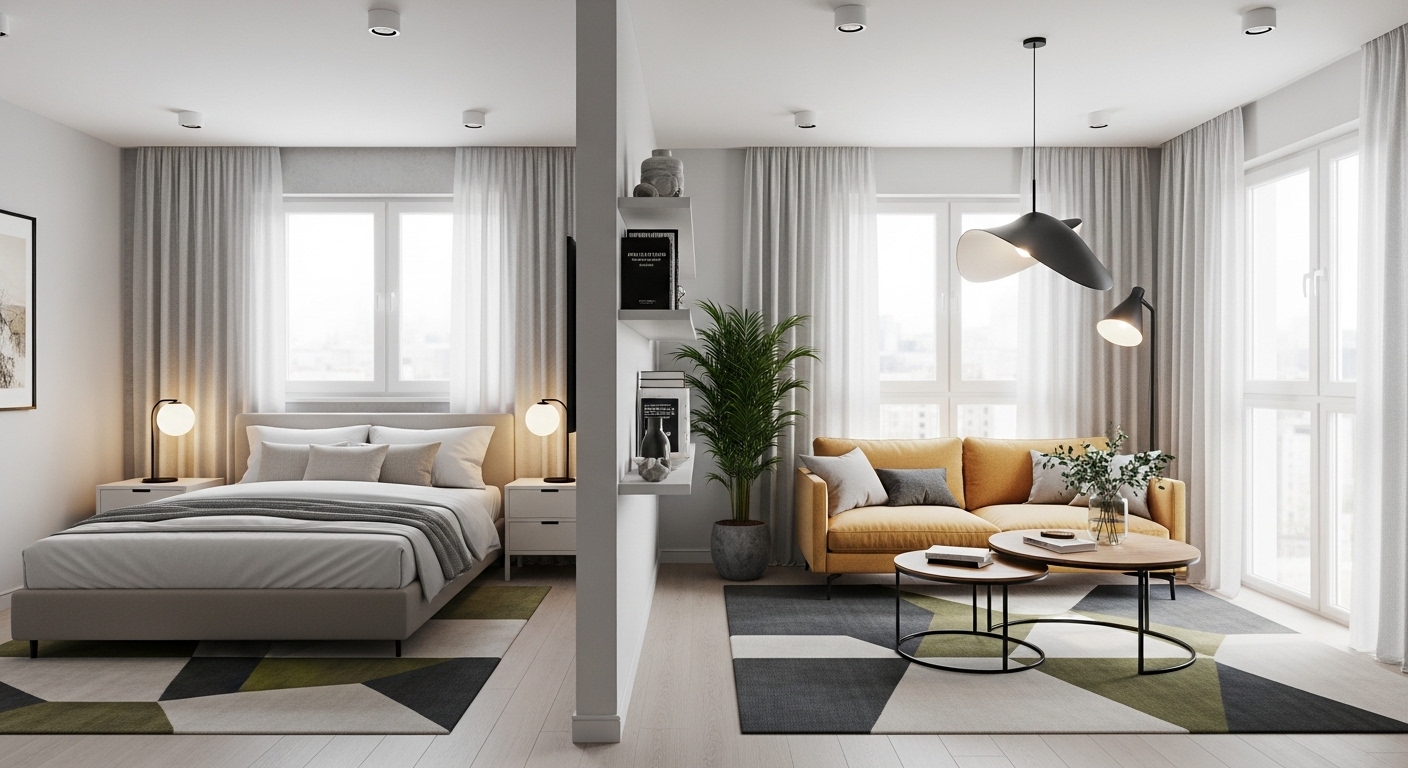
Studio apartment layout ideas that work are the ones that make zones without walls: a rug, a light and a piece of furniture with a back for each function, so that sitting in one spot tells your brain which room you're in. Before my current apartment I lived in a true studio for two years, 320 square feet, no separation between sleeping, living and working, and the key to not losing my mind was creating psychological zones where there were no physical ones. A pair of bookshelves at about $120 each did the dividing, and the light did the rest. This post is the three zones and what defined each, the bookshelf divider and how to place it, the rug rule, the sofa's back as a wall, the sconces that made the bed a bedroom, the desk with a different temperature, the layouts that work for a long studio, a square one and an L, where the bed goes and why not under the window, the kitchen strip, storage in a studio, the lighting map, what to skip, mistakes and what the zones cost.
The principle: a rug, a light, a back
A room is a floor, a ceiling and walls, and a zone in a studio needs a stand-in for each: a rug for the floor, so the zone has an edge you feel underfoot; a light for the ceiling, a pendant or a sconce that marks where the zone is from above; and a back, a sofa's back, a bookshelf, a headboard, so the zone has one wall. With all three, sitting in the zone feels like being in a room; with only the rug, it feels like a rug. Every zone below has the three, and the studio had five things doing the work of walls.
Zone one: the living area
Anchored by a rug, 5 by 8, that defined the space. A sofa facing away from the bed, so its back was the living room's fourth wall and the bed was behind it and out of sight from the couch. A plug-in pendant above the coffee table, on a swag hook, that marked the ceiling of the zone. When I sat on that couch I was in the living room; the rug and the light made it so, and the fact that the bed was six feet behind me stopped mattering because I couldn't see it. A chair at an angle, a small lamp on the shelf, and the zone was a room with three light sources and one wall.
Zone two: the sleeping area
The bed against the far wall, a different and smaller rug beneath it, and two plug-in wall sconces on either side at 60 inches. The sconces created a bedroom "header," a visual boundary at the top of the sleeping zone, and this was the most important piece: before the sconces it was a bed floating in a room; after, it was a bedroom. A headboard, even a simple one, is the back; the sconces are the light; the small rug is the floor. At night the living zone's lights went off and the sconces were the only light on, and the studio became a bedroom the size of the bed, which is the whole trick of a studio at 11 pm.
Zone three: the work area
A desk in the corner by the window, a task lamp at 3000K, a small rug under the chair, and the bookshelf's end as its wall. The distinct light temperature, slightly cooler for focus, reinforced that the corner had a different function; when the 3000K lamp was on I was at work, and when it went off at six the corner was just a corner. The desk faced the wall with the window to the side, which is the rule for any desk and is doubly the rule in a studio where facing into the room means working in the living room.
The bookshelf divider
Two open-backed bookshelves, 30 inches wide and 70 tall, placed back to back across the studio between the living zone and the bed, perpendicular to the long wall, leaving a 30-inch walkway at one end. Open-backed so light passes through and the studio doesn't become two dark cells; anchored to each other and, with one strap, to the wall; books on the living side, baskets on the bedroom side. They're storage, a wall, and a place for a lamp on the top shelf that lit both zones. $240 for the pair, and they're the two things from the studio that came to the next apartment and are still the divider between the entry and the living room.
The rug rule
One rug per zone, and no rug touching another; a 12-inch gap of bare floor between the living rug and the bedroom rug is the doorway between them. The living rug big enough for the sofa's front legs and the chair; the bedroom rug under the bed's front two-thirds and out 18 inches each side; the desk rug just under the chair. Different rugs, the same family: the living one flat-weave in oatmeal, the bedroom one a small wool in grey, the desk one a jute square. Three rugs in a 320-square-foot room sounds like a lot, and it's less than three doors.
Layouts: long, square, L
A long studio, which mine was, zones along its length: living by the door, the divider, the bed at the far end, the desk at the window on the long wall, so you walk from public to private. A square studio zones by corners: bed in the corner furthest from the door, living in the corner nearest the window, desk in the third, kitchen in the fourth, with the sofa's back and the rugs doing the dividing because there's no length for a bookshelf wall. An L-shaped studio has the bed in the short leg, which is the layout everyone with an L wants and should take, with a curtain on a ceiling track across the leg's opening for the nights with a guest.
Where the bed goes, and why not under the window
The far wall from the door, so the bed is the last thing you reach and the first thing hidden by the sofa's back. Not under the window, which is the layout the floor plan suggests and which puts the bed in the coldest, brightest spot and takes the window from the living zone that uses it all day; the desk gets the window. Not beside the kitchen, for the smell and the fridge hum. And with its long side to the wall if the studio is under 14 feet wide, which loses one sconce and gains 2 feet of floor.
The kitchen strip
A studio kitchen is a wall, and the zone is the counter's light: an LED strip under the cabinet at 3000K on a smart plug, and a plug-in pendant or a lamp on the counter's end at 2700K for the evening, and the ceiling light off. The kitchen zone is defined by the strip being on; when it's off the kitchen is a wall of cabinets in the living room, which is what it should be after dinner. The counter lighting post is the strip and the pendant.
Storage in a studio
The bookshelves, which hold half of it. A bed with drawers underneath or on risers with bins, which hold the season's clothes. A trunk as the coffee table. Hooks on the back of every door. And the rule that nothing is stored in a zone that isn't that zone's: no work things by the bed, no bedding in the living zone, which is the rule that keeps the zones feeling like rooms. A studio's mess is zone-mixing more than volume.
The lighting map
Living: the pendant over the coffee table at 40 percent, a lamp on the bookshelf, an arc lamp in the corner. Bedroom: the two sconces, and nothing else. Desk: the 3000K lamp. Kitchen: the strip and the counter lamp. Every zone's lights on their own switch or plug, so a zone can be off while the next is on, and the ceiling light, the one the studio came with, on a 2700K bulb and used to find things. At 11 pm the studio is a bedroom because only the sconces are on; at 9 am it's an office because only the desk lamp is; and the walls that aren't there are the switches. The layers post is the same system in the next apartment.
Guests, and the studio that has to be two rooms for a night
A guest in a studio sleeps in the living zone on the sofa bed, and the bedroom zone's sconces are what let the host sleep in a bedroom while a guest sleeps in a living room ten feet away: the living zone's lights off, the divider between, and a rechargeable sconce beside the sofa bed as the guest's bedside light. The bookshelf divider matters most on those nights, and so does the rule about the sofa facing away from the bed. Two rooms for a night, in 320 square feet, and both people have a light they can reach.
The entry, which a studio doesn't have
The 18 inches inside the door became an entry with the bookshelf's end as its wall, a hook strip on the shelf's side, a small mat, and a plug-in sconce on the wall by the door on a timer. The living zone starts where the rug starts, 3 feet in, and the bare floor between the mat and the rug is the entry. It's the same trick as the console in the entryway post, done with the divider's end because there was no wall for a console.
What to skip
A room divider screen, which is a wall that blocks light and stores nothing. Curtains from the ceiling around the bed, unless there's an L, because a curtained bed in a square studio is a tent. A loft bed, which is a bed you can't sit up in and a room that's always half ladder. A murphy bed, which costs more than the divider and the sofa together and which nobody folds up daily. And a second sofa, which is the mistake of treating a studio as a small apartment instead of one room with zones.
The studio in the morning
Bed made in ninety seconds so the bedroom zone reads as furniture and not as sleep; the sconces off; the desk lamp on and the corner is the office; the kitchen strip on for coffee and off after. A studio's zones only work if each one is closed when you leave it, and the made bed is the door on the bedroom. It's the discipline the divider can't do for you, and it's the reason the studio was livable for two years and not two months.
Mistakes
The bed under the window for the first six months, cold and bright and the window lost to the living zone. One big rug across everything, which made the studio one room, which it was and shouldn't have felt like. The sofa facing the bed, so the bed was the television. Bookshelves with backs, which made the bedroom a cave for a month before I swapped them. And the desk facing into the room, working in the living room every day for a year.
In one paragraph
A rug, a light and a back for every zone; the sofa facing away from the bed with a bookshelf divider between; two sconces at the bed as its header; a 3000K lamp at the desk; a strip in the kitchen; every zone's lights on their own switch; the bed on the far wall and not under the window. Three rooms in one, made of five things that aren't walls.
What the zones cost
Two bookshelves, $240. Three rugs, $180 secondhand and new. The plug-in pendant and swag hook, $70. Two plug-in sconces, $96. The desk lamp, $35. Plug-in dimmers and a smart plug, $40. About $660 for three rooms in a 320-square-foot studio, and $96 of it, the sconces, was the purchase that turned a bed into a bedroom, which was the zone that had been missing.
Shop this post: bedroom wall lamps and plug-in pendant lights, the two lights that mark the zones