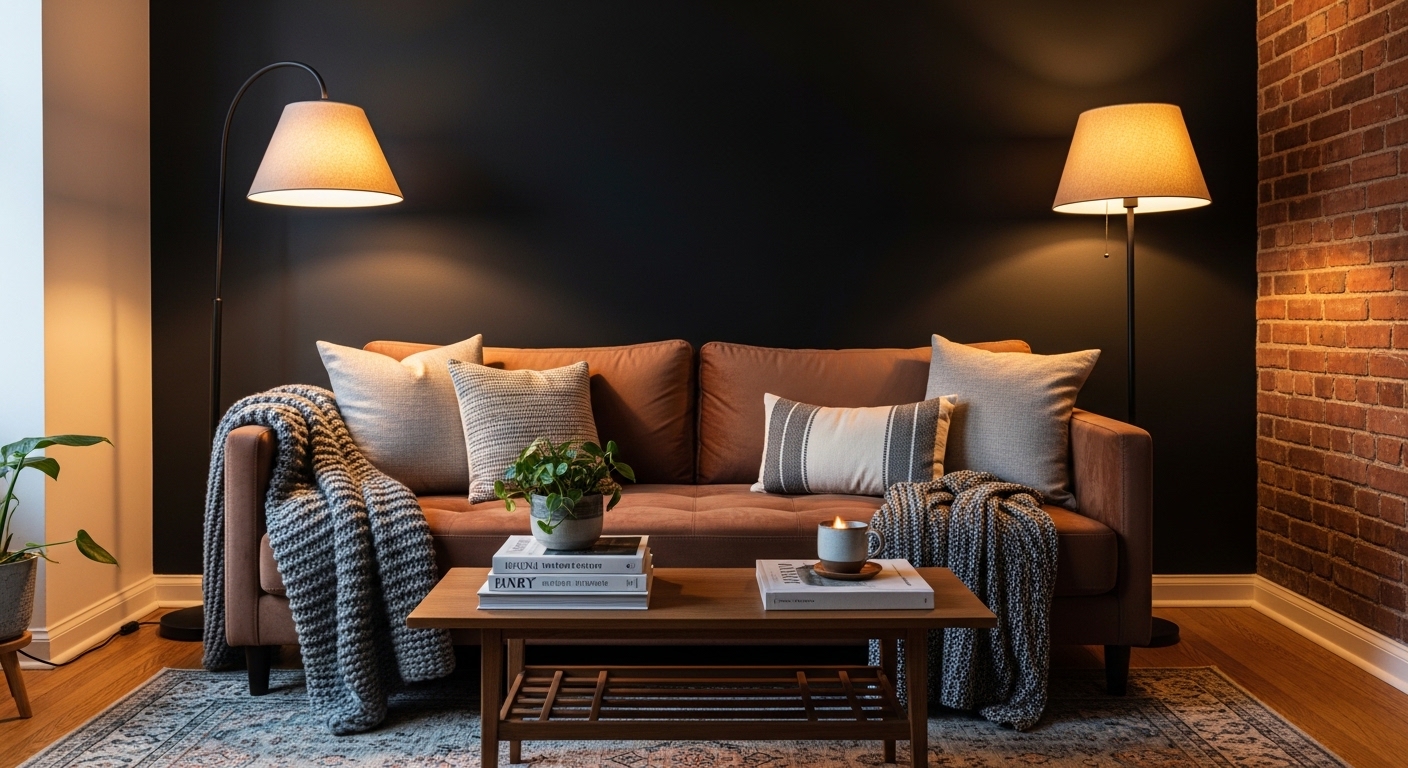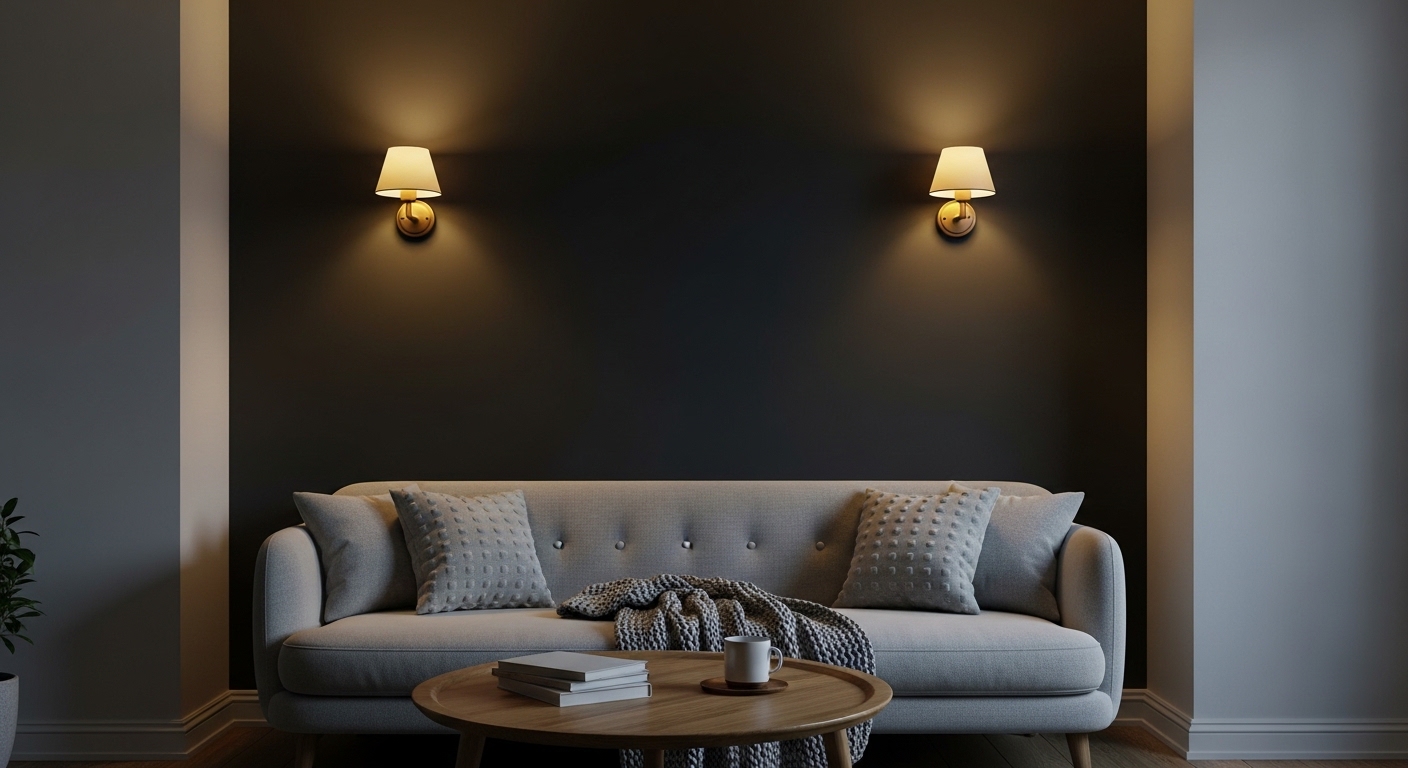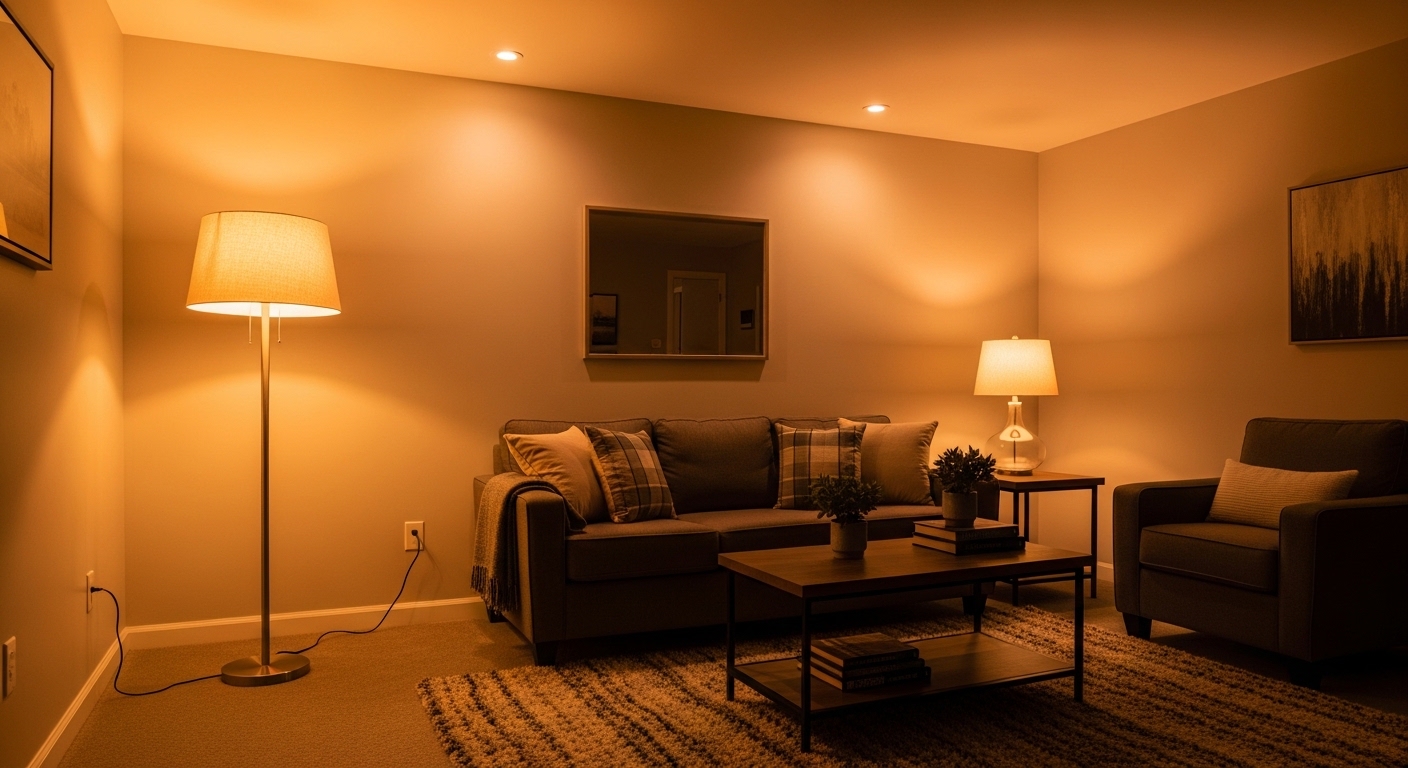
Layered lighting means lighting a room with three separate layers that do three separate jobs: ambient light for the whole room, task light where you actually do things, and accent light that gives the eye somewhere to rest. In a small apartment it's the difference between a room that feels like an interrogation and a room that feels like somewhere you'd choose to sit, and it costs less than the sofa. For the first year in my 480 square feet in Brooklyn I had one light source, a ceiling fixture with a bulb bright enough for a stadium. The apartment looked like a police procedural. I kept the lights off and blamed the space for feeling depressing. It wasn't the space. Here's the three-layer rule as I use it now, room by room, with the fixtures, the bulbs, the heights, the mistakes, and what it cost.
What are the three layers of lighting?
Ambient is the general light that lets you walk around and see the room: in a house that's often the ceiling fixture, in my apartment it's a floor lamp bouncing light off the ceiling. Task is light aimed at an activity: a reading lamp beside the chair, a desk lamp, a pendant over the counter, sconces beside the bed. Accent is the low, decorative light that isn't for doing anything: a small lamp on a shelf, a strip behind a bookcase, a string of bulbs above the sofa. Designers have used the framework for decades because it's how rooms in good photographs are lit, and it works in a 480-square-foot apartment exactly as it works in a house, only with fewer fixtures and more plugs.
The rule that makes it work in a small space: every layer comes from a different height. Ambient from high (a lamp pointing at the ceiling), task from the middle (60 inches and below, at the eye or the hand), accent from low (30 inches and under). Three heights and the room has depth. Three lamps at the same height and it's a waiting room with nicer lamps. I did that first. Everyone does.
Layer 1, ambient: replace the overhead, don't use it
The overhead fixture that came with the apartment goes off. In its place, a tall floor lamp in the corner with the shade open at the top, so most of its light lands on the ceiling and comes back down soft and even. In my living room it's an arc floor lamp in the far corner, 800-lumen 2700K bulb, on a plug-in dimmer, and it's the only general light the room has. A torchiere does the same thing for less; an uplighter with a bowl shade does it with more style. The corner matters: it should be the corner you see from the doorway, not the one behind the door, and it should be the corner diagonally opposite the room's brightest window, so day and night light come from different sides.
In a room with a truly dark ceiling or a very high one, two smaller uplighters beat one big one. In a studio, the ambient lamp goes in the living-end corner, and the sleeping end gets its own from the sconces.
Layer 2, task: light where you do things
This is the layer that most apartments get half right, because everyone owns a desk lamp. The full list, in my place: a desk lamp at the workspace, 2700K, 450 lumens, on an arm so I can push it away. A reading lamp beside the sofa, which in my case is a plug-in wall sconce at 62 inches, because the side table is too small for a lamp. A plug-in pendant over the 30 inches of counter where I cook. Two sconces beside the bed at 26 inches above the mattress. The bathroom sconces at the mirror. Each one is aimed at a surface or a page, each one is bright enough for the job and no brighter, and each one has its own switch so the task light is on only when the task is happening.
The test for a task light: sit or stand where you'd use it, turn everything else off, and see if you can do the thing without squinting or without your own shadow on the work. If your hand shadows the cutting board, the light is behind you and needs to be in front or above, which is the entire reason the kitchen pendant exists.
Layer 3, accent: the light that isn't for anything
The cheapest layer and the one that makes the apartment look considered. A small lamp on the bookshelf, 4 watts, on a timer. A short LED strip behind the top of the bookcase, throwing a glow up the wall. A string of warm G40 bulbs along the ceiling line above the sofa, from my string lights post. A rechargeable puck light in the entry on a dusk sensor. None of these is bright enough to read by. All of them are the first thing you see from the hall, and they're what makes a rental look like a home in a photo, because they light the walls and the objects rather than the floor.
Accent lights are where I keep the color temperature warmest, 2200K to 2700K, and the brightness lowest. A 40-watt-equivalent accent lamp is too bright; a nightlight-strength one is right, and if you can read by it, it's a task light in the wrong place.
The rule for small spaces: fewer fixtures, more heights
A 480-square-foot apartment can't hold nine lamps, and doesn't need to. My whole apartment runs on eleven light sources across four rooms, and the living room, which is 10 by 12, has four: the arc lamp (ambient), the sconce by the sofa (task), and the shelf lamp plus the string lights (accent). What makes it feel lit is that those four are at four different heights, from 12 inches (the shelf lamp) to 84 (the string lights), and on three different switches. Add a fifth and the room gets busy. Remove one and it gets a dead corner. Four, at four heights, is the number for a small living room, and three is the number for a small bedroom.
Why layered lighting makes a small room look bigger
A room reads as the size of its lit surfaces. One overhead lights the floor and the top of the furniture and leaves the walls and ceiling dark, so the eye stops at the edge of the pool of light, and the room ends there. The ambient uplighter puts the ceiling in light, so the ceiling feels higher. The accent lamp on the far shelf puts the far wall in light, so the wall feels farther. The sconce puts the side wall in light. Three surfaces lit, and the same 120 square feet feels like 160, which is a trick I stole from lighting a stage and use on every layout I design at work. It's also why the string lights go at the ceiling line and not around the mirror: the line of light draws the eye up and along, and a small room needs the eye to travel.
The reverse trick is useful too. At 11 pm, with only the accent layer on, the room shrinks to the lit corner, which is what you want before bed. Layered lighting isn't just three lamps; it's the ability to make one room feel like two sizes.
Bulbs, dimmers and switches: the invisible half
All three layers are 2700K and 90 CRI, from the same brand, bought the same day; the accent bulbs can go warmer. Every lamp that can be dimmed is dimmed, on a $12 plug-in dimmer or a smart bulb, because layered lighting without dimming is three brightnesses stuck at full, which is just a brighter interrogation. And every layer is on its own switch or smart plug, so "evening" is ambient at 60 percent plus accent, "reading" adds the task light, and "cleaning" is the overhead, once a fortnight. The smart plugs cost $14 each; three of them run the whole living room and they moved from the last apartment in a shoebox.
The living room, before and after, with numbers
Before: one ceiling fixture, 1,600 lumens, 4000K, on all evening, and a room I avoided. After: arc floor lamp ($89), plug-in sconce beside the sofa ($42), shelf lamp ($28), string lights and hooks ($38), three plug-in dimmers and two smart plugs ($64), five bulbs ($20). $281, and the ceiling fixture off since the week I moved in. Time to install everything: one Saturday, mostly spent hiding cords. The photographs of the room from before and after are the reason I started this blog: the same room, the same furniture, the same $0 rent increase, and a friend asked if I'd moved.
Room by room in a small apartment
Bedroom: sconces (task), corner floor lamp pointed up (ambient), dresser lamp (accent). Three sources, three heights, in my bedroom post. Kitchen: pendant over the counter (task), an under-shelf strip (accent that doubles as task), and the overhead as ambient, because a kitchen is the one room where the overhead earns its keep, with a 2700K bulb in it. Bathroom: sconces at the mirror (task), overhead with a warm bulb (ambient), rechargeable shelf light (accent). Entry: one rechargeable sconce on a dusk sensor, which is ambient, task and accent in a space the size of a phone box, and the only light in the apartment on a sensor rather than a schedule. Studio: the same three layers, but each zone gets a set, in my studio zoning post.
Where the layers go, by height
High, 72 inches and up: the ambient uplighter's shade, the string lights, any pendant over a table. Middle, 26 to 66 inches: task, the sconces, the desk lamp, the reading light; this is eye and hand height and it's where the light that makes faces look good comes from. Low, under 30 inches: accent, the shelf lamp, a strip behind the bookcase, a lamp on the floor behind a plant. I keep a note on my phone with the heights of every fixture in the apartment. Not because I'm precise about it, but because the day I moved in and put everything at 60 inches, the room looked like a store, and the note is how I don't do that again. It works in a 36-inch-wide hallway and a 10 by 12 living room. It's a rule about heights, not rooms.
The mistakes I made getting here
Buying three matching lamps and putting them at three matching heights, which produced a very even, very dull room. Putting the ambient lamp behind the door, where it lit the door. Using 3000K in the living room and 2700K everywhere else, so the living room looked colder than the hall. Leaving the accent lights on a wall switch nobody used, so the accent layer existed in theory only, until the smart plug. And, for a full year, not turning the overhead off, because I thought the answer to a depressing room was more light. The answer was lower light, from more directions, on a timer.
How to start if you have one overhead and no budget
Turn the overhead off. Put a 2700K bulb in it anyway. Move whatever lamp you own to the corner you can see from the door and point it up. Buy one $12 plug-in dimmer and put that lamp on it. That's a two-layer room for $16, and it's most of the improvement. The third layer, a $20 accent lamp on a $14 smart plug, comes with the next paycheck, and the sconces after that. The order matters less than the heights: high, middle, low, and never all three at once at full. If you do one thing tonight, turn off the ceiling light and put the lamp in the corner. Then look at the room from the door.
Shop this post: plug-in wall sconces, pendant lights and wall sconces