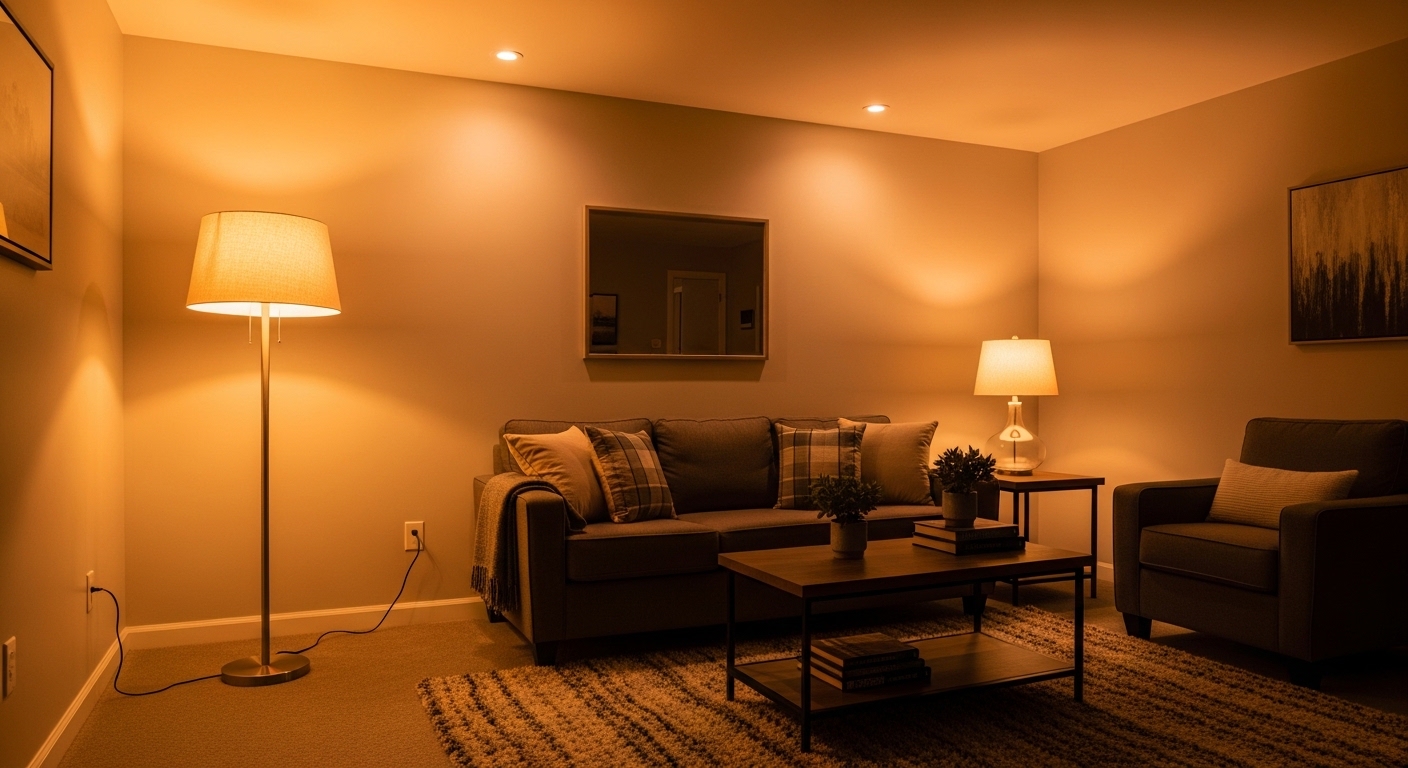
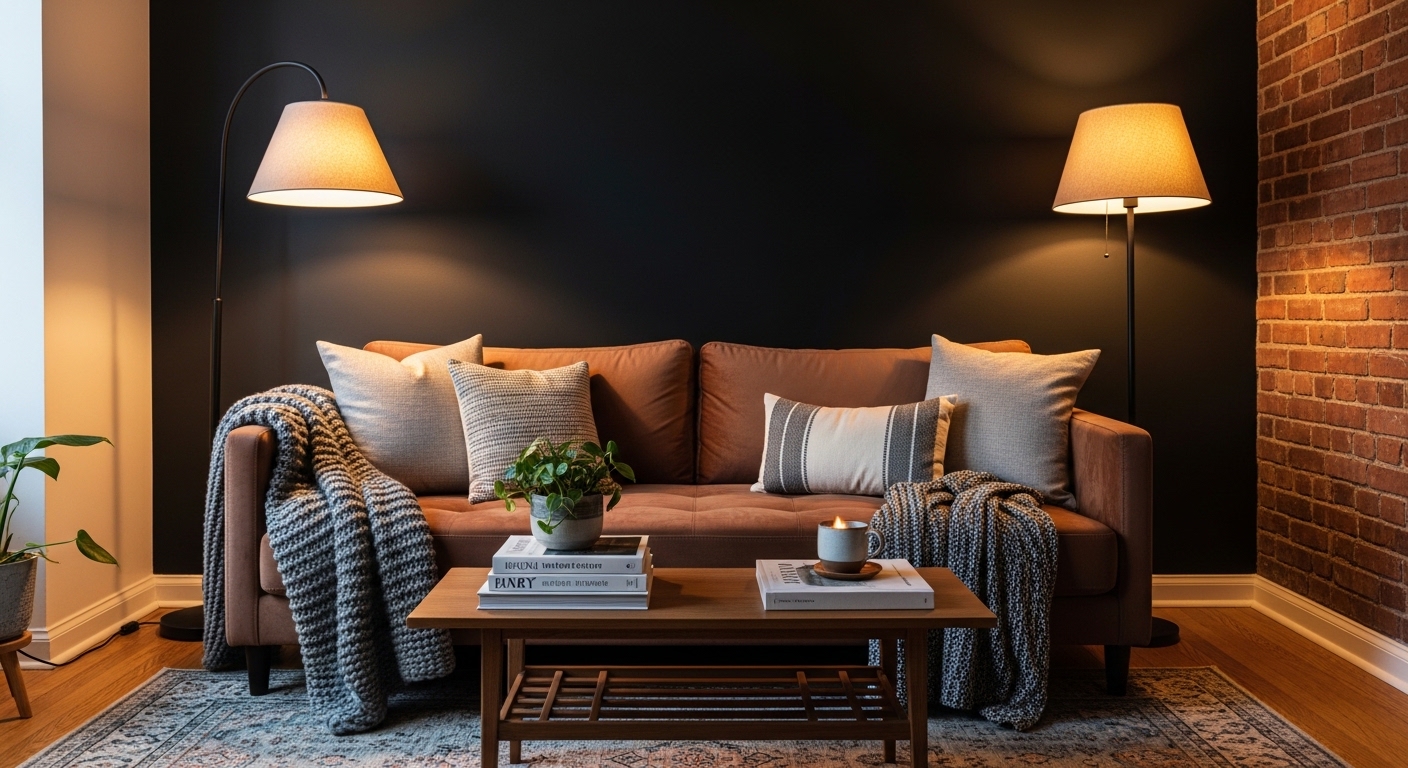
The right rug size for a small living room is bigger than you want to buy: large enough that at least the front legs of every piece of seating sit on it, which for most small living rooms means an 8 by 10, not the 5 by 8 that looks reasonable on the shopping page. My living room is 10 by 12 feet, in a 480-square-foot Brooklyn apartment, and the rug that made it look like a room is an 8 by 10 that cost more than I wanted to spend and did more than anything else I've put in here except the lighting. This post is the measurements that matter, the mistake everyone makes and why, how to measure your own room in five minutes, what to do when the "right" size doesn't fit, which rugs survive a small apartment, and how the rug and the lamps work together.
The most common decorating mistake in a small apartment
A rug that's too small. It happens for an understandable reason: a bigger rug costs more and looks like it takes up more space, so people default to a 4 by 6 or 5 by 8 and then wonder why their living room looks like a doctor's waiting room. A small rug floating in the middle of the floor doesn't define the seating area. It marks the approximate center of the room and draws a line around a patch of floor that nobody uses. The floor around it reads as leftover, the sofa reads as pushed against the wall, and the whole room reads as smaller, which is the exact opposite of what a small rug was supposed to achieve.
I know this because I bought the 5 by 8 first. It sat in front of the sofa like a bath mat for a year, and I kept nudging it toward the sofa as if that would make it grow.
The rule: front legs on the rug, all of them
Every piece of seating in the group, the sofa, the chair, the ottoman, has its front legs on the rug. If you can go further and get all four legs of everything on the rug, do it; that's the version that makes a room within a room. If you can only get the front legs on, that's still right, and it's the realistic version for a small living room where the sofa is against the wall. What's never right is the rug stopping short of the sofa. For my 10 by 12 room with a 78-inch sofa on the long wall and one armchair, that meant an 8 by 10, with the sofa's front legs on the rug, the chair fully on it, and about 12 inches of floor showing at the sides. More than I wanted to spend. Completely transformative.
How to measure for a rug in five minutes
Arrange the furniture where it's going to live. Measure from the front legs of the sofa to the front legs of the seating opposite (or to the far edge of the coffee table if there's nothing opposite), and add 12 inches beyond that. That's the depth. Measure from the outside edge of the leftmost seat to the outside edge of the rightmost, and add 6 to 12 inches each side. That's the width. Then round up to the nearest standard size: 5 by 8, 6 by 9, 8 by 10, 9 by 12. If you land between sizes, go up; nobody has ever regretted the bigger rug, and I've asked. Painter's tape on the floor at the measured rectangle for a day will show you what it looks like before you spend anything, and it's the single most useful thing in this post. I taped out an 8 by 10 and a 6 by 9 side by side, lived with both outlines for a weekend, and the 6 by 9 looked like a placemat by Sunday.
A second rule of thumb, for rooms rather than furniture: leave 12 to 18 inches of bare floor between the rug and the walls in a small room, 18 to 24 in a large one. In a 10 by 12 room, an 8 by 10 leaves exactly that, which is not a coincidence; the sizes are standard because the rooms are.
What size rug for a small living room, by room size
Up to 9 by 10 feet: a 6 by 9, or an 8 by 10 if the sofa is on the long wall and the room is closer to 10 feet. 10 by 12 feet, which is most small apartment living rooms: 8 by 10, no debate. 11 by 13 or 12 by 14: 9 by 12. A studio's living zone: measure the seating group only, not the room, and the answer is usually a 6 by 9 or a 5 by 8 with everything's front legs on it, because the rug is doing zoning work as much as decorating work and it needs a clear edge where the bedroom zone begins. That zoning logic is in my studio post.
When the right size doesn't fit the budget or the door
Two workarounds that work and one that doesn't. First, two identical smaller rugs side by side, low pile, in a solid color or a pattern that hides the seam; a pair of 5 by 8s makes a 10 by 8 for less than one 8 by 10 and gets through a stairwell that turns. I did this in Queens and nobody ever noticed the seam under the coffee table. Second, a rug pad cut to size under an inexpensive flatweave, which makes a $120 cotton rug lie and feel like a $400 one and stops it creeping. The one that doesn't work: layering a small "nice" rug on top of a big cheap jute one. In a large room it's a look; in a small room it's two rugs and it makes the seating look like it's on a raft.
Which rugs survive a small apartment
Low pile. Anything over about half an inch collects everything in a small room, where the rug is also the hallway, the dining room and the place the bike gets wheeled through. Flatweave wool or a wool-blend, or a washable cotton or polyester if there are pets or red wine. Solid or tonal patterns in a small room; a busy pattern on an 8 by 10 in a 10 by 12 room is a lot of pattern. Lighter than you think, because a pale rug reflects light up into the room and a dark one swallows it, which matters in an apartment where the lamps do the lighting. Mine is an oatmeal wool flatweave, 8 by 10, $340 on sale, with a $40 felt pad, and it has survived two moves, one spilled bottle, and a cat that isn't mine but has opinions about the rug.
The lighting connection
A rug and the lamps are one decision, not two. The rug defines the seating area on the floor; the lamps define it in the air. The floor lamp goes at a corner of the rug, not the corner of the room, so its pool of light lands on the seating. The sconce beside the sofa lights the near edge; a pendant over the coffee table, if you have one, centers on the rug, not the ceiling box. When the rug is too small, the lamps end up outside it and the room has two centers; when it's right, everything agrees on where the room is. The pale rug also bounces the 2700K light from the lamps back up, which is a good part of why the living room in my layered lighting post reads as bright with 800 lumens of ambient light.
Rug size for a small living room with a sectional, a rental layout, or an open plan
A sectional in a small room takes the 8 by 10 with the chaise fully on the rug and the rug extending 6 inches past the sectional's outer arm, which usually means the rug is off-center in the room and centered on the seating, which is correct. A rental layout where the sofa has to sit on the long wall under the window (the radiator wall, in every pre-war apartment I've had) takes the 8 by 10 pushed to within 6 inches of that wall, so the room reads as one block of seating rather than a strip of floor between the sofa and the rug. An open-plan living and dining area takes two rugs, one under each group, with a clear 12-inch channel of floor between them; a single enormous rug under both makes the space one undefined field. In every case the rug goes where the seating is, not where the room's center is, and in a small apartment those are rarely the same point.
Runner and entry rugs, briefly
A runner in a rental hallway is the second-best rug purchase after the living room, because it turns a corridor into a route. Width: 6 inches narrower than the hall, so the floor shows at both edges. Length: to within 12 inches of each end. Pile: the lowest you can find, because the hall is where the shoes are. An entry rug inside the door is 2 by 3 feet, washable, and replaced every couple of years without ceremony. Neither needs a pad if it's rubber-backed, and both should be a shade darker than the living room rug, because they take the dirt so the big one doesn't.
Getting an 8 by 10 into a walk-up
The reason people buy small rugs in New York isn't only price; it's the stairs. A rolled 8 by 10 wool rug is about 8 feet long and 10 inches across, and it goes up a turning stairwell standing on end, one person, carried like a log. A rolled 9 by 12 is 9 feet and needs two people and a landing. Order rolled, not folded, because a folded wool rug keeps its creases for a month. If the delivery service won't bring it up, the two-rug workaround above exists for exactly this reason, and so does the trick of carrying the rug in through the window on a first-floor apartment, which I've done once and would not recommend to anyone with a landlord watching.
Placement mistakes I made after buying the right size
Centering the rug on the room instead of on the sofa, so it ran under the bookcase and the seating sat on one edge. Putting the coffee table half on, half off, which looked like an accident. Leaving the rug crooked to the floorboards by an inch, which the eye reads instantly in a small room. And skipping the pad for six months, so the rug walked toward the door a few inches a week. Each of these took five minutes to fix and a month to notice, because a rug is the one object in a room you look at least and see most.
What it cost, against what the small rug cost
The 5 by 8 I bought first: $140, and it now lives in the bedroom under the bed where it's exactly the right size. The 8 by 10: $340 on sale, plus $40 for the pad. So $380 for a rug versus $140, and the $380 one is the reason people say the living room looks bigger than 120 square feet. Rugs are also the best thing to buy secondhand: an 8 by 10 wool rug on a resale site is often a third of retail, cleaned for $60, and it's how I'd buy the next one, ideally from someone moving out of a building with an elevator. Whatever you spend, spend it on the size first and the pattern second. Size is the whole trick, and it's the one rug decision that no amount of styling fixes afterward.
Shop this post: wall sconces, pendant lights and plug-in wall sconces