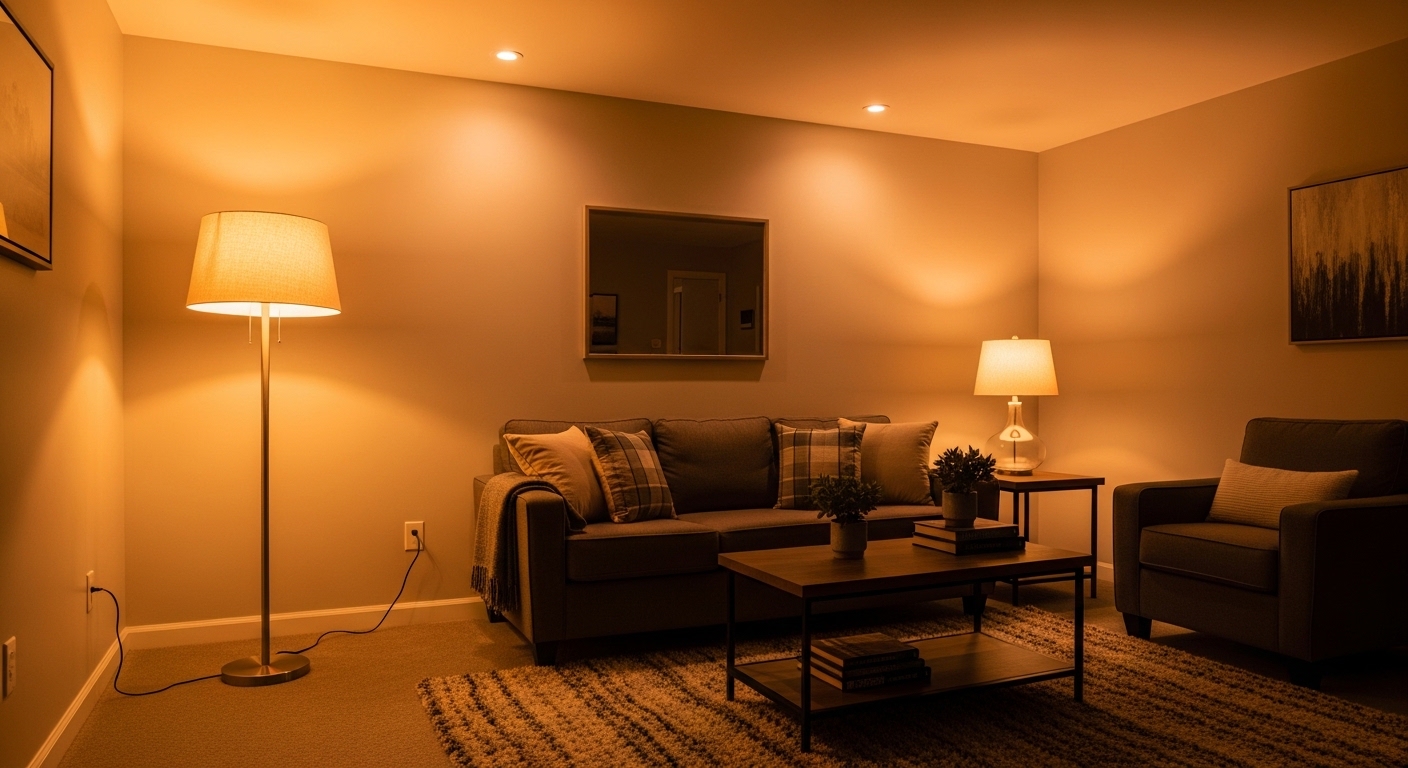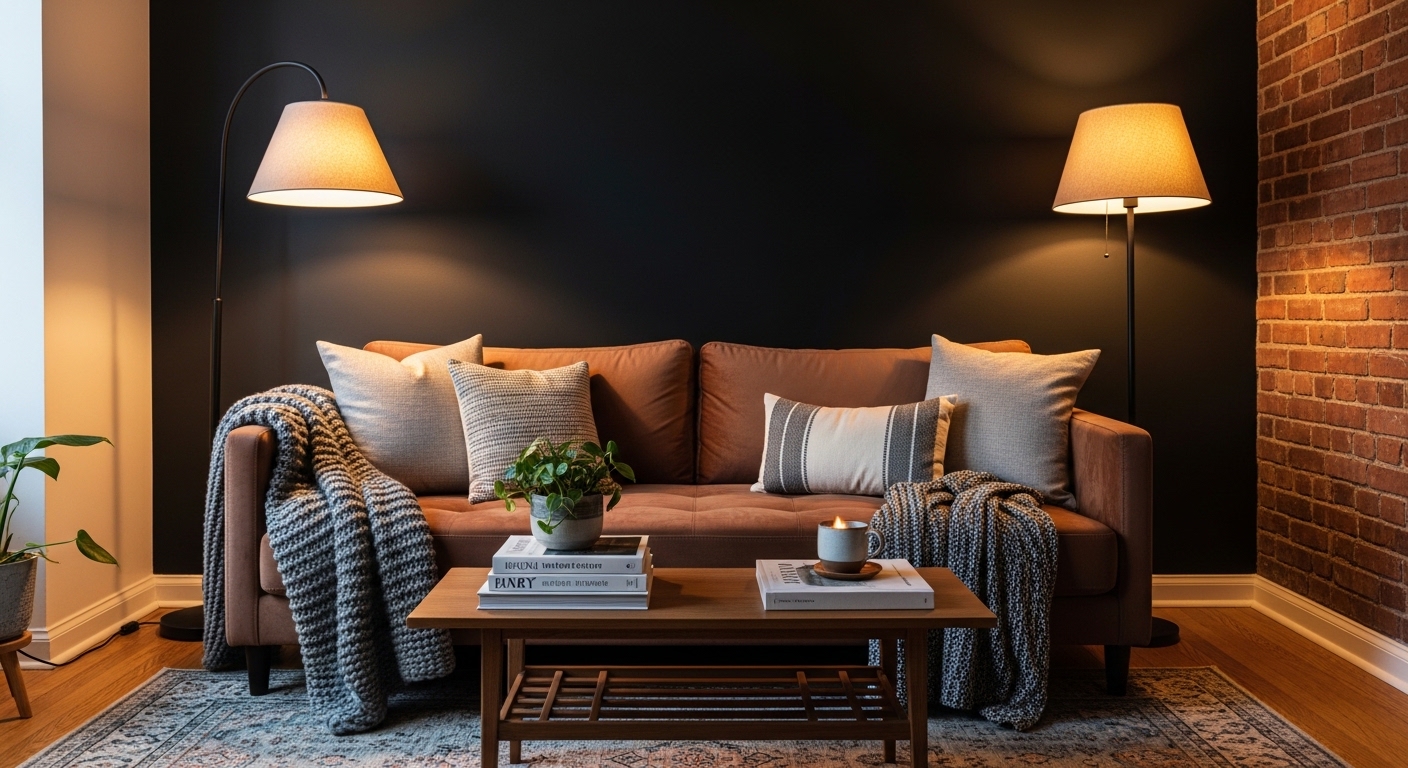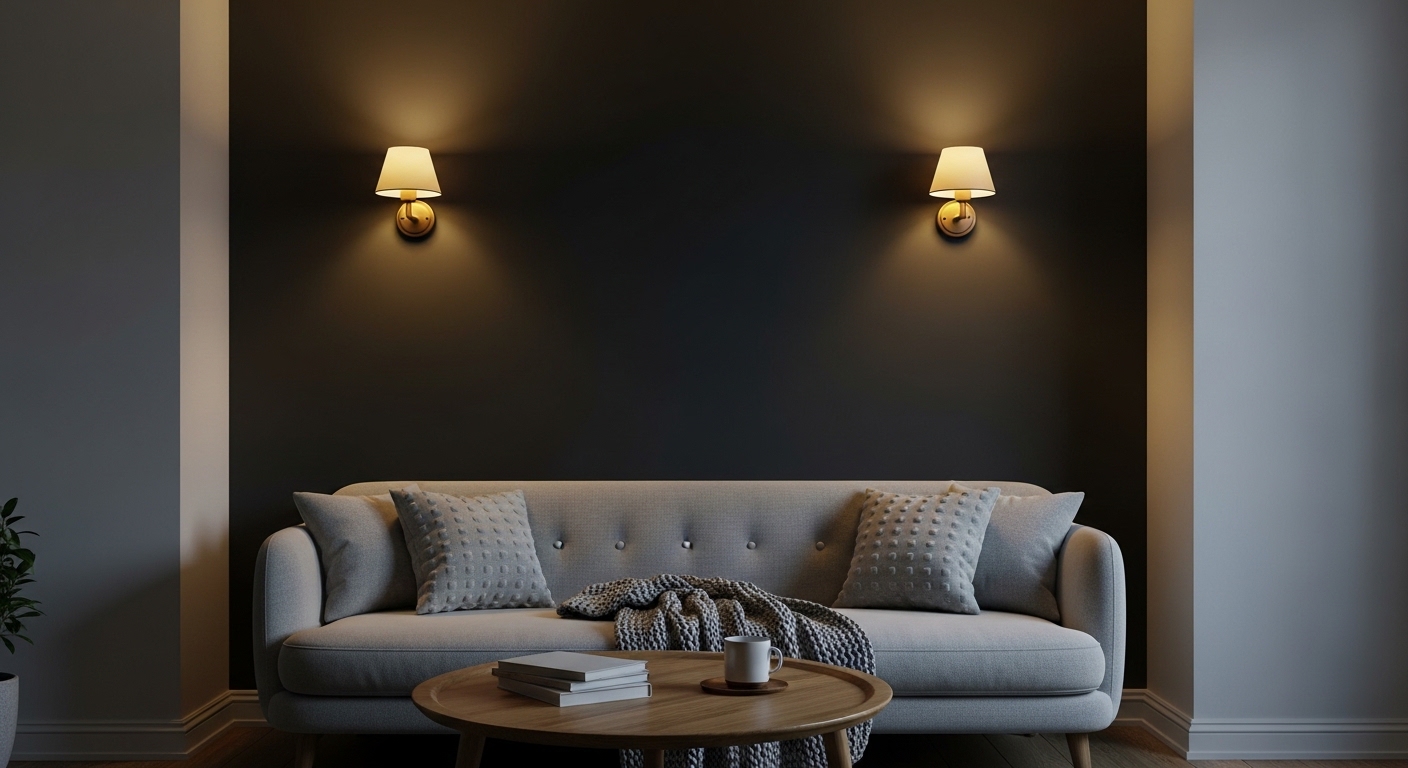
A dark accent wall in a small apartment makes the room look bigger, not smaller, on one condition: the light on it is warm and the light is on the wall, not the ceiling. Everyone told me not to paint a wall dark in 480 square feet, and I did it anyway, charcoal, on the wall behind the sofa, with a plug-in sconce beside the gallery wall at 2700K and the ceiling light off; the wall reads as depth, like the room goes back further than it does, and the north-facing apartment that gets no direct sun is the one that could take it. This post is the formula, dark wall plus warm light, the color I used and the three I tested, which wall and why the one with the least daylight, the sconce and the lamp that light it and why the ceiling light ruins it, the finish, the landlord's opinion and the repaint, what to hang on it, the furniture in front, the north-facing exception that makes it work, the colors that fail and the one that always works, the cost of the wall and the light, mistakes, and how it looks at 9 pm.
The formula
One dark wall, the one that gets the least daylight. Warm light on it, 2700K, from the side and low, a sconce or a lamp. Everything else in the room light: three white walls, a pale rug, an oatmeal sofa. The dark wall recedes because the eye can't find its edges, and the warm light in front of it makes the objects in front of it, the sofa, the frames, the plant, come forward; the room reads as deeper than it is, which in a 12-foot room is the whole game. The formula fails the moment the light is cool or from above, because a dark wall under a 4000K ceiling light is a dark wall, flat and close and grey.
The color, and the three I tested
Charcoal with a hint of brown, not blue, which is warmer under a 2700K bulb; a sample pot painted on a 2-foot square and looked at for a week under the sconce, at 9 am and at 9 pm, before the wall. Three tested: a navy, which went black at night and cold at noon; a forest green, which was the one I wanted and the one that fought the oak; and the charcoal, which did nothing at noon and everything at 9 pm. The sample square is the rule: a dark color on a chip is a different color on a wall, and a dark color on a wall is a different color under the light you'll live with.
Which wall
The wall behind the sofa, which is the wall facing the window and the one the window's light doesn't reach, because a north window lights the walls beside it and leaves the far wall grey anyway; painting the greyest wall charcoal makes a decision out of a defect. Not the window wall, which loses the window's frame; not a wall you walk past, which reads as a corridor; and never all four, in 480 square feet, which is a cave with a sofa. One wall, the one with the least light, and the one the sofa's back is against, so the biggest piece of furniture sits in front of the depth.
The light on it, and where it comes from
A plug-in wall sconce at 62 inches at the gallery wall's edge, on strips, 2700K, 400 lumens, that grazes across the frames and the charcoal, and an arc floor lamp over the sofa's end that lights the wall from the side and low. The two light the wall at an angle, which is what shows its texture and makes the frames cast shadows; the ceiling light lights it from above and flat, which makes it a backdrop. The layers post is the three-height system, and the dark wall is the reason the system exists in this room: the wall only works lit from the sides, and the sides are where the sconce and the lamp are.
Why the ceiling light ruins it
A ceiling fixture lights the top of the wall brightest and the bottom least, so a dark wall under one has a bright band at the ceiling and a dark band at the floor, which reads as short and top-heavy. It also lights the wall and everything in front of it equally, so nothing comes forward. The sconce and the lamp light the middle of the wall and the objects in front of it, and leave the top and bottom dark, which reads as tall and deep. The ceiling light in my living room has a 2700K bulb and a dimmer and it's on for cleaning.
The finish
Matte, not eggshell and never satin, because a dark wall in a sheen shows every roller mark and every bit of the window's light as a smear; matte absorbs and reads as velvet under the sconce. Two coats over a grey primer, which is the thing nobody tells you: a dark color over white primer takes four coats and a dark color over grey primer takes two. A sample of the finish as well as the color, because the same charcoal in eggshell was a different wall.
The landlord, and the repaint
Asked, in writing, with the color and the promise to repaint at move-out, and a yes in two days; most landlords say yes to one wall with a repaint clause and no to four. The repaint is a coat of grey primer and two of the landlord's white, a Saturday and $40, and it's in the move-out budget with the strip holes. Two of my four apartments had a dark wall, and both went back to white in an afternoon; the renter rules post is the rest of what's reversible.
What to hang on it
Light frames, white or oak, with white mats, because dark frames on a dark wall disappear and light frames float; the gallery wall on this wall is eleven frames in oak and white, on strips, and the charcoal behind them is what makes eleven frames read as one composition instead of a cluttered wall. A mirror on a dark wall doubles the light and the depth. A single large print in a light frame is the other option, and it's the one for a wall with a bed against it.
The furniture in front
Light and low: the oatmeal sofa, 32 inches high, so the wall shows above it; an oak console; a pale rug. A dark sofa against a dark wall merges into it and the room loses its biggest object; a tall bookshelf against it hides the wall you painted. The rule is that the dark wall is the background and everything in front of it is lighter than it, which is the contrast principle from the design post, done with paint.
The north-facing exception
A north-facing apartment gets flat, cool, even light all day and no direct sun, and it's the apartment where a dark wall works best, because the light never hits it hard enough to show it as a color; it stays a depth. A south-facing room with a dark wall gets a bright, hot wall at noon and a cave at night, and the dark wall there is the one people regret. If the window faces north, paint the wall; if it faces south, paint the wall opposite the window and keep the sconce on all day.
The colors that fail, and the one that always works
Black, which is a hole under any light. Navy, which is cold by day and black by night. A bright saturated color, which is a dark wall's problem with a color's problem added. Grey with a blue base, which is an office. The one that always works: a charcoal or a deep warm grey with a brown or green base, because the 2700K light warms it and it reads as a color that was chosen for the light and not despite it. Deep green works with brass and fights oak; deep brown works with everything and reads as the bravest choice.
What the wall and the light cost
A quart of sample and a gallon of paint, $65. Grey primer, $22. A roller, a brush, tape and a drop cloth, $30. The plug-in sconce, $48, and its strips and channel, $12. The arc lamp was already here. About $180 for a wall that changed the room more than the sofa did, and $60 of it, the sconce, is the part that decided whether the wall would work.
The dark wall in the bedroom
The same charcoal, on the wall behind the bed, with the two plug-in sconces at 60 inches on either side, and it's the wall that made the bedroom a bedroom: the bed sits in front of a depth and the sconces light the pillows and not the wall, so at night the wall disappears and the bed floats. A dark wall behind a bed is the easiest version of the formula, because the sconces are already at the right height and the ceiling light in a bedroom is already off, and it's the wall I'd tell a nervous friend to paint first.
The rest of the palette around it
Three white walls, an oatmeal sofa and rug, oak wood, black metal on the fixtures and the frames' hardware, and a plant. The charcoal is the darkest thing in the room and the only dark thing, so it reads as a decision; a second dark object, a black bookshelf, a dark rug, competes and the wall stops being the depth. One dark wall, everything else light, one green thing, and the light warm: the whole palette is four things and it's the same four in the bedroom.
Painting it, in an afternoon
Tape the edges and the ceiling line, which on a dark wall against white is the line everyone will look at; cut in with a 2-inch angled brush and a steady hand, and if the hand isn't steady, a second run of tape on the white side after the first coat. Grey primer, one coat, an hour to dry. Charcoal, first coat with a roller in a W, second coat two hours later, and the wall done by dinner with the sconce on it. The outlet covers on the wall painted to match, which is $3 of paint and the detail that reads as intentional. A weekday evening for the primer and a Saturday for the coats, and the strips for the frames go on the following weekend, once the paint has cured.
The dark wall and the daylight it does get
A north window at noon in June puts a soft grey light on the charcoal, and the wall reads as a warm grey, quieter than at night and a different room; the trick is that the sconce stays on at 30 percent all day in winter and off in summer, so the wall always has one warm light on it somewhere. The wall by day is the reason for the brown undertone: a blue-grey charcoal in north light is a filing cabinet, and a brown-grey one is a stone. The sample square in the window's light at noon is the test for the day; the sample under the sconce at 9 pm is the test for the night, and the color has to pass both.
Mistakes
Navy, in the second apartment, over white primer, four coats, cold all winter. Eggshell, once, and the roller marks under the window's light. A dark frame on the dark wall that vanished. Leaving the ceiling light on for a guest, who said the wall made the room feel small, which under that light it did. And painting before the sample week, once, which is how the navy happened.
In one paragraph
One dark wall, the one with the least daylight, in a warm charcoal, matte, over grey primer. A sconce and a lamp lighting it from the sides at 2700K, and the ceiling light off. Light frames on it, light furniture in front of it, everything else in the room pale. A north window makes it easy and a south window makes it the wall opposite. It reads as depth and the room reads as bigger, and the light is the half of the formula that nobody paints.
How it looks at 9 pm
The sconce grazing eleven light frames on a wall that has no visible edges, the arc lamp's pool on the sofa's oatmeal and the oak console, the plant's leaves in silhouette against the charcoal, and the rest of the room, the three white walls, soft and grey behind the lamps. The living room is 12 feet deep and at 9 pm it reads as 16, and a guest on the sofa asked whether the wall was a different room. It's paint and a $48 light, and it's the formula.
Shop this post: plug-in wall sconces and modern wall sconces, the warm light half of the dark wall formula