There are four ways to hang curtains in a rental without drilling: a tension rod inside the window frame, adhesive brackets on the wall or the frame, a rod that rests on the top of the window trim with no-drill "hanger" brackets, and, for the desperate, a rod hooked to the ceiling with heavy-duty adhesive hooks. I've used all four across four apartments, and one of them has fallen down on me at 3 am. Curtains are the fastest way to make a rental look like someone chose to live there: they add color, texture, privacy, and the impression of height. They also require a rod, a rod requires holes, holes require landlord approval, and landlord approval requires a level of optimism I no longer possess. Here's what holds, what falls, what each option costs, and which curtains are light enough to make any of it work.
Option 1: tension rod, inside the frame
A tension rod sits inside the window opening under spring pressure. Nothing touches the wall, nothing leaves a mark, and it takes about 90 seconds. It's the right answer for small windows where an inside mount looks intentional: bathroom, kitchen, a bedroom window under 36 inches. It's the wrong answer for anything wider, because a tension rod over about 48 inches sags in the middle and slips at the ends, and it's the wrong answer for anything heavier than a sheer or a light cotton. Buy one with rubber end caps, not plastic, and twist it a quarter turn tighter than feels necessary. $8 to $20. Mine in the bathroom has held a linen café curtain for two years. Mine in the first apartment's bedroom, 52 inches wide, is the one that came down at 3 am.
The look: curtains that sit inside the frame read as a blind or a café curtain, which is neat and slightly small. If you want the tall, wide, "the window is bigger than it is" effect, you need the rod outside and above the frame, which means one of the next three.
Option 2: adhesive brackets on the wall (the no-drill curtain rod most people mean)
The adhesive curtain brackets, Command's and the cheaper copies, are a small hook-shaped bracket that sticks to the wall with a removable strip and holds a standard 5/8-inch rod. They work, with three conditions that the packaging mentions in small type. Stay under the weight limit, which is usually 3 to 5 pounds per bracket for the whole assembly: rod, rings, and both panels. Use at least four brackets for any rod over 48 inches, one at each end and two spaced in the middle, even though the pack gives you two. And hang them on smooth painted drywall or plaster that has been cleaned with rubbing alcohol and left alone for an hour after pressing. On textured walls, fresh paint, or wallpaper, they let go, usually slowly and usually at night.
Weight is the whole game. A 5/8-inch metal rod at 72 inches is about 2 pounds. Two linen panels are 2 to 3 pounds. Two blackout panels are 6 to 8 pounds and will pull the brackets off inside a month. So this option is for sheers, light linen, and light cotton, which is fine, because light linen is what looks best in a small apartment anyway. My living room rod, 84 inches wide on four brackets with two linen panels, has been up 14 months. $18 for the brackets, $22 for the rod.
Option 3: brackets that hang on the window trim
If your windows have wood trim (most pre-war apartments do), there's a bracket that hooks over the top edge of the trim and holds a rod out in front of it, with no adhesive and no screws. It holds more than adhesive brackets, since it's resting on wood instead of glue, so it's the option for a heavier cotton or a lined curtain. It only works when the top trim is at least an inch thick and is square, not sloped, and it puts the rod at trim height, not above it, so you lose some of the height trick. $12 to $25 a pair. I use these in the bedroom, where I wanted a curtain heavy enough to block the streetlight.
Option 4: ceiling hooks, for when the wall won't cooperate
Heavy-duty adhesive hooks rated for 7.5 pounds, stuck to the ceiling just in front of the window, with the rod resting in the hooks. It looks like a ceiling-mounted track, which in a small room is a nice effect: curtains from ceiling to floor make the wall look twice as tall. It's also the most fragile option, because the hooks are fighting gravity straight on and their rating roughly halves on a ceiling. Sheers only, three hooks per 48 inches, and be ready to reapply once. I did this in the Queens apartment and it lasted eleven months, then I did it again and it lasted the rest of the lease.
Which curtains work with no-drill hardware?
Light ones, and this is where most people go wrong: they get the hardware right and hang the wrong curtain. Sheer voile, at under a pound a panel, works on everything. Unlined linen or linen-look polyester, 1 to 1.5 pounds a panel, works on adhesive brackets and tension rods under 48 inches. Medium cotton, about 2 pounds a panel, works on trim brackets. Lined, blackout, or velvet, 3 to 4 pounds a panel, needs screws, full stop; if you need real darkness in a rental, use a tension-rod blackout blind inside the frame and a light curtain outside it for the look, which is what I do in the bedroom. Grommet or rod-pocket tops are lighter than rings and clips, and they don't rattle.
Length: floor to a half inch above it. Curtains that stop at the sill make a window look short; curtains that puddle look like they came in the wrong size. Buy the 96-inch panels and hem them with iron-on tape, which I've done six times without a sewing machine, and which holds through the wash if you iron it on a cotton setting and let it cool flat before you touch it. Width: total curtain width should be at least twice the rod, so two 50-inch panels on a 48-inch window, or the fabric looks flat when closed.
Can you hang curtains with Command strips alone?
Yes, and I did it for six months with a set of large picture-hanging strips and a wooden dowel, and it's the method I'd recommend least. The problem isn't the strips, which hold about 16 pounds a pair on a flat surface; it's that a rod puts its load on the strips at an angle, pulling out and down, and adhesive holds much better in shear (straight down along the wall) than in peel (out from the wall). The purpose-made adhesive brackets are shaped to convert that pull into shear, which is the entire reason they exist and cost $18. If you're going to use plain strips, put them high on a wide flat surface, use two pairs per bracket point, and hang a sheer. And accept that you're on borrowed time.
What about blinds and shades without drilling?
Inside the frame, a tension-rod roller blind or a "no-drill" cordless blackout blind that clamps to the top of the frame with two small brackets is the best privacy-and-darkness solution I've found for a rental, and it hides completely behind a curtain during the day. They come in 24 to 48 inch widths for $25 to $60, install in five minutes, and mine has survived two years of daily use. The clamp brackets leave two tiny marks on the inside of the frame, invisible unless you're looking for them, which no landlord ever has. Paper pleated shades that stick to the glass with a strip are the $6 emergency version and are fine for a bathroom. Outside-mount blinds need screws; skip them.
Where to put the rod for the most height
As high as the hardware allows and 6 to 10 inches past the frame on each side, so that when the curtains are open, the fabric sits on the wall and the whole window shows glass. On adhesive brackets, that means the wall 4 to 6 inches above the trim. On trim brackets, you're at trim height, which is fine. On ceiling hooks, you're at the ceiling, which is the tall look every small-space post promises. My living room ceilings are 8 feet 4 inches, the window is 4 feet tall, and with the rod 5 inches above the frame and the curtains to the floor, the window reads as nearly 7 feet. It's the cheapest square footage I've ever added. The graphic-design version of the rule: the curtain is a vertical line, and a vertical line makes a plane look taller. Extend the line, extend the wall.
What I'd do in each room of a small apartment
Living room: adhesive brackets, four of them, high and wide, two light linen panels, open all day. Bedroom: trim brackets with a medium cotton panel outside, a tension-rod blackout blind inside the frame. Bathroom and kitchen: tension rod with a café curtain at half height, which gives privacy at the sink and keeps the light. Studio: one rod across the whole window wall on adhesive brackets, sheer panels you can pull across the sleeping half, which is the trick in my studio zoning post.
Where lighting comes in
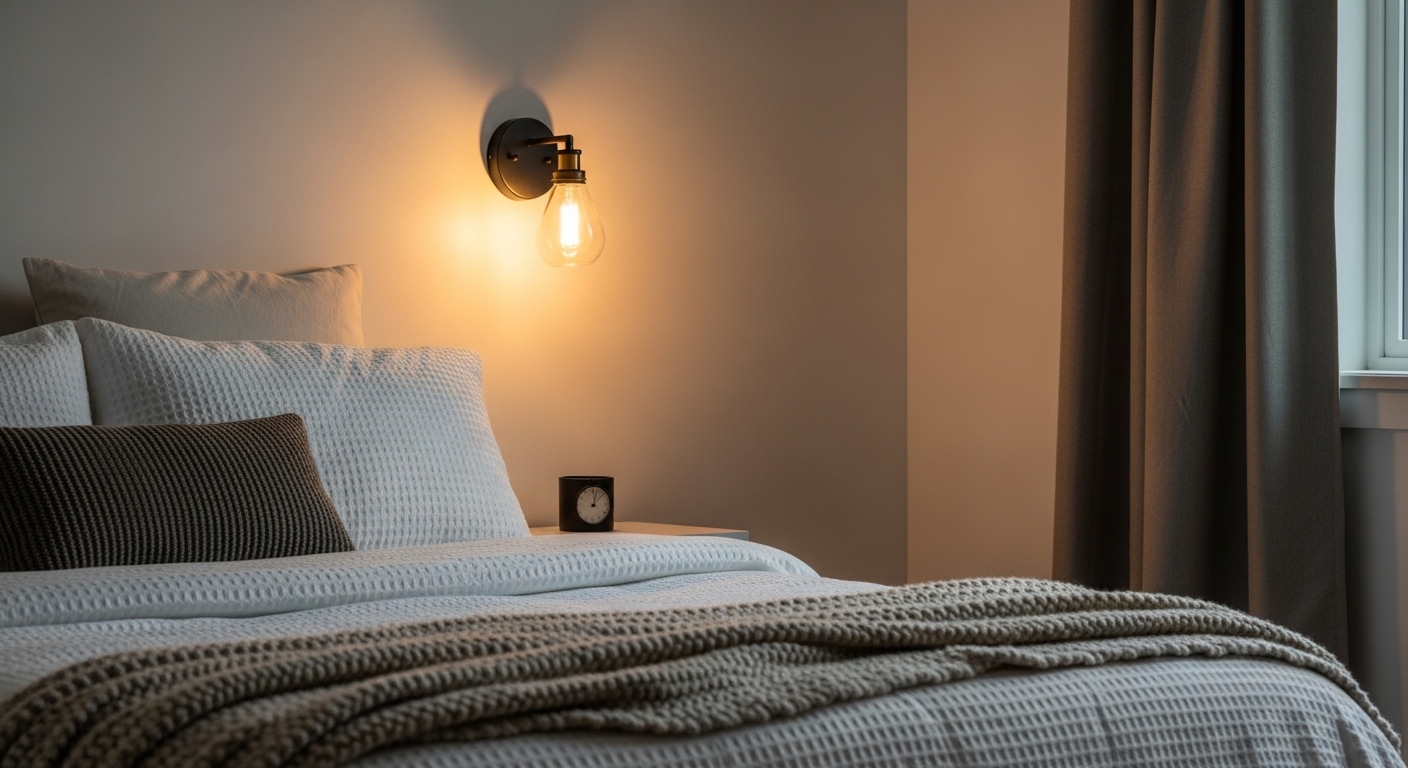
A wall sconce beside or between windows ties the curtains to the lighting scheme and makes both look decided. The light bouncing off linen at night is the softest light in the apartment, and it's why my sconce sits 8 inches from the curtain edge rather than centered on the wall. In a rental that means a plug-in sconce, mounted the same way as the brackets, and the cord runs down behind the curtain, which is the one place in the room where a cord is invisible. The rules for placing it are in my renter lighting rules, and the sconces I've tested on adhesive mounts are in the no-drill sconce review.
What all of this costs
Living room: four adhesive brackets ($18), an 84-inch rod ($22), two 96-inch linen panels hemmed with tape ($48, $4 for the tape). Bedroom: trim brackets ($16), rod ($18), two cotton panels ($40), inside-mount blackout blind ($42). Bathroom and kitchen: two tension rods ($20) and two café curtains I made from one linen panel cut in half ($24). Total for the whole apartment, $252, and all of it except the tape comes with me to the next lease. A single professionally installed rod with real curtains in this city runs $200 to $400 per window, and it stays with the landlord.
What fell down, and why
The 52-inch tension rod: too wide, plastic caps. The first set of adhesive brackets in Queens: two brackets on a 72-inch rod, on paint that was a week old. The ceiling hooks, round one: two hooks where there should have been three. None of the failures were the hardware's fault, exactly; they were the instructions' fault for being printed at a size nobody reads. Four brackets, light fabric, clean wall, wait an hour. That's the entire post in eleven words, and it's taken me four apartments to trust it.
Taking it all down
Adhesive brackets: pull the tab straight down, slowly, parallel to the wall. Trim brackets: lift off. Tension rods: twist and release. Ceiling hooks: same tab, same patience, hair dryer if stuck. Across four apartments and something like twenty brackets, I've lost one patch of paint, and it was the flat paint that lost a hook for the string lights too. Keep the hardware. Rods are the one thing that fits every apartment, and the brackets are cheaper to keep than to rebuy.
Shop this post: wall sconces and plug-in wall sconces for beside the window