A plug-in pendant light is a pendant with a long cord and a wall plug instead of a hardwired ceiling box, hung from a hook in the ceiling or from the screws of the existing fixture, with the cord running along the ceiling and down the wall to an outlet. It's how I got a real pendant over the counter in a rental kitchen whose lease says "no hardwiring" in capital letters, for $71, in one afternoon, without a single new hole in the ceiling. The fixture that came with the kitchen was a flush-mount dome, circa 1994, that cast a greenish light over everything; my cooking photos looked like I was making dinner in a submarine. Here's the setup I used, the hook-versus-canopy question, how to hide a cord on a ceiling, what height to hang it, which pendants work as plug-ins and which don't, and the two mistakes I'd skip.
How does a plug-in pendant light work?
Three parts. The pendant itself: a shade and a socket on a cord, usually 12 to 15 feet long, with an inline switch and a two-prong plug at the end. A hanging point on the ceiling: either a swag hook, or a small canopy plate that screws into the existing fixture's holes, or, in a strict lease, an adhesive ceiling hook rated for the weight. And the cord route: from the hanging point across the ceiling to the wall, down the wall, into the outlet, held by cord clips or a paintable cord cover. The light is a normal E26 bulb, which means you choose the color and brightness, and the whole thing comes down in ten minutes when you move. Nothing touches the wiring in the ceiling; the old dome stays where it is with its switch off, or you use its screws as your hanging point.
What I hung, and where
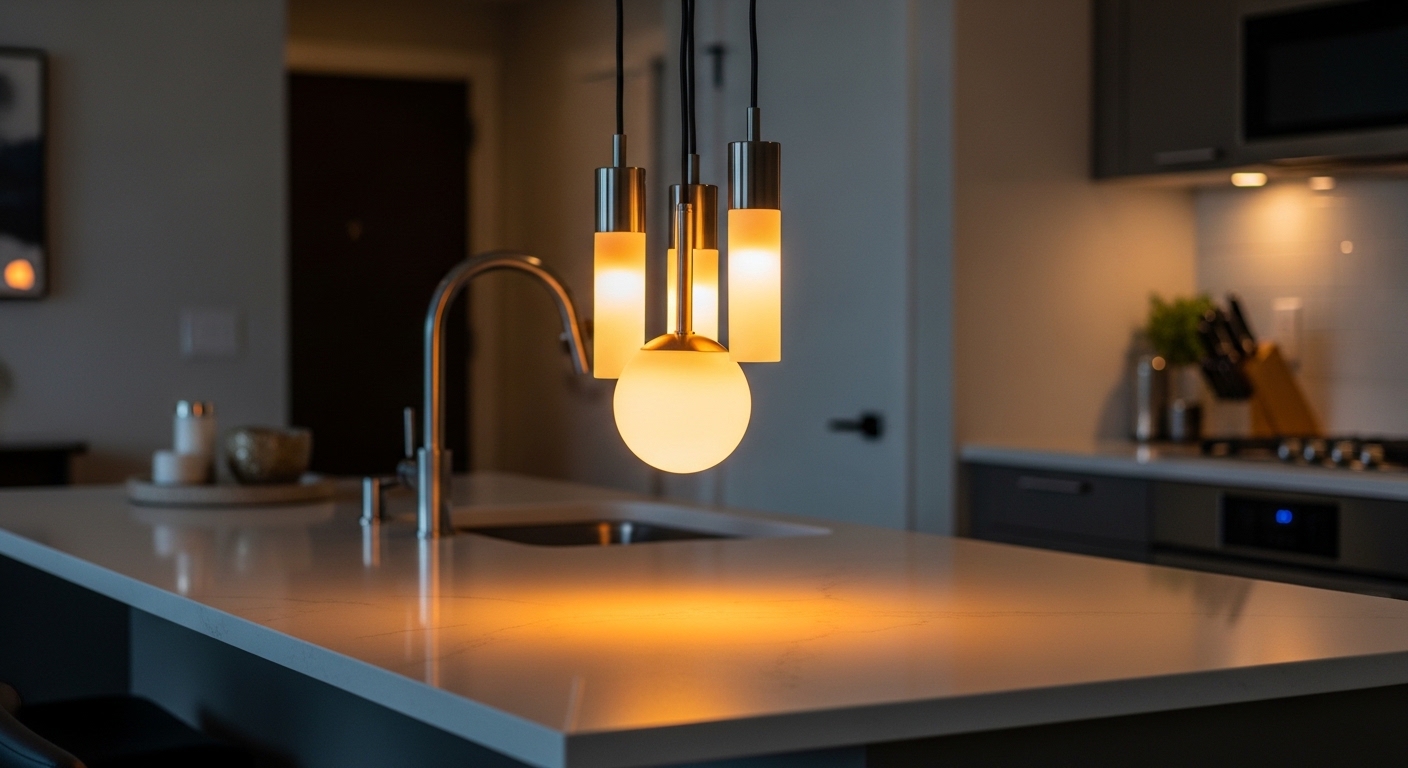
A black metal dome pendant, 10 inches across, with a 15-foot black fabric cord: $52. I hung it over the 30-inch stretch of counter between the stove and the sink, where I do all the actual cooking, because that's the spot the ceiling dome never reached. It hangs from a swag hook screwed into the ceiling joist (more on that below), 30 inches above the counter, with a 2700K 800-lumen bulb on a plug-in dimmer, $12. The cord runs 4 feet across the ceiling to the corner, down the corner in a white cord cover, and into the outlet by the fridge. Total: $52 for the pendant, $12 for the dimmer, $7 for the cord cover and clips. The 1994 dome is still on the ceiling, switched off, and the kitchen looks like a different room.
Hook, canopy, or adhesive: how to hang it without wiring
A swag hook is one screw into the ceiling, and it's the strongest option. If you can find a joist with a stud finder (in most apartments they run every 16 inches), a hook rated for 20 pounds screws straight in and holds any pendant you'd buy. If you can't find a joist, use a toggle-style swag hook rated for drywall, which needs a slightly larger hole. Either way it's one hole, filled with spackle at move-out, and my landlord has never noticed or cared. That's what I used.
The canopy option uses the two screws that already hold your existing flush-mount fixture, or the crossbar under it, to hold a small plate with a hook or a cord grip. No new holes at all, but you have to take the old fixture down, which means the breaker off and a little courage, and it puts your pendant exactly where the old light was, which may not be where you want it. Good if the old fixture is already in the right spot.
Adhesive ceiling hooks are the strict-lease answer and the weakest: their rated weight roughly halves on a ceiling because the load is straight-down peel. Fine for a paper lantern or a pendant under 2 pounds; not fine for a metal dome. If adhesive is your only option, buy the lightest pendant you like and use two hooks 3 inches apart with the cord wrapped through both.
How to hide the cord on a ceiling
You mostly can't hide it; you make it deliberate. A cord that runs in a straight line along the ceiling to the nearest corner, then straight down the corner, reads as a line and disappears within a day. A cord that wanders diagonally or loops reads as an extension cord forever. Match the cord to the ceiling: a white cord on a white ceiling, run through white adhesive cord clips every 12 inches, is nearly invisible from standing height. A black cord on a white ceiling can look intentional if it's dead straight and the pendant is black too, and it's what I have, though I'd choose white if I did it again. Down the wall, use a paintable PVC cord cover ($7 for 5 feet) in the corner, not across a wall. If you have crown molding, run the cord along the top edge of it; it vanishes. Pre-war apartments with picture rails are the jackpot: the cord rides the rail and nobody has ever spotted mine in the Queens place.
How high to hang a pendant over a counter
30 to 36 inches from the counter surface to the bottom of the shade, which for a standard 36-inch counter puts the shade bottom at 66 to 72 inches from the floor. Lower than 30 and you'll hit it with a pot; higher than 36 and it lights the ceiling instead of the cutting board. Over a table, 28 to 34 inches above the tabletop. If the pendant is in a walkway rather than over a surface, the bottom needs to be at least 78 inches from the floor or someone will meet it. Plug-in pendants adjust by wrapping the cord around the hook or through a cord grip, so hang it, stand under it, and adjust before you commit the cord clips.
Which pendants work as plug-ins
Anything under about 5 pounds with an E26 socket and a cord. The listing will say "plug-in" or "swag" and show the plug; if it shows a canopy with three wires poking out, it's hardwired, and while a hardwired pendant can be converted with a $15 plug-in cord kit, that's a job I'd rather not do in someone else's apartment. Shades: a dome, cone or globe in metal or opal glass, 8 to 12 inches, is the right scale over a counter. Clear glass shows the bulb, so it wants a decorative filament bulb and a dimmer or it glares at eye level. Rattan and paper are lightest and best for adhesive hooks. Avoid anything that needs a driver box, anything over 5 pounds, and anything with a rigid rod instead of a cord, because a rod can't swag.
Bulb and switch
2700K, 800 lumens, 90 CRI, dimmable, in a frosted bulb if the shade is open at the bottom. Kitchens are the one room where I'd accept 3000K, because it makes vegetables look like vegetables; I tried both and stayed at 2700K for consistency with the rest of the apartment. For the switch, skip the inline switch on the cord, which will end up on the ceiling where you can't reach it, and plug into a smart plug or a plug-in dimmer at the outlet. Mine is on the same smart plug as the under-shelf strips from my open shelving post and the counter lights in my counter lighting setup, so "kitchen" is one tap.
Can you plug in a pendant light over a dining table or a desk?
Yes, and the table is the easier job, because a swag hook centered over a table can go anywhere and the cord has a wall nearby. Over a desk, hang the pendant slightly forward of where you sit, about 30 inches above the desktop, so it lights the keyboard and not the top of your head; put it on a dimmer because at desk height a bare 800-lumen bulb in your eyeline is a lot. Over a bed, a pair of small plug-in pendants either side, hung low at about 20 inches above the nightstand, is the renter's version of the hotel look, and their cords run down the headboard wall exactly as sconce cords do. The one place I wouldn't hang a plug-in pendant is a hallway or anywhere people walk under it, because a swagged cord moves when the pendant is bumped and the hook is the only thing holding it.
Is a plug-in pendant safe?
As safe as any lamp, with three conditions. The hook holds at least four times the pendant's weight, which is why I use a joist. The cord isn't pinched by a clip, a door, or a cabinet, and the clips are the rounded kind, not the nail-in staples. And the bulb is an LED, which stays cool enough to touch, so a fabric cord and a dome shade never see real heat; an incandescent bulb in an enclosed metal shade is the one combination I'd avoid. Keep the plug end where you can reach it, on a smart plug or dimmer at outlet height, and it's no different from the floor lamp in the corner. Mine has been up two years and the only incident was the stockpot.
Two mistakes from the first attempt
I bought a 6-foot cord pendant first, which is what the product photos show, and 6 feet reaches the nearest outlet in exactly no rental kitchens. You need 12 to 15 feet: across the ceiling, down the wall, along the baseboard. Measure the route before ordering, and add 3 feet. Second, I hung it 24 inches above the counter because it looked dramatic. It was dramatic for a week and then I clipped it with a stockpot lid and the shade has a dent I look at every day. 30 inches. The stockpot is the boss.
Plug-in pendant versus other rental kitchen lighting
If the kitchen has a real ceiling box in the right place, the plug-in pendant is the only way to get a pendant without wiring, and it's better than a plug-in sconce for lighting a work surface because it lights from above without shadows from your hands. If the kitchen is a galley with no ceiling fixture at all, an under-cabinet strip does more for less and is in my kitchen lighting for cooks post. If there's a dining nook, a second plug-in pendant over the table on a dimmer is the nicest $60 I've spent in this apartment, and the two together are the whole of my "one statement piece per room" rule applied twice, which I'm allowed because the kitchen and the nook are different rooms if you squint.
What it cost, against the alternatives
Pendant $52, dimmer $12, cord cover and clips $7, swag hook $4, bulb $5: $80. An electrician to move the ceiling box 30 inches and hardwire a pendant in this building quoted $340 plus the fixture, plus a landlord conversation I'd already lost, plus patching. A second identical plug-in pendant over the nook table was $60 because I already had the dimmer. The under-shelf strip that finishes the kitchen was $30. For under $200 the room has three layers of light and the 1994 dome has not been switched on since April, which is the most satisfying sentence in this post.
Taking it down
Unplug. Unclip the cord. Lift the pendant off the hook. Unscrew the hook and fill the hole with a fingertip of spackle and a dot of ceiling paint, or leave the hook, which the next tenant will thank you for. Ten minutes. The pendant, the dimmer, the cord cover and the hook have now moved with me once and will move again, and the kitchen it's in next will also, I promise, have a 1994 dome.
Shop this post: plug-in pendant lights and pendant lights