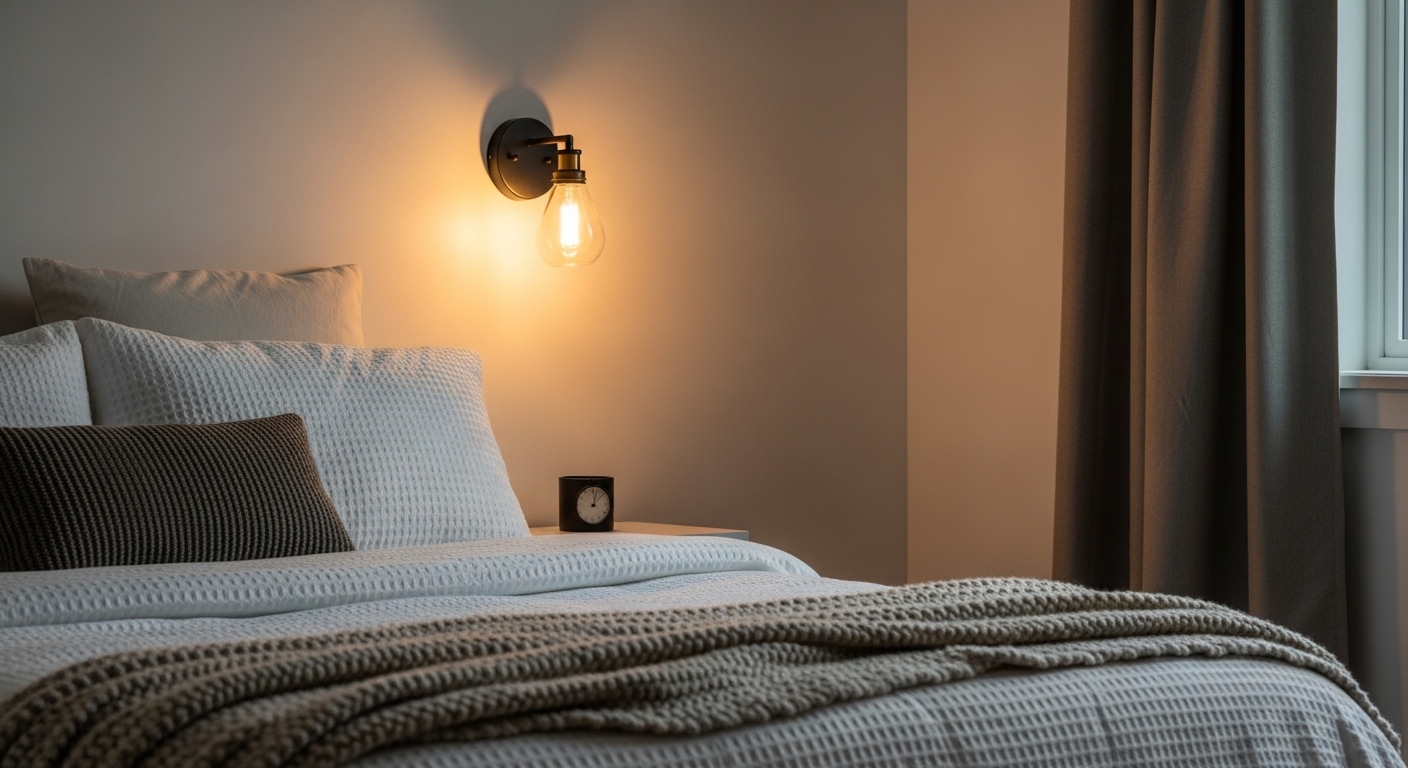
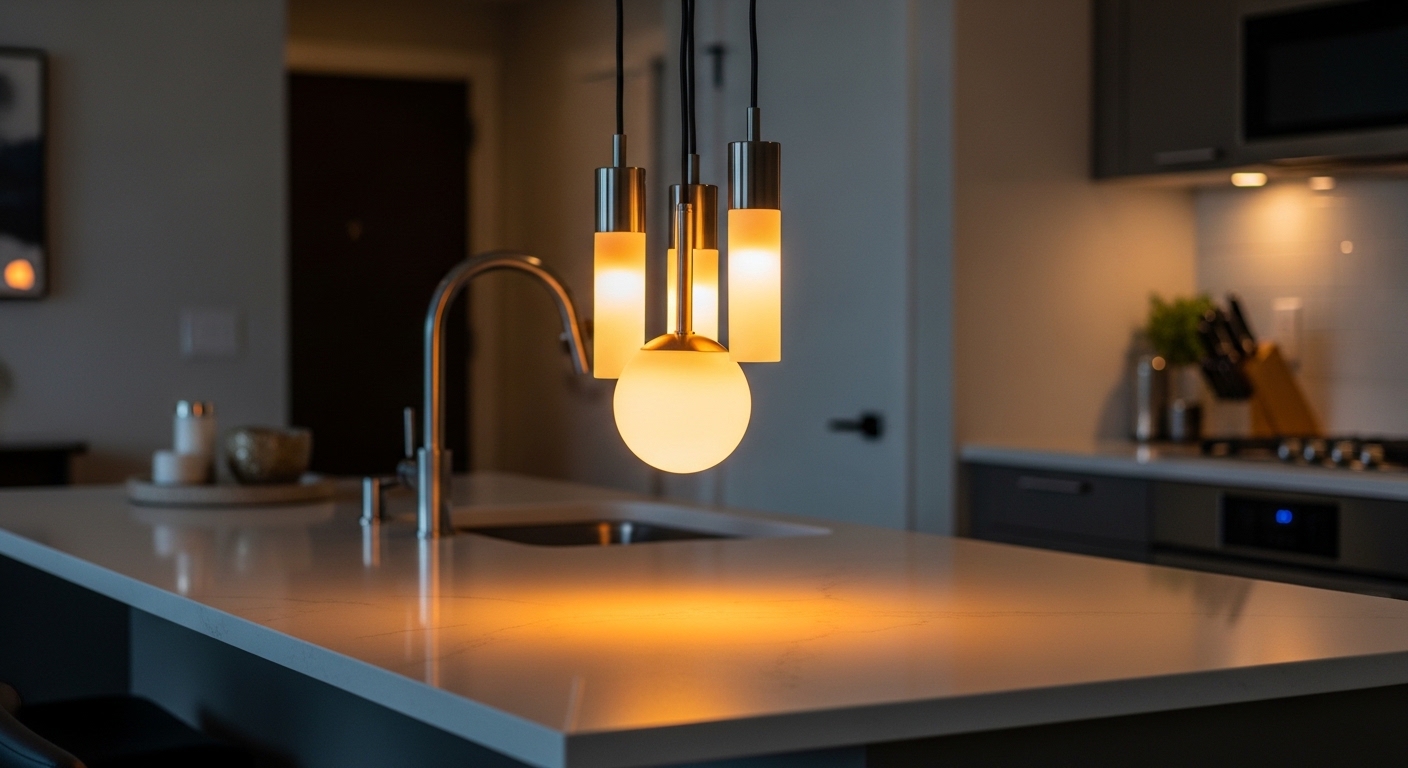
Renter-friendly lighting is lighting you can install without permission, live with for years, and take with you: plug-in fixtures, adhesive mounts, better bulbs, and a habit of leaving the landlord's fixtures exactly as you found them. Four apartments, three cities, five years, and zero security deposit deductions for anything to do with light. That's not luck, and it isn't a friendly landlord either; I've had one of those in four apartments. It's five rules I made after breaking most of them in the first apartment, and they've held through a Philadelphia studio, a Queens one-bedroom, and two Brooklyn apartments including my current 480 square feet. Here they are in full, with the reasoning, the exceptions, the products that made each one possible, and what each apartment cost to light from scratch.
Rule 1: never trust the overhead
Whatever's on the ceiling when you move in is probably wrong: too bright, wrong color, centered on a room you'll furnish off-center, and on a switch with no dimmer. Turn it off and build the light from the floor up: a floor lamp for general light, a task lamp where you work, a sconce beside where you sit or sleep. The overhead exists for cleaning, for finding an earring, and for the landlord's inspection. In my current apartment there are five ceiling fixtures and I use one, in the bathroom, and only after a 2700K bulb went in it.
The reasoning is about direction. A single ceiling light throws light down onto the floor and leaves the walls and ceiling dark, so the room reads as small and the faces in it read as tired. Light from lamps at 30 to 66 inches hits walls and faces from the side, which is how rooms in photographs look and how faces in restaurants look. My three-layer post is the long version of this rule.
Rule 2: keep every original fixture, and photograph the wall
If you swap a fixture, the old one goes in a labeled box in the closet with its screws taped inside, and it goes back on the wall or ceiling the week you move out. Before you mount anything, photograph the bare wall with your phone, date-stamped, so you have proof of what it looked like. This has saved my deposit at least twice: once when a landlord claimed a mark was mine (it was in the move-in photo) and once when the super couldn't find the original bathroom light (it was in the closet, labeled). It's boring. It's the rule that pays, and it takes four minutes on move-in day when you're already photographing the scuffs on the floor.
The corollary: never throw out a lampshade, a bulb, a mounting bracket, or the manual that came with a landlord's fixture. They weigh nothing and they cost you at move-out, usually more than the fixture was worth.
Rule 3: warm bulbs, always
2700K, occasionally 3000K, never higher, in every socket in the apartment, including the ones you don't use. 90 CRI or above. Dimmable wherever there's a dimmer. Buy them all from one brand at one time so the color matches from room to room. Cool bulbs, the 4000K and 5000K "daylight" ones landlords and previous tenants leave behind, make a rental look like the office you're renting to get away from. This is the cheapest rule on the list: my whole apartment re-bulbed cost $38, and it's the first thing I do on move-in day, before the boxes are open, because it changes how every other decision looks. Paint colors, rugs, the sofa: all of them look different under 2700K, and you should choose them under the light you'll live in.
Rule 4: one statement piece per room
A room with only functional lamps looks like a waiting room. A room with only decorative ones looks like a store display. Each room gets one piece that's chosen for how it looks, a pendant over the table, a sculptural floor lamp, a pair of sconces beside the bed, and everything else is quiet and functional. Two statements in a room fight; my living room briefly had a swag pendant and an arc lamp and it looked like a showroom. The arc lamp went to the bedroom, where it's the only thing anyone notices, which is the point. If you can't decide which piece is the statement, it's the one you'd be sad to lose in a move.
The statement piece is also where the money goes. A $150 pendant over a dining table that came with the apartment turns the table into a room; the same $150 spread across three ordinary lamps gets you three ordinary lamps.
Rule 5: invest in what moves with you
Every lighting dollar goes to something that's coming to the next apartment: plug-in sconces, floor lamps, table lamps, plug-in pendants, dimmers, smart plugs, the good bulbs. Nothing goes to anything that stays: hardwired fixtures, ceiling boxes, switches. The landlord's ceiling gets a $4 bulb and nothing else. Across four apartments I've spent about $1,100 on lighting in total, and roughly $950 of it is in the apartment I live in now, because it all came with me. The one purchase that broke this rule, a hardwired vanity light I fitted in my first apartment, stayed in Philadelphia and I still mind.
The exceptions I allow
Swapping a light fixture, as I did with the bathroom vanity light, is technically a breach of Rule 5 and I did it anyway, because the swap was reversible and the improvement was daily. The full story, including the landlord's one-word reply, is in the bathroom post. And a single screw for a swag hook in the kitchen ceiling, which I fill at move-out. Everything else in my apartments is adhesive, plug-in, or freestanding.
Where the rules come from: four apartments, briefly
Philadelphia, a 400-square-foot studio, first lease: I broke Rules 1, 3 and 5. Lived under a 5000K ceiling light for a year, bought a cheap lamp that died, and hardwired a vanity light I couldn't take. Cost to light: about $180, all lost. Queens, a one-bedroom: Rules 1 and 3 in place, Rule 2 learned the hard way when a landlord tried to charge me for a mark that was in my move-in photos. First plug-in sconces, first cord cover. About $340, most of which came with me. Brooklyn, a one-bedroom: all five rules, a floor lamp behind the door I never turned on (a placement lesson, not a rule), and the swag pendant that started Rule 4. Brooklyn, current, 480 square feet: everything from the previous two apartments plus the bathroom sconces and the string lights, on schedules, on smart plugs, and nothing new bought in eight months. Cost to light this apartment from nothing would be about $600; cost to light it from the boxes I moved in with was $84.
What renter-friendly lighting costs, per room
Bedroom: two plug-in sconces ($84), a corner floor lamp ($58), a small dresser lamp ($32), bulbs and a smart plug ($40): $214, in my bedroom post. Living room: an arc or torchiere floor lamp ($70 to $120), a plug-in sconce beside the sofa ($42), a string-light run for atmosphere ($30 with hooks), dimmer and smart plug ($30): about $200. Kitchen: a plug-in pendant over the counter ($52), an under-shelf strip ($30), dimmer ($12): about $95, in the pendant post. Bathroom: two plug-in sconces and a bulb ($120). Entry and hall: one plug-in sconce or a rechargeable one on a schedule ($45). All of it, from nothing, around $675, and all of it moves.
The mounting rule that isn't a rule, but should be
Anything on a wall in my apartments is on adhesive strips rated for four times its weight, pressed onto a wall cleaned with alcohol, left an hour before hanging, with any cord supported by clips below the fixture. That's the whole reason Rules 1, 4 and 5 are possible in a lease that says "no nails, screws, or hardware of any kind." It's written up with the failures in the no-drill sconce review, and it applies to curtain brackets and mirrors as much as lights.
What to ask the landlord, and what not to
Ask, in writing, before doing anything that involves a screw, a fixture swap, or paint: a two-line email with a photo of the fixture and a promise to restore it. Most say yes; the ones who say no have told you something useful about the deposit. Don't ask about adhesive strips, plug-in lamps, bulbs, or cord covers, because there's nothing to ask; they aren't alterations, they're furniture, and asking invites a no to something that was never theirs to refuse. In four apartments I've sent three of those emails. Two got "ok," one got "no," and the no was the apartment where I used a plug-in sconce on strips instead and nobody could tell the difference.
What renter-friendly lighting looks like in a listing photo
I design for a living, and the test I use before I finish a room is the same one I'd use on a layout: take a photo at 7 pm with no flash. If the photo shows a bright spot in the middle of the ceiling and dark corners, the room fails Rule 1. If every lamp is the same height, it fails Rule 4. If the photo looks like a hotel room, warm walls, a lit corner, a pool of light by the seat, you're done. Every apartment I've had has passed that test only after the overhead went off, and the photos are the reason friends ask which designer did it. The designer is a $14 smart plug and a rule about bulbs.
The five rules applied to a studio
A studio breaks the "per room" logic because it's one room doing four jobs, so the rules get applied per zone instead. Rule 1: the single overhead goes off and each zone gets its own lamp, a floor lamp for the living end, sconces for the sleeping end, a small lamp on the kitchen counter. Rule 4: one statement piece for the whole studio, not one per zone, or the room turns into a lighting shop; in my Philadelphia studio it was a single paper pendant over the table, and it was enough. Rule 5 is where a studio shines, because everything is a lamp and everything moves. The zoning itself, which walls get which light and how a smart plug per zone lets the studio go from "day" to "bed" without walking around it, is its own post on studio zones.
What I got wrong before the rules
The first apartment's lighting cost $180 and I brought none of it. I bought a big-box floor lamp with a 5000K bulb and left the overhead on all evening because I didn't know the overhead was the problem. I put a lamp behind a door. I hardwired a fixture and gave it to a landlord. And I never photographed a wall, which in that building would have saved me a $40 "cleaning" deduction I still think was for a picture hook that predated me. None of it was expensive. All of it was avoidable with the five rules, which is why they're written down.
The rule I'd add if I were starting now
Put it on a schedule. A $14 smart plug per room, with the evening lights coming on at sunset and off at midnight, is the difference between an apartment that's designed and one that's a collection of lamps you have to remember. It took me three apartments to do this and about twenty minutes when I finally did. It's the closest a rental gets to feeling like it was built for you, and it moves in a pocket. Rule 6, then, unofficially: if you're switching a lamp on by hand every evening, you haven't finished.
Shop this post: plug-in wall sconces, plug-in pendant lights and wall sconces