Small bedroom lighting for a renter comes down to four moves that need no drilling and no rewiring: turn the overhead off and swap its bulb anyway, put a plug-in sconce on each side of the bed, add one floor lamp in the corner that lights the ceiling, and put all of it on a smart plug so the room has an evening setting. My bedroom is 10 by 11 feet in a Brooklyn building from 1928, with a ceiling fan light kit that emits the exact frequency designed to make you feel tired, ugly, and vaguely like you're in a waiting room. I can't remove it; it's hardwired and my landlord considers it a feature. So I turned it off, permanently, and built a whole lighting system around it for $340 all-in, including the bedding and the mirror. This is the before, the after, every line item, the mounting method that has held for three years, and the things I bought and returned.
Before: what a rental bedroom usually comes with
One overhead fixture on a switch by the door, no dimmer, with a 5000K "daylight" bulb the previous tenant left, which makes skin look grey. One outlet per wall, usually behind where the bed has to go. A window with a blind. That's the canvas, and it's the same canvas in every apartment I've rented: a studio in Philadelphia, a one-bedroom in Queens, a one-bedroom in Brooklyn before this one. The overhead is the problem in almost every small rental bedroom: too bright at full power, at the wrong height to feel warm, impossible to dim without replacing the switch, which means a landlord conversation. Everything below works around it, and none of it requires asking anyone for anything.
Step 1: swap the overhead bulb, then stop using the overhead
Before anything else, put a 2700K bulb in the ceiling fixture. It costs $4, takes a minute, and means that on the nights you do need the overhead (finding a lost earring, changing the sheets) the room isn't the color of a dentist's office. If you want the overhead dimmable without touching the switch, a smart bulb with app dimming works, though in my experience the fan light kit's shade eats half the light anyway. Then leave it off. Every other light in this post is plugged into a wall, and together they do a better job than the ceiling ever did.
Step 2: plug-in sconces on both sides of the bed
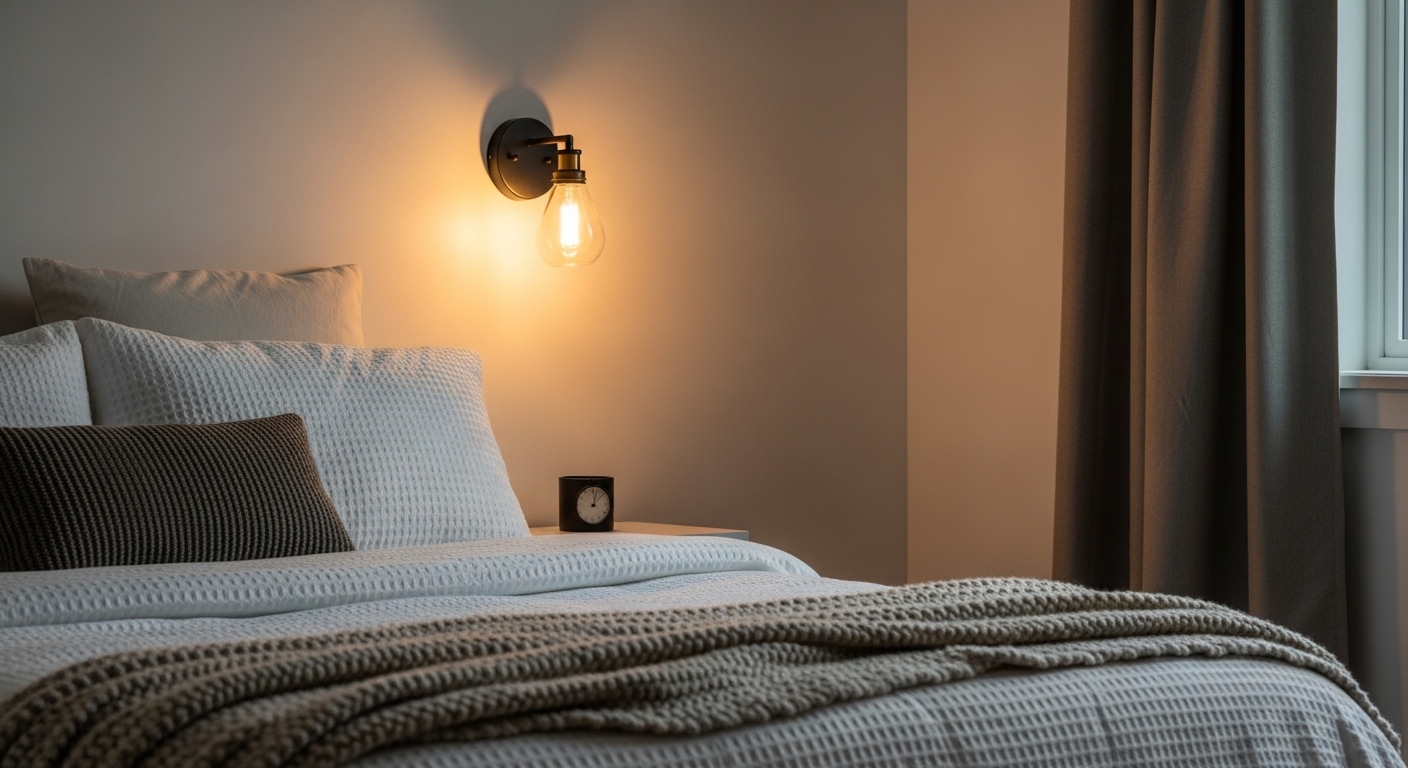
This is the change that matters, the one I'd make in any bedroom on any budget. Two plug-in wall sconces, one each side of the bed, mounted with adhesive strips at 24 to 28 inches above the mattress top (about 50 to 54 inches from the floor for a standard bed), with the cords dropping straight down behind the nightstands to the outlet. Mine are a pair of small dome sconces in black, $84 for the two, and they have been my primary bedroom light for three years. Each one is on its own inline switch on the cord, so you can read while the other person sleeps, and both are on a smart plug so "bedroom" turns them on together at 7 pm.
Placement matters more than the fixture. Center the sconce over the nightstand, not over the edge of the mattress, or the light lands on the wall instead of the page. Angle it slightly down if the arm allows. If you have one nightstand and the other side is against a wall, put the second sconce there anyway; a single sconce reads as an afterthought. The full mounting method, and the products I've tested that actually stay up, are in my no-drill sconce review and the plug-in sconce guide.
Step 3: the corner floor lamp that lights the ceiling
A tall floor lamp in the corner opposite the door, with the shade open at the top so most of the light hits the ceiling and bounces back soft. This replaces the overhead as the room's general light, and because it's in a corner and pointing up, it makes a 10 by 11 room feel taller. Mine is a simple torchiere-style lamp, $58, with a 2700K bulb at 800 lumens on a plug-in dimmer, and it's the only light on when I'm getting dressed. Rule: the lamp goes in the corner you see from the bed, not behind the door, or you'll never turn it on. I learned that one in Queens, where it lived behind the door for a year and got switched on twice.
Step 4: a small light where the eye goes
A low-wattage lamp, a rechargeable puck, or a short LED strip on a shelf, dresser or windowsill: something at about 30 inches off the floor that gives the room a third point of light and a place for the eye to rest. Mine is a small ceramic lamp on the dresser with a 4-watt bulb, $32, on a timer. It's on from dusk to midnight and it's the light I see from the hallway, which is the whole reason a bedroom looks welcoming instead of dark. In the Queens apartment, the same job was done by a $19 rechargeable lamp on the windowsill.
The lamp-behind-the-headboard trick
If your bed is against a wall and there's an outlet behind it, a short LED strip or a small lamp on the floor behind the headboard, pointed at the wall, makes the headboard glow at night and costs $15. It's the cheapest "hotel" effect I know, and it works better with a fabric or slatted headboard than a solid one. Put it on the same smart plug as the sconces so it never becomes the one light you forget to turn off. Skip it if your bed is on a platform with no gap, or if the outlet is the one your phone charger needs.
Bulbs: the part everyone gets wrong
Everything in the bedroom is 2700K, 90 CRI, and dimmable. 2700K is the warm end of white without going orange; 3000K is acceptable if you prefer it a touch crisper, and nothing above that belongs in a room you sleep in. Lumens: 400 to 500 per bedside sconce (enough to read, not enough to wake the other side), 800 for the corner lamp, 200 or less for the accent. Buy them all from the same brand at the same time so the color matches; two different "2700K" bulbs from two brands don't look the same on the same wall, and in a small room you notice.
The $340 makeover, line by line
Bedside sconces, two, adhesive-mounted: $84. Corner floor lamp: $58. Dresser lamp: $32. Bulbs, five, 2700K: $22. Plug-in dimmer and smart plug: $31. Linen duvet cover: $110, which isn't lighting but which is the other half of why the room changed; texture reads warmth the way 2700K does. Large mirror, leaned against the wall opposite the window, no installation: $55, and it doubles the corner lamp at night. That's $392 if you add it up, but the mirror and the dimmer were birthday money, so the number I tell people is $340 and I'm sticking to it. The sconces made the largest single difference of anything on the list, and if I could only keep one line it would be that one.
How to make a rental bedroom feel bigger with light
Light the walls and the ceiling, not the middle of the floor. A room reads as the size of its lit boundaries: the corner lamp pointing up makes the ceiling the brightest surface, so the ceiling feels higher; the sconces throw a wash up the headboard wall, so that wall feels farther away; the dresser lamp lights the opposite wall low, so the room has a far edge. The one overhead in the center does the reverse, lighting the bed and leaving every wall in shadow, which is why a small bedroom with only an overhead feels like a closet with a bed in it. Two more cheap tricks that work in mine: a mirror opposite the window and the corner lamp, which doubles both, and keeping the lampshades pale. A black shade on a bedside lamp looks smart in a photo and swallows half the light in a 10 by 11 room.
The evening routine, as a system
At 7 pm the smart plug turns on the sconces and the dresser lamp at their dimmed settings. When I get changed, the corner lamp goes on by hand. At 10:30 the corner lamp and the dresser lamp go off on the schedule and the sconces stay, one side or both, for reading. At midnight everything's off except whichever sconce is still being read by. It sounds like a lot of configuration for a bedroom. It took twenty minutes once, and I haven't touched a switch in the evening since March, which is the closest a rental gets to feeling designed rather than survived.
Where the outlets are, and what to do about it
The single most common reason a rental bedroom lighting plan fails is that the only outlet is behind the bed and it already has a phone charger and an alarm clock in it. My solution in every apartment has been the same: a flat, six-outlet power strip with a long cord, mounted with adhesive to the back of the nightstand or the bed frame, fed from that one outlet. The sconces, the phone, the alarm and the smart plug all live there. On the far side of the room, a flat extension cord under the rug to the corner lamp, taped down at the edge so nobody trips. It's not glamorous. It's also invisible once the bed is made, and it has passed three move-out inspections without a comment.
What I bought and returned
A clip-on headboard reading light, because it was in every listicle: it clamps at exactly the point where your head goes, and the LED is 4000K with no way to change it. Returned. A set of "smart" fairy lights around the window: charming for a week, then a tangle I had to look at. Returned. A second floor lamp for the other corner: too much; a small room wants three points of light, not four. The rule I've settled on is that every light in the bedroom has a job, sconces for reading, corner lamp for getting dressed, dresser lamp for walking in, and anything without a job goes back in the box, however good it looked on someone else's feed.
Small bedroom lighting ideas that don't need any of this
If you can't mount anything at all: two table lamps on the nightstands, one on each side, same rules on bulbs and dimming, $30 each and they move with you. If you have a single outlet and it's across the room: a 12-foot flat extension cord under the rug to a power strip behind the bed, which I did in Philadelphia for two years. If your bedroom has no nightstand space: a rechargeable sconce that charges by USB and mounts on adhesive, no cord at all, in my sconce review. If the room is a studio and the bed is in the living room: the bedroom "zone" gets its own smart plug, and the zoning is in my studio post.
Taking it down at move-out
Adhesive strips pull straight down with the tab. The lamps unplug. The overhead bulb, I admit, I leave the good one in as a gift to the next person. Total damage across three bedrooms and six sconces: none, and the one deposit deduction I've ever had was for a wine stain, not a wall. Everything in this post has moved with me at least once, which is the real argument for spending $340 on a rental: you're not decorating the apartment, you're decorating the next ten years of apartments.
Shop this post: bedroom wall lamps, plug-in wall sconces and rechargeable wall sconces