The best low light indoor plants, tested in a north-facing Brooklyn apartment where the windows are half blocked by the building across the alley and some winter months get about an hour of direct sun, are pothos, snake plants and ZZ plants, in that order of forgiveness, with a cast iron plant and a peace lily as the next tier and a grow light disguised as a sconce for anything that wants more than the apartment has. I have killed many plants. I have not killed these. This is the honest survival list from four apartments in five years, with what "low light" actually means in lumens and in feet from a window, the six plants that live here and how each one is watered, the four I killed and why, the grow light cheat and how to hide one, where to put plants in a dark apartment, pots and drainage, the watering mistake that kills more low-light plants than darkness does, what to do in January, the plants that look expensive and aren't, the plants to skip, and what the whole collection cost.
What "low light" actually means
Nursery tags say "low light" for anything that won't die on a windowsill facing a wall, and that covers a range from "bright shade" to "a closet." The useful measure: a north window gives 100 to 300 lux at the sill on a grey day and a tenth of that six feet into the room; a spot where you can read a book comfortably without a lamp at noon is medium light; a spot where you'd want the lamp is low. My apartment is low almost everywhere except the 3 feet nearest the window, and the plants below live in the low zone, 5 to 10 feet from a north window, and a couple live in the corner that gets no daylight at all with help. If your phone's light meter app reads under 100 lux at noon, that's the corner this post is about.
The unkillable: pothos
Golden pothos and the plainer jade pothos, trailing from the top of a bookshelf in the dim corner by the door, 9 feet from the window. Watered when the top two inches of soil are dry, which in winter is every two to three weeks, and it tells you by drooping slightly and recovers in an hour. It grows toward the window, so I turn it monthly; the vines are 6 feet long after three years and get trimmed and rooted in water, which is where the other two pothos in the apartment came from. If you can't keep a pothos alive, the problem is water, not light, and it's usually too much.
The architectural one: snake plant
A snake plant, the tall dark-green one with the yellow edge, on the floor in the corner opposite the window, 12 feet from any daylight. It looks like something from a showroom, it actively prefers low light and infrequent watering, and it has been watered roughly once a month for three years and once every six weeks in winter. Overwatering is the only way to kill it; the roots rot in wet soil in a dark room, which is what happened to the first one I owned in a pot without a hole. This one is in a terracotta pot with a hole, on a saucer, and it's the plant guests ask about.
The cheat: ZZ plant
The ZZ plant is so good at surviving neglect that it feels like cheating. Mine sits on the floor beside the desk, 8 feet from the window, watered once a month, zero direct light, completely alive, with glossy leaves that look waxed. It stores water in rhizomes under the soil and would rather be forgotten than fussed over. It grows slowly in low light, which is a feature in an apartment where floor space is the constraint. The dark "raven" variety looks like a design object and costs twice as much for the same plant.
The next tier: cast iron plant and peace lily
A cast iron plant, named for what it tolerates, on the bathroom shelf in a room with no window and a light that's on for an hour a day; watered every two weeks, unbothered. A peace lily on the kitchen counter's dim end, which is the one plant on this list that tells you when it's thirsty by wilting dramatically and then standing back up within an hour of a drink; it also flowers, occasionally, in a north-facing room, which no one told me was possible. Both are cheap, both are in every hardware store, and both are the plants I'd give someone who has killed a pothos.
The four I killed, and why
A fiddle-leaf fig, twice, before the grow light: it dropped a leaf a week in the dim corner and was dead in four months each time. A monstera, which lived but stopped growing and got leggy reaching for the window, and now lives at my sister's in New Jersey where it has a south window and is enormous. A string of pearls, which needs bright light and which I bought because it was pretty. And a calathea, which needs humidity and consistency and which a radiator-heated apartment does not provide. Every one of them was a plant I wanted rather than a plant the room could keep, and the list above is the plants the room can keep.
The grow light cheat, and how to hide one
In my darkest corner I mounted a grow light disguised as a regular wall sconce: a plug-in wall sconce with a full-spectrum LED grow bulb in it, E26 base, 3000K-looking to the eye so it reads as a normal warm lamp, on a timer from 8 am to 6 pm. My fiddle-leaf fig has lived under it for two years; before the light it dropped leaves weekly and now it's fine and has grown a foot. Sometimes the answer is giving plants what they need, and a grow bulb in a fixture that looks like a lamp is how you do that without the apartment looking like a dispensary. The bulb was $22, the sconce $48, and the fig is the plant I'd killed twice.
Where to put plants in a dark apartment
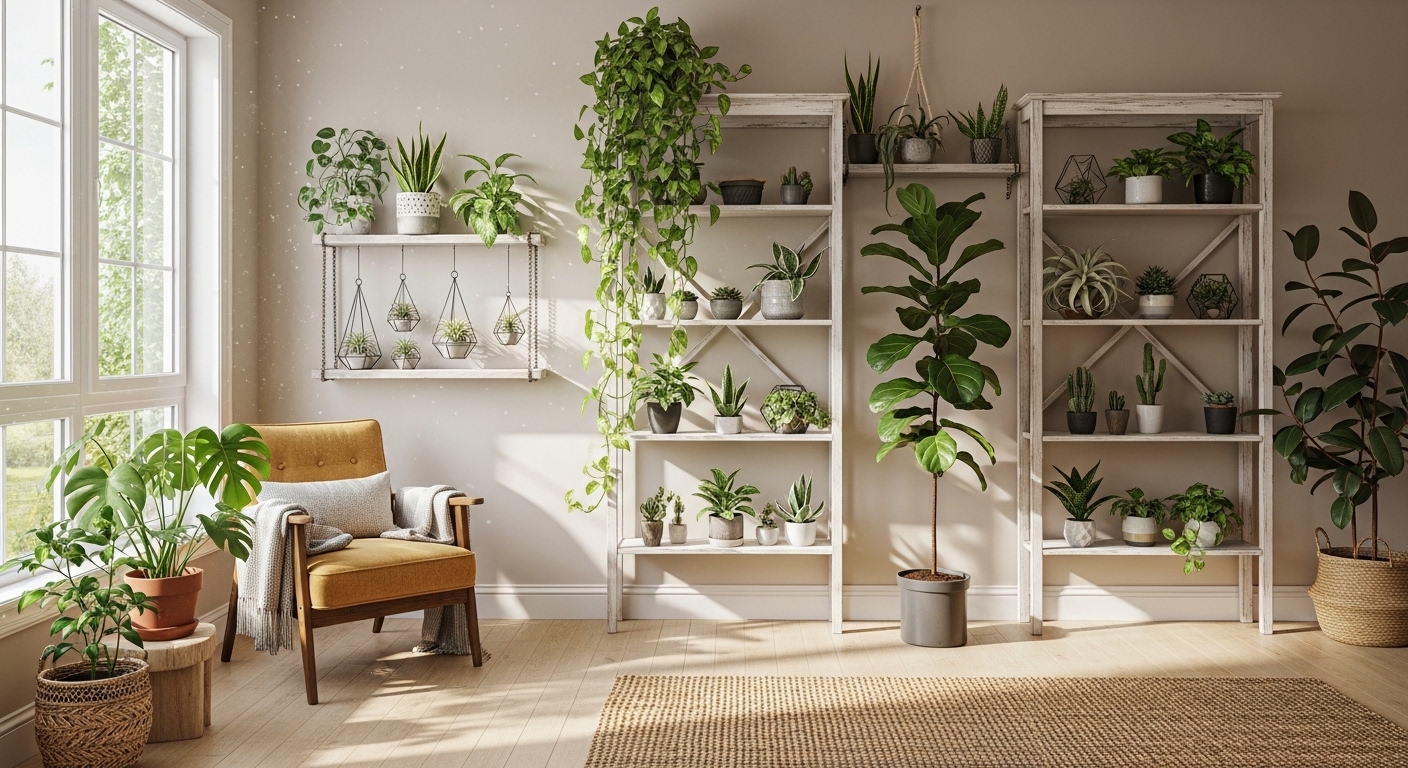
The 3 feet by the window is for anything that needs light, which here is one small herb pot. High shelves for pothos, because trailing plants look best from above and the top of a bookshelf is dim anyway. The floor in corners for snake plants and ZZs, which are upright and read as furniture. A bathroom shelf for the cast iron plant. Groups of two or three rather than one per surface, on a stool, the floor and a shelf, so they read as an arrangement and not a collection. And nothing on the radiator cover, which cooks roots in January; the plant that was there is the calathea, and it's in the compost.
Pots, drainage, and the saucer
Every pot has a drainage hole and sits on a saucer, because in a dark room the soil dries slowly and standing water rots roots faster than any lack of light. Terracotta for the snake plant and the ZZ, because it breathes and dries; glazed ceramic for the pothos and the peace lily, which like a little more moisture. A plastic nursery pot inside a decorative one without a hole is the compromise, lifted out to water and drained in the sink. One material of pot across the apartment, so the plants look like a decision; mine are terracotta and one white glazed, and the plastic ones are inside them.
The watering mistake
Low-light plants use less water because they photosynthesize less, and the same weekly watering that works on a sunny sill drowns them in a dark room. The rule: finger two inches into the soil, and water only when it's dry there, which in this apartment means every two to three weeks in summer and monthly in winter. Water until it runs out of the bottom, then empty the saucer after an hour. More low-light plants die of care than of neglect, and the snake plant I killed was the most cared-for plant I've owned.
January
The month the apartment gets an hour of sun. Watering drops to monthly. The pothos stops growing and I stop expecting it to. The grow light timer runs an extra hour. Nothing gets repotted, nothing gets fertilized, and the plants that make it to March are the ones on this list. I lost the monstera in a January, not to darkness but to a radiator, which is the other thing January does to plants in a Brooklyn apartment.
The plants that look expensive and aren't
A tall snake plant in a terracotta pot, $28 at the hardware store, looks like a $150 plant from a design shop. A ZZ in a plain white pot, $22. A big pothos trailing 6 feet from a high shelf, which is a $12 plant given three years. A peace lily in flower, $15. The expensive-looking dark apartment plant collection is under $100 and takes three years, and the one thing that made it look designed was putting them in matching pots and grouping them, which is the same rule as the objects on a shelf.
Plants to skip in a dark apartment
Fiddle-leaf figs without a grow light. Monsteras, which live and sulk. Succulents and cacti, which are sold as easy and which need sun and will stretch and rot without it. String of pearls, string of anything. Calatheas and prayer plants, which need humidity. Citrus, herbs other than mint, and anything that flowers on purpose. The nursery will sell you all of them with a "low light" tag; the tag is a lie about half the time, and the list above is the other half.
Light for the plants and light for you: two bulbs, one fixture
The grow sconce is the one fixture in the apartment that has two jobs. On the timer by day it runs the grow bulb; the second sconce beside it, a plain plug-in at 2700K, does the evening. If there's only one fixture, a smart plug that runs the grow bulb 8 to 6 and a swap to a warm bulb for the evening is a chore, so two sconces, one for the fig and one for me, $96 the pair. The corner reads as a lit corner with a plant in it, which in a north-facing apartment is the corner that used to read as a storage closet. The rest of the apartment's plants live on the light that's already there, which is the whole point of the list.
A note on cats, kids and the ones that are toxic
Pothos, snake plants, ZZ plants and peace lilies are all mildly toxic to cats and dogs if chewed, and the cast iron plant isn't. I don't have a cat; my sister does, and her apartment has the cast iron plant, a spider plant, which is another low-light survivor I'd add for a pet household, and a parlor palm, which tolerates dim rooms and is safe. High shelves for the trailing ones solves most of it in a cat household, and the ZZ on the floor doesn't.
What the collection cost
Three pothos, $12 for the first and the other two rooted from it. The snake plant, $28. The ZZ, $22. The cast iron plant, $18. The peace lily, $15. The fiddle-leaf fig, $45, plus the grow bulb and the sconce, $70. Pots and saucers over three years, about $80. Under $300 for a north-facing apartment with living things in every room, and the two figs I killed before the light were another $90 that taught me the last section. The sconce is also a sconce, and in the evening it's a lamp; the renter lighting rules is how the rest of the corner is lit.
Shop this post: plug-in wall sconces, which take a grow bulb by day and a warm one by night