How to hang pictures without nails, in a way that holds for years and comes off clean: adhesive picture-hanging strips, two sets per frame regardless of weight, on a wall cleaned with rubbing alcohol, pressed for thirty seconds, left for 72 hours before the frame goes on, and removed by pulling the tab straight down. My bedroom gallery wall has eleven frames, none of them required a hole, and my deposit is safe after two years and one summer of radiator heat. This post is the exact method: the paper-template planning that I never skip, the strips and their ratings and which kind for which frame, the wall prep that decides whether they hold, the 72-hour wait, the frames that work and the ones that don't, the layout rules for a small bedroom wall, the sconce at the edge that makes the wall look chosen, the alternatives to strips and when each is right, the walls strips don't work on, removing them without taking the paint, mistakes, the weight limits nobody reads, and what a nail-free gallery wall costs.
The planning phase, which decides everything
Trace every frame on kraft paper and cut out the shapes. Tape them to the wall with painter's tape in the layout you think you want, and live with it for a day, because I always change something when I see it full-size and the day is what stops the strips going on twice. Once the layout is right, mark on each paper template exactly where the hanging hardware or the strip will sit on the frame's back, measured from the frame's edges. Then, one template at a time: remove the paper, and put the strip on the wall at that exact mark. The templates are the whole trick, and skipping them is how people end up with strips in the wrong places and a wall of ghost squares.
The strips: which kind, how many
Large picture-hanging strips, the interlocking hook-and-loop kind, rated for 16 pounds per set of four. Two sets per frame, even for light frames, because the rating is for a fresh strip on a perfect wall and a frame that holds for two years needs margin. For frames under 8 by 10, the medium strips, two sets. For anything over 5 pounds, four sets. Skip the poster strips, which are for posters, and skip the double-sided foam tape, which is permanent and takes the paint. The strips are $18 for a box that does four frames, so an eleven-frame wall is about $50 of strips, which is the price of the deposit's peace.
Wall prep, which is why they hold or don't
Clean the wall where each strip goes with rubbing alcohol on a cloth, not a cleaning spray, which leaves residue, and not water, which does nothing. Let it dry completely. Press each strip to the wall for thirty seconds with your whole palm, then press the frame's strip to the wall strip for thirty more. The wall has to be smooth, painted, and at room temperature; a wall painted in the last month, a wall over a radiator in January, and a wall with any texture are the three that fail. Mine is smooth plaster painted two years before I moved in, and every strip has held.
The 72-hour wait
The strips say one hour. I wait 72 before hanging anything, and this patience has never failed me, and the two friends who hung at hour one both had a frame on the floor by morning. The adhesive cures to the wall over days; the frame's weight on it before then peels it slowly. Put the wall strips up on a Thursday, hang the frames on Sunday, and use the three days to enjoy the taped-up templates, which is also when you'll swap two of them.
Frames that work, and frames that don't
Flat-backed frames, which most gallery frames are, take the strips directly on the back's corners. Frames with a sawtooth hanger or a wire need the strips on the frame's back rails, with the hanger left unused, and the frame sits flat to the wall, which is the look you want anyway. Heavy frames with glass over 16 by 20 are over the comfortable limit and get a mirror-and-picture hook that's still nail-free, below. Canvases on stretcher bars take the strips on the bars. Frames with a bumpy back, a deep rebate or a paper dust cover over the rails need the strips on the hard parts only, and the paper cover trimmed where the strip goes. All eleven of mine are flat-backed wood frames in one finish, which is a layout rule as much as a hanging one.
Layout rules for a small bedroom wall
An 8-foot wall over a queen bed, and the gallery is 60 inches wide and 36 tall, centered on the bed with its bottom edge 8 inches above the headboard and its center at about 60 inches from the floor. Eleven frames in three sizes, one finish, 2 inches between them, in a loose grid that reads as a rectangle from the door. One large frame off-center as the anchor, the rest around it. All black-and-white or all one palette, which is what makes eleven things read as one; the mix of colors is where gallery walls go wrong. The design lessons post is the hierarchy argument, and the gallery wall is the poster.
Where the gallery wall goes in a small apartment
Over the bed, because it's the one wall in a 480-square-foot apartment that's seen from the door and never has furniture against it. Not in the entry, which is 18 inches of hall; not over the sofa, where one large piece does more; not in the bathroom, where strips fail. One gallery wall per apartment, and the rest of the walls with one thing or nothing, which is the white-space rule and the reason the eleven frames read as the point of the room and not as more stuff.
The sconce that makes it work
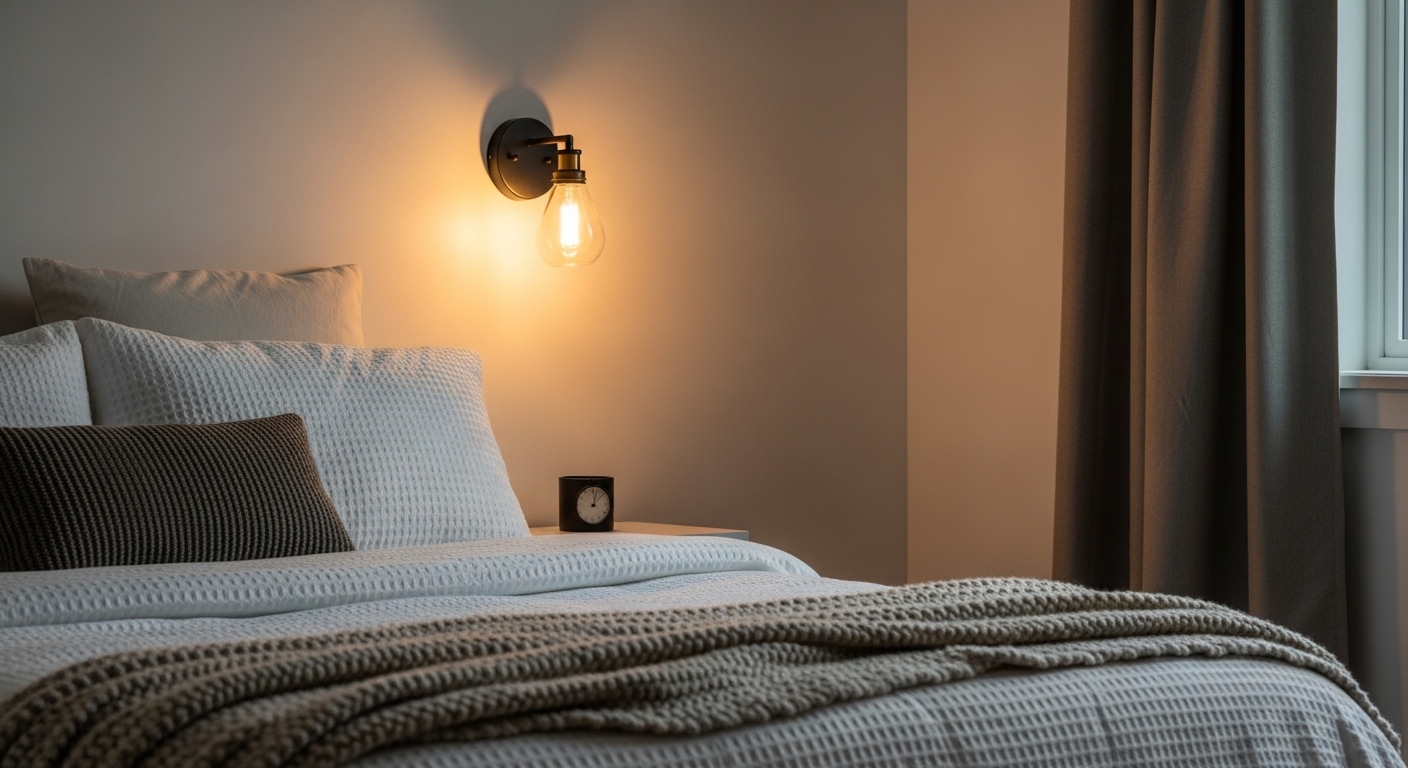
A gallery wall without intentional lighting is a collection of frames. I added a plug-in wall sconce at the right edge of the gallery, at 64 inches, on strips too, and the light grazes across the frames and creates dimension; the same frames lit by the overhead look flat, and lit by the sconce they look chosen. The sconce is on the bedside's dimmer at 30 percent in the evening, and it's the light that makes people stop at the wall. A picture light on strips over the anchor frame is the other option, and it draws the eye to one frame where the sconce lights the whole wall.
Alternatives to strips, and when
Adhesive hooks, the small ones rated for 3 to 8 pounds, for frames with a wire; they hold well and stand the frame off the wall by a quarter inch, and they're the choice for a frame you'll swap often. Adhesive picture rail, a strip of molding stuck along the wall with frames hung from cords, for a wall of frames that change monthly; it's a look, and it's a commitment. Leaning frames on a shelf or the floor, which is nail-free by definition and the choice for anything over 20 pounds. Tension-pole picture stands, which I've seen and don't love. And, for a mirror or a heavy frame, the adhesive hook rated for 16 pounds that is a real hook and not a strip, on two strips of its own, which holds the one mirror in the apartment.
Walls strips don't work on
Textured or popcorn walls, which give the adhesive nothing to hold. Wallpaper, which the strip will take with it. Brick and concrete, which need a different adhesive or a lean. Fresh paint under thirty days. Bathrooms with steam and no fan. And walls over radiators in a New York winter, where the adhesive softens; the frame that fell in my first apartment was over the radiator in February, and it's the exception that made the rule. On any of these, the leaning shelf or the picture rail are the answers.
Removing them without taking the paint
Pull the frame off by separating the hook-and-loop, not by pulling the frame away from the wall. Then hold the wall strip's tab and pull it straight down, slowly, parallel to the wall, stretching it; it releases without a mark. Never pull outward, which is how the paint comes with it. A hair dryer for thirty seconds on a stubborn one. Two apartments, about forty strips removed, and one paint chip, which was the one I pulled outward in a hurry on moving day.
Hanging one large piece without nails
A single big frame, 24 by 36 with glass, is over the strip limit and is the piece most people want over a sofa. Two options that hold: an adhesive hook rated for 16 pounds on its own strips, with the frame's wire on it, which stands the frame a quarter inch off and holds a 12-pound frame for years; or a shelf, a narrow picture ledge on strips or a floor lean, which is how the large print in my living room sits, leaning on the console against the wall, and which looks more deliberate than a hung frame does over a sofa in a rental. For a mirror, the hook, and never the strips alone, which is the one thing the strips' box is right to warn about.
Straightening and spacing, which strips make easy
Strips don't swing, so a frame that's level on the day is level forever, and a frame that's crooked on the day is crooked forever; a small level on the top edge before pressing, every time. Spacing: 2 inches between frames, measured with a block of wood cut to 2 inches and held between them while the next one goes on, which is faster than a tape and consistent. The templates set the spacing on the wall; the block keeps it when the paper comes down and the frame goes up.
Mistakes
Hanging at hour one, in the first apartment: a frame on the floor. One set of strips on a light frame: a frame on the floor. Strips on a paper dust cover: the cover peeled and the frame slid. Not cleaning the wall on the first three frames: two held, one didn't, and the alcohol step became a rule. And a layout decided without the paper templates, once, which took two evenings of re-sticking that the templates would have made one.
The weight limits nobody reads
A set of four large strips holds 16 pounds; a set of four medium holds 12; the small ones hold 4. A 16 by 20 frame with glass weighs 5 to 8 pounds, an 11 by 14 about 3, an 8 by 10 about 1.5. Two sets per frame doubles the margin, and four sets on a heavy one is cheap insurance. The ratings assume a clean, smooth, cured wall at room temperature, and every condition that isn't met takes a third off. I treat 8 pounds as the practical maximum for strips and use a hook above it.
In one paragraph
Paper templates taped up for a day; large strips, two sets per frame, on a wall wiped with alcohol; thirty seconds of pressure; 72 hours before the frames go on; one finish, one palette, 2-inch gaps; a sconce at the edge; a hook not strips for anything over 8 pounds; pull the tab straight down to remove. Eleven frames, no holes, two years.
What it cost
Eleven frames, secondhand and from a discount store, in one black finish, about $110. Prints, my own and a few from a print shop, about $90. Strips, three boxes, $54. Kraft paper and painter's tape, $12. The plug-in sconce, $48, and its strips. About $320 for a wall people photograph, and $0 of it is deposit risk, which in a Brooklyn rental is the number that matters. The bedroom lighting post has the sconces on the other wall, which are on strips too.
Shop this post: plug-in wall sconces, which mount on the same strips as the frames