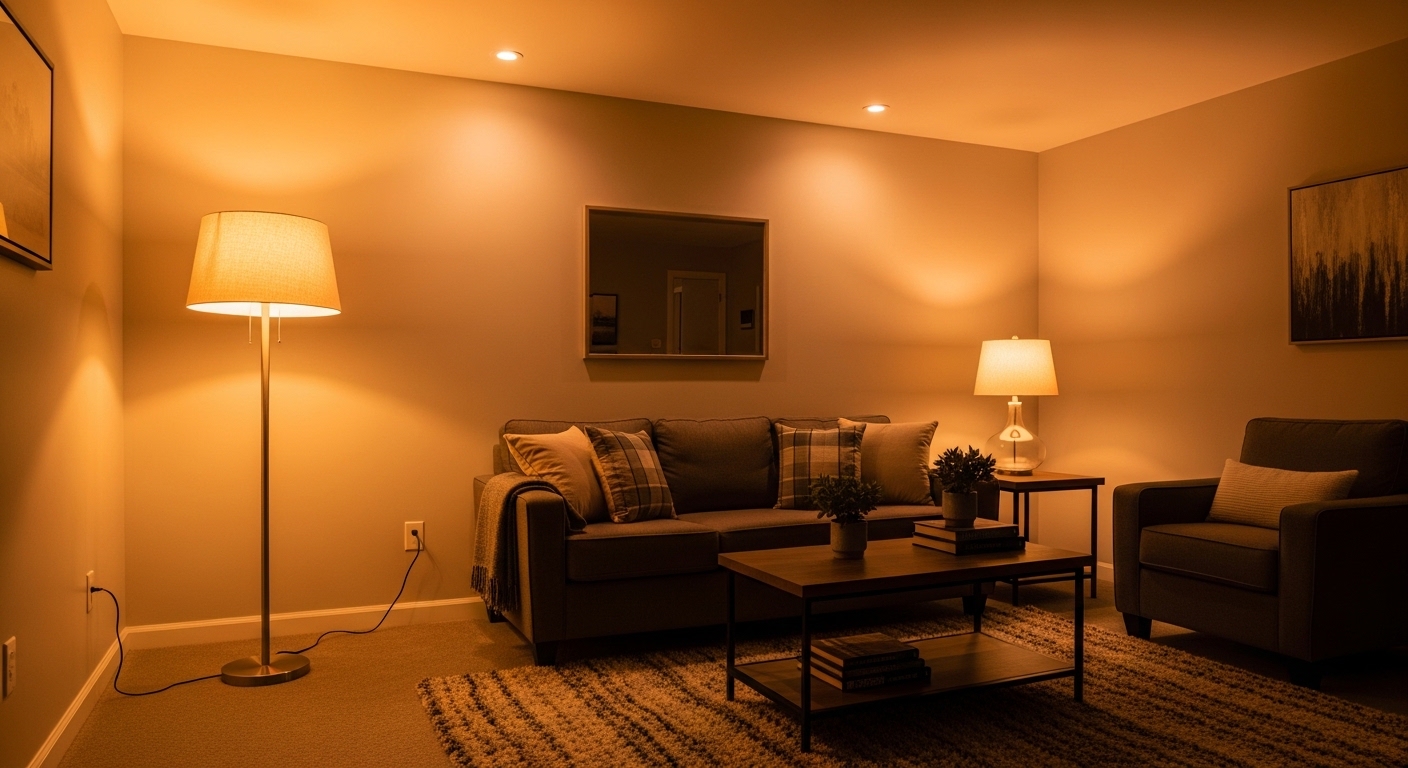
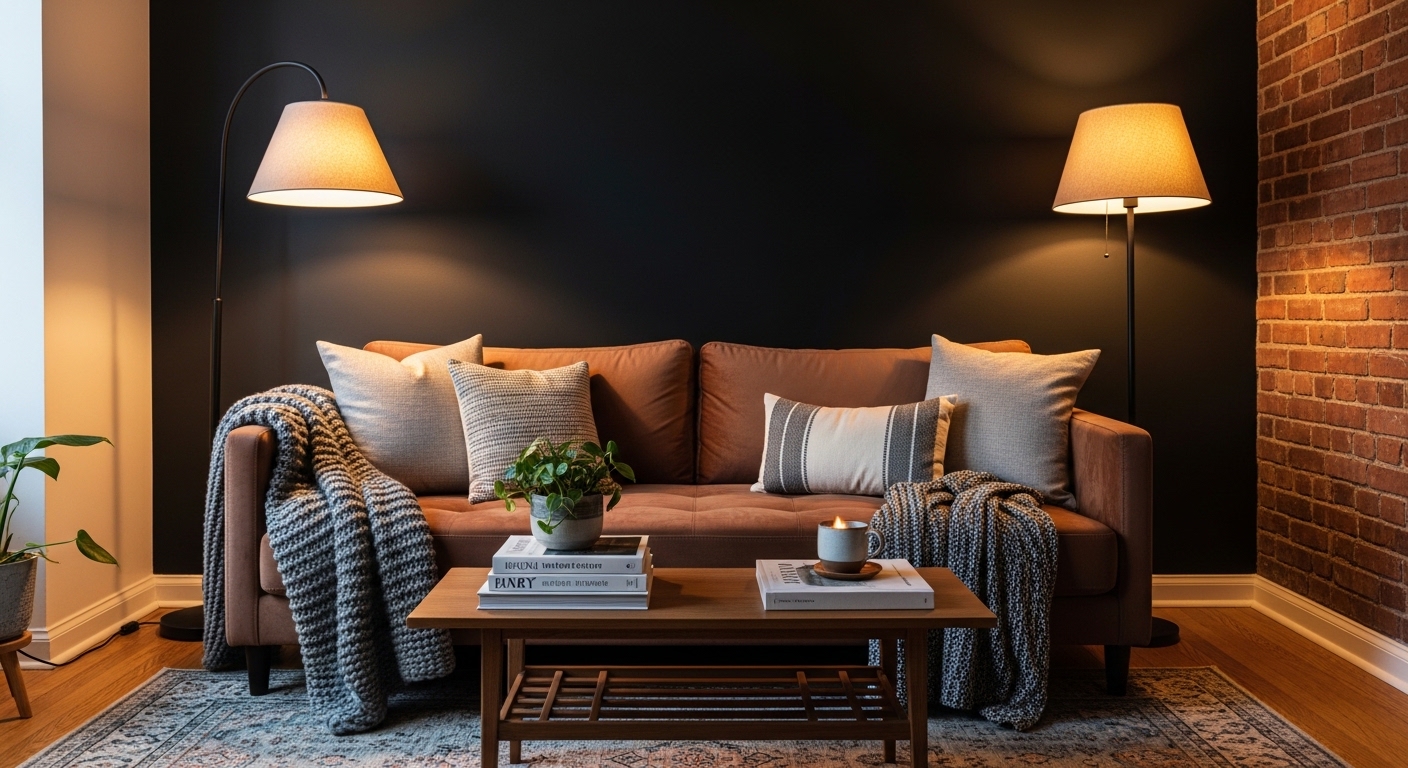
Apartment lighting ideas start with one observation: the first thing I notice in any apartment is where the light comes from, and in most apartments it comes from the ceiling, which is the one place light should never come from alone. Seven years as a graphic designer trained me to see contrast, hierarchy and where the eye goes, and I can't turn it off when I walk into a friend's living room; I see a ceiling light flattening a room that has four good surfaces and no light on any of them. This post is the twelve things I notice, in the order I notice them, with what each one means and the fix for each: the ceiling light, the color temperature mix, the bulb showing through the shade, the lamp that's in the wrong place, the dark corner, the wall nobody lit, the mirror with no light beside it, the kitchen lit from behind, the bedroom with one switch, the light at the wrong height, the too-bright evening, and the room that has no focal point, plus what I'd do first in a friend's apartment, what a designer's eye costs, and the one thing that fixes half the list.
One: the light comes from the ceiling
The first second in any room: is the light overhead? If it is, the room is lit like a store and every face in it is lit from above, which is the least flattering angle there is, and every object in it casts a shadow straight down. Overhead light flattens a room, because it lights everything equally and the eye has nowhere to go. The fix is the whole of the layers post: three lamps at three heights and the ceiling light off, and it's the observation that makes the other eleven.
Two: the bulbs don't match
A 2700K lamp beside a 4000K ceiling light beside a 5000K kitchen strip, which is most apartments, and which I see as three different rooms in one; the eye reads color temperature as a signal about what kind of place this is, and three signals is confusion. The fix is twenty minutes and $18: every bulb to 2700K, with the kitchen and bathroom at 3000K, and the apartment reads as one place. A designer notices mismatched type on a page instantly, and mismatched light is the same thing on a wall.
Three: the bulb shows through the shade
A lamp with a thin shade is a lamp that lights itself; from the sofa I see a bright point with a dark room around it, which is glare, and glare is what makes a room feel cheap even when it isn't. The fix is a lined linen shade, $30, on a lamp that's fine, and the bulb becomes a glow. The lamp post is the shade rule, and it's the fix I've done in three friends' apartments with the shade in a bag.
Four: the lamp is in the wrong place
A lamp beside the door, where the outlet is, lighting the wall by the door, in a room where the sofa is on the far side in the dark; the lamp went where the cord reached and not where the light was needed. The fix is a 10-foot extension cord in a channel, $12, and the lamp at the sofa's end where it should have been. I see it because a designer sees the layout as a grid and the lamp is off the grid; the outlet decided and it shouldn't have.
Five: the dark corner
Every room has one, the corner the ceiling light doesn't reach and no lamp is in, and it's where the eye stops and the room ends; a dark corner makes a room read as smaller by the size of the corner. The fix is one light in it, a small lamp on a stool, an uplighter on the floor, a plant with a grow bulb, and the room's edges come back. The corner is the first thing I'd light in a friend's apartment, and it's the last thing anyone lights in their own.
Six: the wall nobody lit
A wall with art on it and no light on the art, so the art reads as a dark rectangle at night; or a wall with nothing on it and nothing lighting it, which is a wall that's not doing anything. A sconce grazing a wall makes it a surface, shows its texture, and gives the room a second focal plane behind the furniture; the fix is a plug-in wall sconce on strips at 62 inches, and the dark wall post is the extreme version. A designer lights the poster, not the room the poster is in.
Seven: the mirror with no light beside it
An overhead in the bathroom and a mirror below it, and a face lit from the crown with the eyes in shadow; I notice it in the first glance at a friend's bathroom and I've never said so, because it's the observation nobody wants. The fix is the $40 in the bathroom post: a sconce beside the mirror at face height. Light a face from the side and it's a face; light it from above and it's a mugshot.
Eight: the kitchen lit from behind
A ceiling light behind the cook, so the cook's shadow is on the cutting board, which is how most rental kitchens are lit and why people say their kitchen is dark when it has a 100-watt fixture in it. The fix is a strip under the cabinet, $28, on the counter and in front of the cook, and the shadow is gone. The counter post is the strip. It's the observation that's most obviously a problem and the one people have lived with longest.
Nine: the bedroom with one switch
A bedroom lit by a ceiling light on a switch by the door, which means the last thing before sleep is a walk across a dark room, and the bed has no light of its own; a bedroom with one switch is a bedroom that gets the ceiling light on at 11 pm. The fix is two plug-in sconces at 60 inches on either side of the bed, on a plug-in dimmer, and the ceiling switch never touched again. It's the fix that changes a friend's apartment most and the one they thank me for six months later.
Ten: the light at the wrong height
A sconce at 72 inches, above everyone's head, lighting the ceiling. A pendant at 60 inches over a table, in everyone's eyes. A lamp on a tall table with the shade's bottom at standing eye level, so it glares at anyone sitting. Height is the thing a designer sees as alignment, and light at the wrong height is a line that's off the grid; the fixes are numbers: sconces at 60 to 66, pendants at 30 to 36 above a table, shade bottoms at seated eye level, which is 40 to 42 inches from the floor.
Eleven: the too-bright evening
Every light in the apartment at 100 percent at 10 pm, which is a room that's shouting, and which I notice as a page with everything in bold. A room at night should be at 30 to 40 percent, with the brightest thing the thing you want looked at and the rest dark; the fix is plug-in dimmers, $14 each, and the habit of turning them down. Brightness is contrast, and contrast at 100 percent everywhere is no contrast at all.
Twelve: the room with no focal point
Four lamps of the same brightness in four corners, and the eye going nowhere, which is a room that's lit and not designed; hierarchy is the first principle on a page and the last one applied in a room. The fix is to pick the thing, the sofa wall, the bed, the shelf, and light it brighter than the rest, and dim the rest; one lamp up and three down, and the room has a subject. The design lessons post is the whole principle.
What I'd do first in a friend's apartment
Turn the ceiling light off and see what's left, which is usually one lamp and a dark room. Then the bulbs, all to 2700K. Then a lamp moved from the door to the sofa with an extension cord. Then a sconce at the bed. Four fixes, an afternoon, under $100, and the apartment reads as a different place, which I've done twice and which both friends described as "you did something and I can't tell what." The answer is that I took the light off the ceiling.
What a designer's eye costs
Every restaurant, every hotel lobby, every friend's living room, seen as a lighting plan with mistakes in it, and the inability to enjoy a dinner under a 4000K pendant at 80 percent; it's a habit that makes a designer good at her job and tiring at a party. The upside is that the fixes are cheap and fast and I've never met a room that couldn't be helped by turning off the overhead. The eye is free; the fixes are under $100; the ceiling light is the thing they all have in common.
The apartments I've done this in
My own four, obviously, and each one lit the way I'd found it for the first week before the box came out. A friend's one-bedroom in Queens with a single overhead in each room and a lamp by the door, which became three lamps and two sconces in an afternoon and $110. My sister's house in New Jersey, where the kitchen was lit from behind the cook for eleven years until a $28 strip. And an office I worked in, where I put a lamp on my desk at 2700K and by the end of the year there were six lamps on six desks and nobody had asked. The observation travels; the fix is always the same.
The hierarchy of fixes, by cost
Free: turn the overhead off and dim what's left. $18: bulbs. $12: an extension cord to move a lamp. $14: a dimmer. $28: a kitchen strip. $30: a better shade. $48: a sconce at the bed or the mirror. In that order, and the first four are under $50 and fix observations one, two, four, nine and eleven, which is most of the list. The sconce is the only one over $30 and it's the one people notice.
What I notice in a good apartment
The opposite list, which is shorter: the ceiling light is off and I can't find a switch that matters. Every bulb is the same color. There's a lamp at the sofa, a light on a wall and a glow in a corner, and the brightest thing in the room is the thing the owner wants me to look at. The bedroom has lights beside the bed. The kitchen counter is lit from the front. I've been in three apartments like that in New York that weren't mine, and in all three the owner had never thought about it and had done it anyway, which is the thing about lighting: it's a set of rules that some people have by instinct and the rest of us have by a list.
In one paragraph
Overhead off. Bulbs matched. Shades lined. Lamps where the light's needed, not where the outlet is. A light in the dark corner and one on the wall. A sconce beside the mirror and two beside the bed. A strip in front of the cook. Every light at its height. Everything at 40 percent at night. One thing brighter than the rest. Twelve things a designer notices in the first minute and twelve fixes that cost less than a dinner out.
The one thing that fixes half the list
Turn the ceiling light off. Half the observations, the overhead, the flat face, the shadow on the board, the too-bright evening, the room with no focal point, are the ceiling light's fault, and the other half become visible only once it's off; a room lit by lamps has problems you can see and fix, and a room lit from the ceiling has one problem you can't see because it's everywhere. Every fix in this post starts at the switch by the door, and it's the one fix that's free.
Shop this post: plug-in wall sconces, the fix for observations six, seven and nine