The apartment decorating tips that worked for me are the rules I'd been using at work for seven years and ignoring at home: hierarchy, one thing the eye goes to first; white space, walls and shelves left empty on purpose; contrast, dark against light and matte against shine; alignment, edges that line up; repetition, one finish and one palette; and scale, things sized to the room and not to the catalog. I spent four years studying graphic design and three more at an agency before I noticed I'd been decorating my apartments with none of it, and the connection clicked while I was laying out a poster and thought: this is exactly what I'm trying to do with my living room. This post is the six principles translated from the page to a 480-square-foot Brooklyn apartment, with the wall, the shelf, the sconce and the print that each one produced, the grid, the focal point and the light that reinforces it, the palette of three, what a poster teaches about a room's edges, the mistakes from the first apartment that broke every rule, the budget that a print and a lamp cost, and the one principle that matters most in a small space.
Hierarchy: one thing first
Every poster has a primary element, the thing your eye goes to first, and everything else is sized and placed to support it. Every room should have one too. In my living room it's the gallery wall over the sofa, and everything else, the sofa, the rug, the lamp, is secondary to it; the plug-in pendant above the coffee table reinforces the focal zone by lighting toward it, and nothing else on that wall competes. In the bedroom it's the bed with the two sconces, and in the kitchen it's the shelf with the lamp. A room without hierarchy is a room where the eye wanders and stops nowhere, which is what "cluttered" means even when it's tidy.
White space: the wall left bare
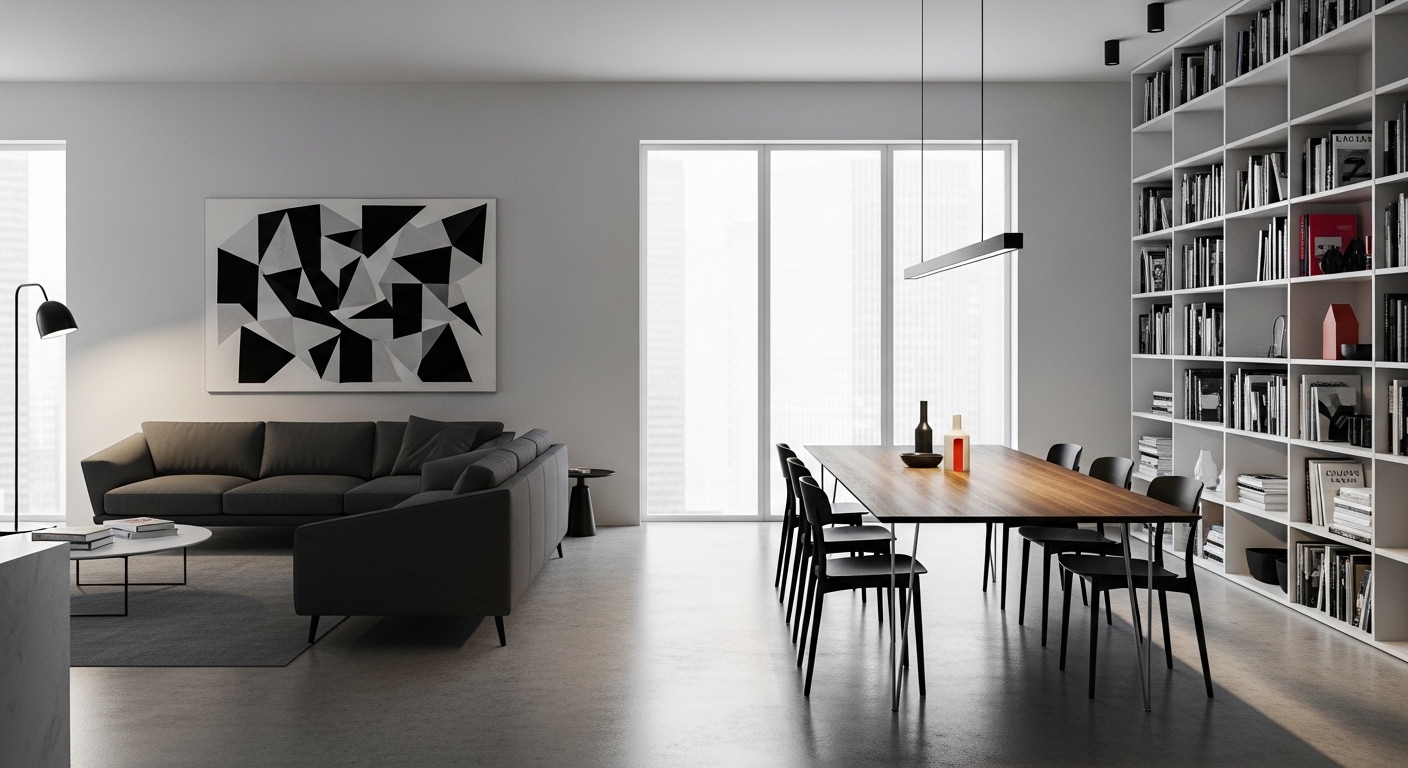
In design, white space isn't empty; it's where the eye rests, and a poster with no white space is unreadable however good the type is. In the apartment I leave one wall completely bare, the one opposite the gallery wall, and keep one shelf deliberately open on the bookcase. The visual rest those empty areas provide makes the styled areas read more clearly, and the bare wall is what makes the gallery wall look like a decision rather than a shortage of wall. The hardest rule to keep in a small apartment, because every surface is precious and the instinct is to use all of them; the rule is that some of them are used by being empty.
Contrast: dark against light, matte against shine
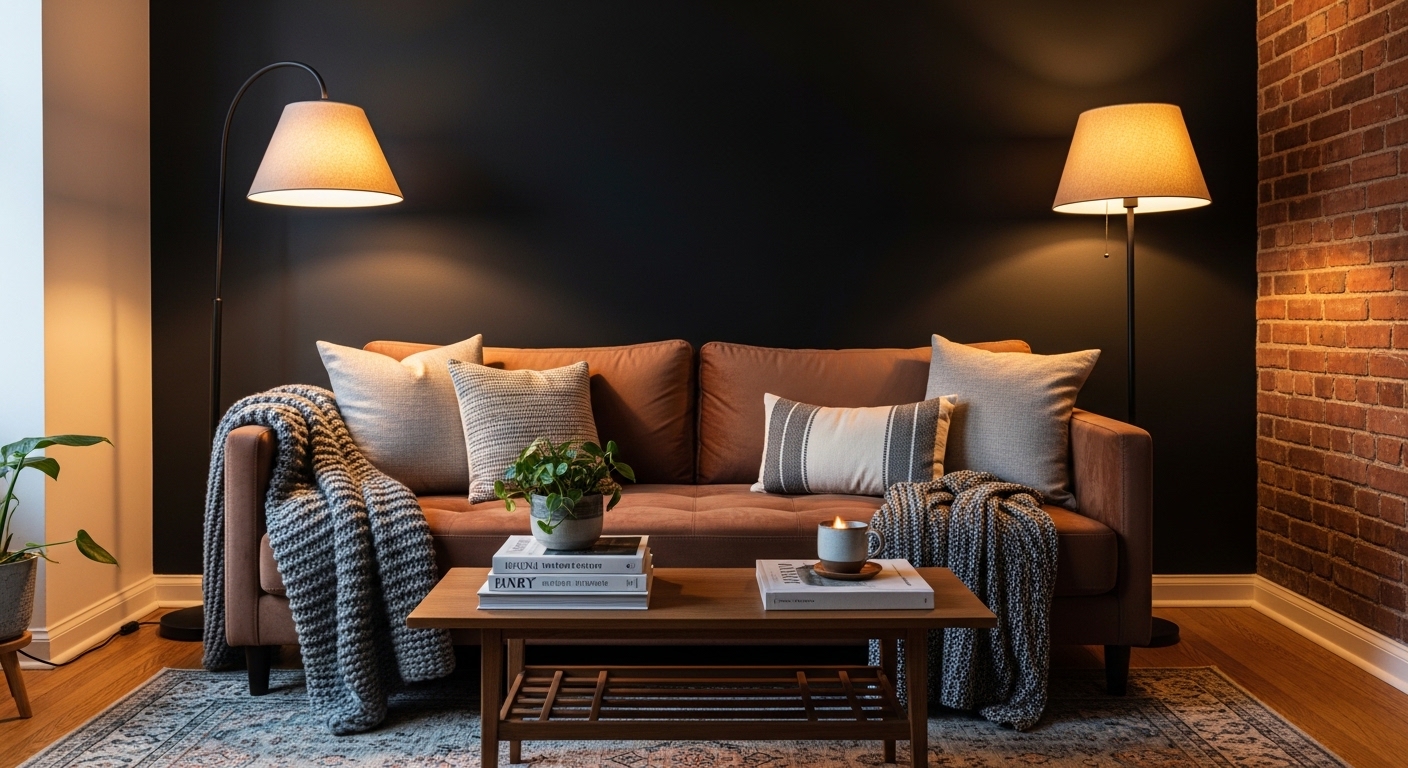
In graphic design contrast creates legibility; in a room it creates interest. One charcoal wall against three white ones. A black wall sconce against a white wall. A dark rug on a pale floor. A matte ceramic lamp beside a glass of water. The contrast makes both elements more visible and more intentional, and the trap is contrast everywhere, which is noise; one strong contrast per room, and the rest of the room in the middle tones. The dark wall post is the biggest contrast in the apartment and the one that made it look larger.
Alignment: edges that line up
A layout looks professional when things line up, and the same is true of a wall. The top of the sofa, the bottom of the gallery wall and the top of the console all sit on lines that relate: the gallery's bottom edge is 8 inches above the sofa's back, the console's top is the sofa's arm height, the sconce's center is the same height as the top of the tallest frame. Nobody notices the alignment; everybody notices when it's off. A level and a tape measure, and the rule that every new thing on a wall relates to an edge that's already there.
Repetition: one finish, one palette
A poster uses two typefaces, not six, and a room uses two metals and three colors. Black metal on every fixture, the sconces, the pendant, the lamp's base, the frames; oatmeal, charcoal and oak as the palette, with one green thing per room that's a plant. Repetition is what makes eleven frames read as one wall and four lamps read as one system, and it's the cheapest rule on the list because it's mostly about not buying the brass thing that's on sale. The lamp post is what happens when the repetition breaks.
Scale: sized to the room, not the catalog
Type at 72 points on a business card is a mistake, and a 90-inch sofa in a 12-foot room is the same mistake. The sofa post is the arithmetic; the principle is that every object in a small room should be about a third smaller than the catalog default: the sofa, the coffee table, the rug, the pendant, the frames. The one exception is the arc lamp, which is tall on purpose to fill vertical space the furniture can't, and the rule for exceptions is one per room.
The grid
Designers lay out on a grid, and a room has one too: the sofa's width sets a column, the rug's edge sets a margin, the window's center sets an axis. The gallery wall is centered on the sofa, which is centered on the rug, which is 12 inches from the wall on both sides; the pendant is centered on the coffee table, which is centered on the sofa. Once the grid is set, everything new snaps to it, and the room stops needing to be rearranged, which in four apartments in five years is the thing that's saved the most time.
The focal point and the light
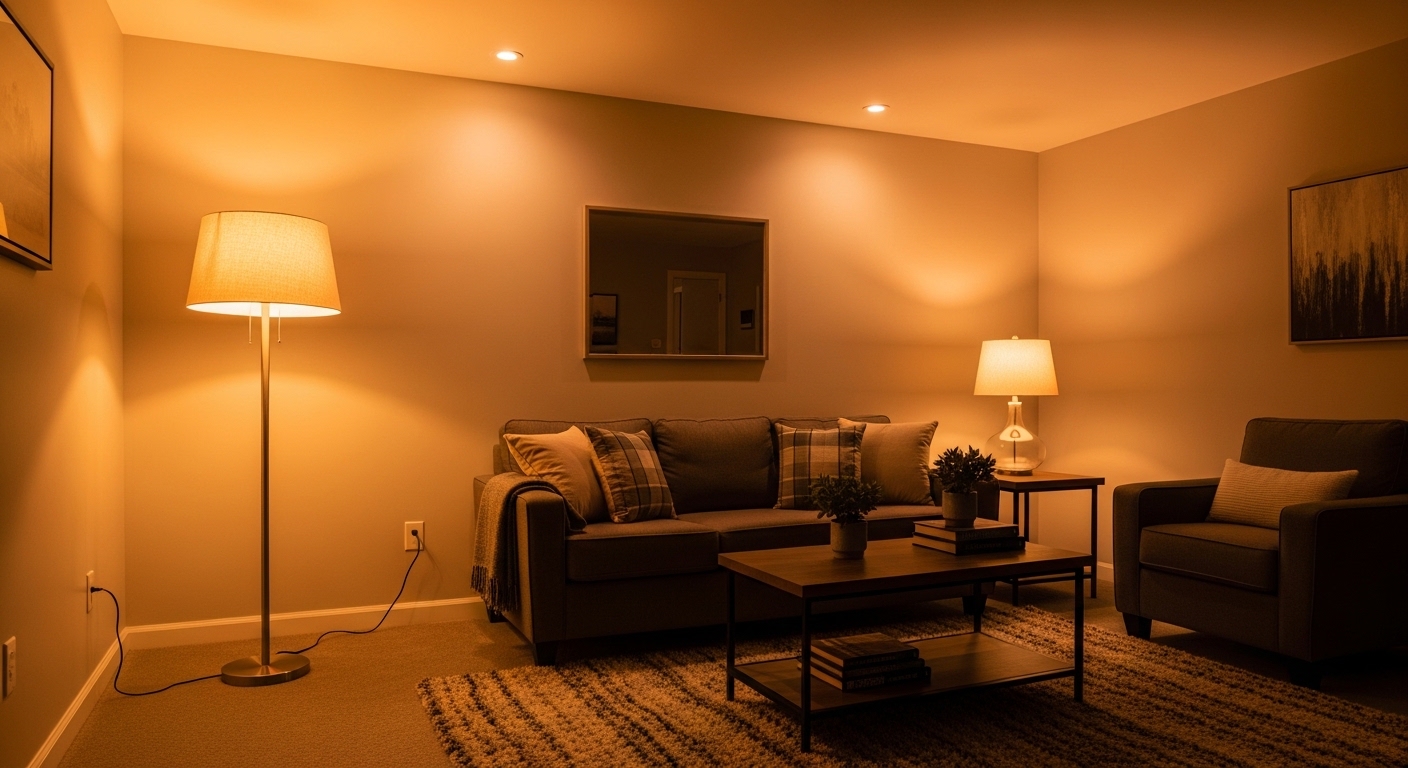
A focal point without light on it is a suggestion. The gallery wall has a sconce at its edge grazing across the frames; the bed has the two sconces; the kitchen shelf has the lamp. Light is the poster's contrast turned up on the primary element, and it's the tool a designer has at home that she doesn't have on the page: you can make the eye go somewhere by lighting it. The three-height system in the layers post is the mechanics; the design principle is that the brightest thing in the room should be the thing you want looked at, and in most apartments it's the ceiling.
Proofing the room
A designer proofs a layout by looking at it small, squinting, and flipping it; a room gets proofed by photographing it from the door on a phone and looking at the photo, which is what a guest sees in the first second and what the eye in the room edits out. If the photo has no obvious first thing, there's no hierarchy; if it's busy, there's no white space; if everything's the same tone, there's no contrast. I proof every change this way, and the phone has vetoed more purchases than my budget has.
The palette of three
Oatmeal for the big soft things, charcoal for the one wall and the small hard things, oak for the wood, and white for the walls that aren't charcoal, which doesn't count. Every purchase for two years has been in one of those, and the apartment reads as designed because nothing in it argues. The temptation in a small apartment is the accent color, the yellow chair, and the answer is one, if any, and it's a plant. A poster with four colors is a flyer; an apartment with four colors is a dorm.
What a poster teaches about edges
The edge of a poster is a decision, the margin between the last element and the paper's edge, and a room's edges are the same: the space between the sofa and the wall, the rug and the baseboard, the frame and the corner. In a small apartment the instinct is to push everything to the walls to gain floor, and it makes the room feel like a storage unit. The sofa is 4 inches off the wall, the rug is 12 inches from the baseboards, the gallery wall stops 10 inches from the corner, and the margins are what make 480 square feet feel composed rather than packed.
The first apartment, which broke every rule
A 320-square-foot studio with a sofa sized for a house, a rug that touched three walls, six colors, a gallery wall on every wall, brass and chrome and black in one room, and a ceiling light as the only light. It was the apartment of a designer who'd never applied a single principle to a room, and the studio post is how it got fixed with two bookshelves and a rug; the rules in this post are the ones I wrote down after, on a poster, which is on the bare wall's opposite side in a black frame.
What a print and a lamp cost
A single framed print runs $30 to $80 and changes a whole wall; a plug-in sconce is $48 and changes what the wall looks like at night; the two together are the cheapest design intervention there is and the one that a designer's eye notices first. The apartment was furnished for under $4,000 in total, and the money that mattered was the $600 on prints, frames and light, because the hierarchy, contrast and focal point are all in that $600 and the sofa is just a sofa.
Typography, translated: the text on the walls and the shelf
A poster's type has a size hierarchy, a headline and a body, and a room's objects do too: one big piece, the sofa or the gallery, a few medium ones, the lamp, the chair, the console, and many small ones that are the body text, the books, the plant, the bowl. The mistake in a small apartment is all medium: six objects of the same size that read as a paragraph with no headline. On the shelf: one tall thing, three medium, and the books as text, and one shelf empty as the paragraph break. On the wall: one frame twice the size of the rest. Size, not count, is what the eye reads first.
Kerning, or the space between things
The gap between two letters is designed, and the gap between two frames, two lamps or the sofa and the chair is too. Two inches between frames; 18 inches between the sofa and the coffee table; the chair at an angle with a foot of floor showing between it and the sofa. Objects that touch merge into one shape; objects too far apart stop relating. The 2-inch block of wood I use for the gallery wall is the kerning tool for the apartment, and the rug's edge does the same for the furniture.
Mistakes I still make
Buying something in a fourth color because it was on sale, twice a year, and returning it. Filling the bare wall when a guest asks why it's bare. Letting the open shelf fill. And hanging things at eye level for me, at 5 foot 4, which is 3 inches below the 60-inch rule and which the taller people in my life have mentioned. The principles are simple and the discipline is the part designers fail at in their own homes, which is the point of this post.
In one paragraph
One focal point per room, lit; one wall left bare; one strong contrast; edges that line up; two metals and three colors; everything a third smaller than the catalog; margins between the furniture and the walls; a size hierarchy on every shelf; and a print and a sconce as the $80 that carry all of it. The principles from the page, applied to 480 square feet by someone who'd been ignoring them at home for seven years.
The one that matters most in a small space
White space. Hierarchy, contrast and scale all help, but the difference between a small apartment that feels designed and one that feels crammed is whether anything has been left empty on purpose: a wall, a shelf, a margin between the sofa and the wall. It's the principle a designer uses on every page and the one nobody uses in a 480-square-foot apartment because every inch feels too expensive to waste, and it's the inch that isn't wasted. Leave one wall bare. Light the wall across from it. Stand in the door.
Shop this post: wall sconces in one finish, the repetition rule in a fixture