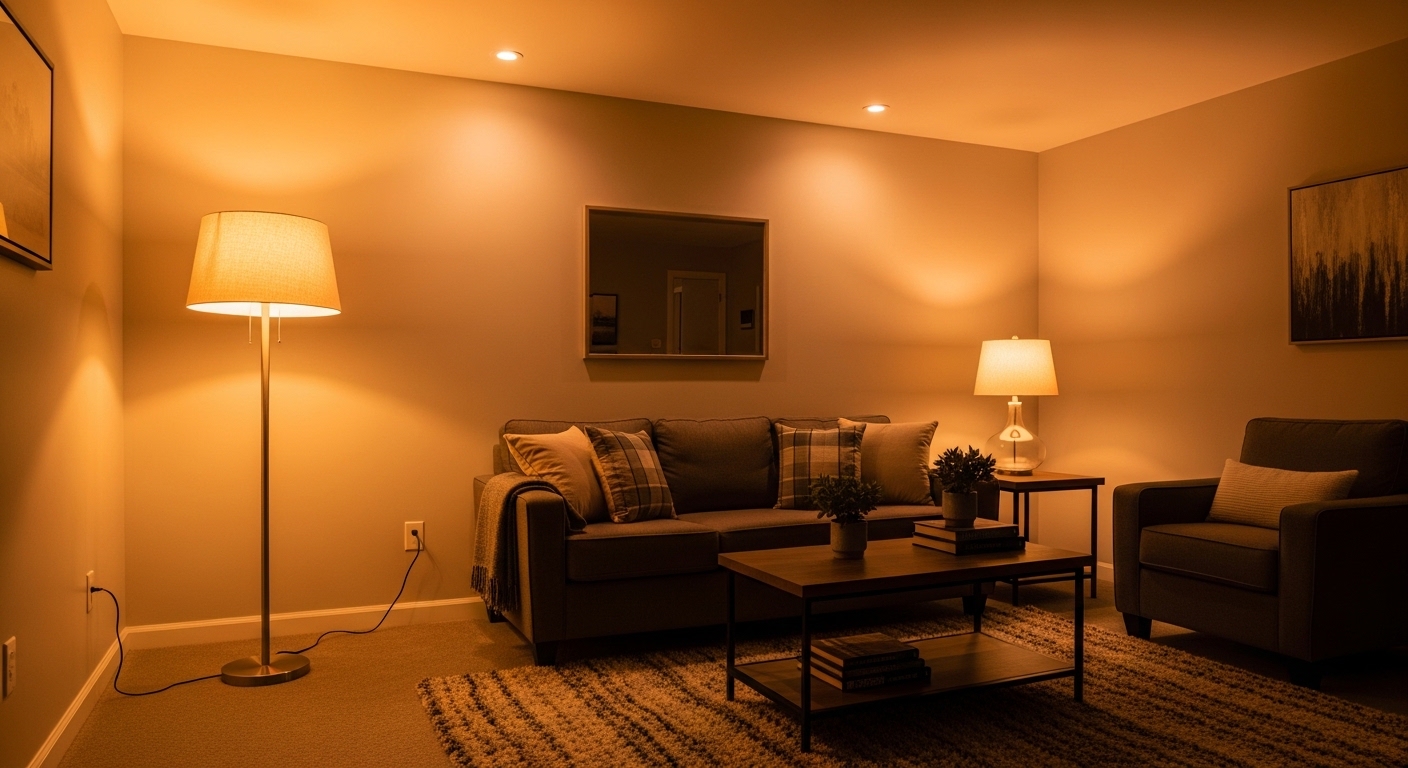
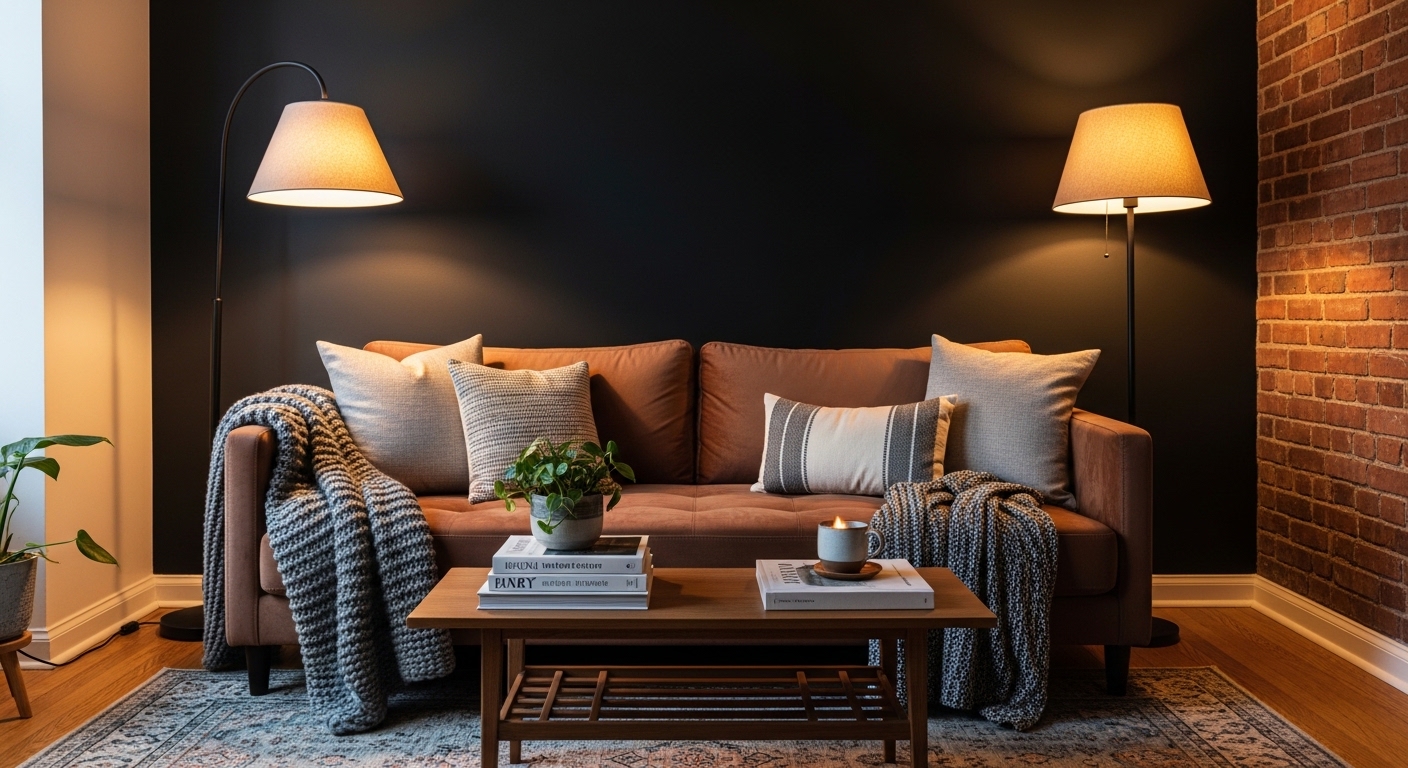
Cozy winter lighting in an apartment is a seasonal shift, not a purchase: every October I drop every bulb from 2700K to 2200K, add one lamp, move the timers earlier, and turn the ceiling lights off until March, and the apartment goes from summer to winter in an afternoon for about $30. A north-facing Brooklyn apartment loses its daylight by 4:30 in December, and an apartment that's lit for June in December is an apartment that feels like an office after dark; the shift is what I do instead of buying candles. This post is the four changes with the order, the bulb swap and why 2200K, the extra lamp and where, the timers, the ceiling lights and why they go off, the candles that aren't candles, the bedroom in winter, the kitchen and bathroom that don't change, the window and the mirror, the plants that have to move, what stays boxed until October, the reverse in March, the seasonal box, mistakes, and what the shift costs.
Why the apartment needs a winter setting
Daylight in June ends at 8:30 and in December at 4:30, and the apartment is lit by lamps for four more hours a night in winter than in summer; the lamps that are a supplement in June are the whole room in December. A summer setting, 2700K at 60 percent with the window doing the rest, is too bright and too white for a room that's dark from 4:30, and the fix is warmer and lower and more of it, which is the shift. The layers post is the system; this is the system's winter mode.
Change one: the bulb swap to 2200K
Every lamp and sconce bulb goes from 2700K to 2200K, which is candle-colored, amber, the color of a fire, and which at 30 percent on a dimmer is the warmest light a bulb makes. In June 2200K reads as orange against the window's daylight; in December there's no daylight to argue with, and it reads as warm. A pack of six 2200K dimmable LEDs, $18, kept in the seasonal box and swapped in twenty minutes on a Saturday in October; the 2700K bulbs go into the same box for March. The desk lamp stays at 3000K, because work doesn't change with the season.
Change two: one more lamp
A small ceramic lamp with a linen shade, on the bookshelf's middle shelf, at 2200K, that only comes out in winter; it's the third pool of light in the living room and the one at the height between the sconce and the floor lamp. In summer three pools are one too many for a room with a window; in winter three is the number, because the eye needs somewhere warm to land in every direction. The lamp is $40 secondhand and it lives in the closet from March to October, which is the only lamp I own that does.
Change three: the timers
The smart plugs on the entry sconce and the living room lamps move from "on at sunset" to "on at 4 pm," so the apartment is lit before it's dark and I never walk into a dark room at 4:45. The bedroom sconces get a 10 pm "drop to 20 percent" routine that's summer's 11 pm. The kitchen strip's off time moves earlier too, because dinner is earlier when it's dark at 4:30. Ten minutes in the app, and it's the change that costs nothing and matters most, because a lit apartment at 4:30 is the difference between winter and a winter mood.
Change four: the ceiling lights go off
From October to March the ceiling lights in the living room and the bedroom don't come on, at all; the switches are taped over with a piece of painter's tape, which is a rule made physical. A ceiling light in a dark room at 5 pm is the office; three lamps at 2200K and 30 percent is the room. In summer the ceiling light comes on for cleaning and for finding things, and in winter the lamps are on early enough that cleaning happens under them.
The candles that aren't candles
Two rechargeable candle-shaped LEDs on the console, at 2200K, on the same timer as the lamps, which flicker slightly and cost $22 the pair and don't set the apartment on fire; a real candle on the dining table for dinner, which is the one real flame. The LED candles are the lowest light in the room and they're on from 4 pm to midnight, which a real candle would be a bad idea for and a $30 a week habit. The guest post is what they do to a table.
The bedroom in winter
The two plug-in sconces at 2200K and 20 percent from 10 pm, a rechargeable lamp on the dresser for the dark mornings, and a heavier throw on the bed, which is the only non-light change in the room. The morning is the winter bedroom's problem: 7 am in December is dark, and a rechargeable lamp at 2700K on a "7 am, 50 percent" routine, brighter than the night light and cooler, is the closest a north-facing bedroom gets to a sunrise. The sconces are the night; the dresser lamp is the morning.
What doesn't change: the kitchen and the bathroom
The kitchen strip stays at 3000K and the bathroom sconce stays at 3000K, because they're task lights and a task doesn't get warmer in winter; cooking under 2200K is cooking in the dark, and the bathroom mirror at 2200K is a mirror for a different face. The counter lamp on the kitchen shelf drops to 2200K with the rest, because it's the after-dinner light. The rule is that working lights keep their color and living lights drop, and the kitchen has one of each.
The window and the mirror
The sheer curtain comes down in October and a heavier linen one goes up, which keeps the heat and turns the black window at 5 pm into a wall; a black window in winter is a mirror of the room with nothing in it, and it's the reason the lamps feel less warm than they are. The round mirror in the entry is angled to catch the entry sconce, so the darkest corner has a second light in it. The window is the one place winter makes darker than summer, and covering it is what lets the lamps do their job.
The plants that have to move
The pothos on the bookshelf moves to the window sill, because a north window in December is the only light in the apartment a plant can use, and the ZZ plant on the console stays where it is because it doesn't care. The grow bulb in the corner lamp, from the plant post, goes from 8 hours to 12, on its own timer, and it's the one light in the apartment that gets brighter in winter. The plants are why the seasonal shift has a fifth item on the list that isn't about people.
The seasonal box
A shoebox in the closet: six 2200K bulbs in October and six 2700K in March, the two LED candles, the small ceramic lamp's shade, the painter's tape, and a card with the timer settings for both seasons. The box is what makes the shift an afternoon and not a project; everything is in it and nothing has to be bought, and the March reverse is the same box run backwards. It's moved apartments three times and the card has been rewritten once.
The reverse in March
The first Saturday the clocks change: 2700K bulbs back in, the extra lamp and the candles into the box, the timers back to "sunset," the tape off the ceiling switches, the sheer curtain up, the plant back to the shelf. The apartment gets cooler and brighter and quieter, and it should, because the window is back and the room has a second light source that's free. The reverse is the same twenty minutes and it's the moment the apartment feels like spring, which in a north-facing apartment isn't something the window announces.
The evening in December, which is the point
Four o'clock and the entry sconce and the living room lamps come on before the window has gone black. Five, and the ceramic lamp on the shelf and the two candles on the console make the third and fourth pools. Six, the kitchen strip for dinner and off after. Eight, the sofa under the arc lamp at 2200K and 30 percent, a throw, the charcoal wall behind. Ten, the bedroom sconces at 20 percent. Every light warmer and lower than in June, on earlier and more of them, and an apartment that gets no sun after 4:30 that feels like the warmest place in Brooklyn.
Working from home in the winter setting
The one place the winter mode fights itself is the desk at 3 pm in December, when the window is already going and the living room lamps aren't on yet; the desk lamp at 3000K is on from 2 pm in winter, on its own routine, and it's the bright island in a room that's about to go amber. At 5 the desk lamp goes off and the corner becomes the living room's corner. The rule that the kitchen and bathroom don't change applies to the desk, and the timer is what keeps the two settings, work and evening, from overlapping; a 2200K desk at 3 pm is a nap.
Guests in December
A guest arriving at 6 in December walks into an apartment that's been lit for two hours, and it's the season the entry sconce on its timer earns its place; the console candles are on, the living room is three pools at 30 percent, and the ceiling light doesn't come on for the coat. Dinner is under the one real candle and the kitchen strip off after the plates are cleared. The winter guest gets the warmest version of the apartment, and it's the version where every light is lower than they'd set it themselves, which is why they stay late.
The dimmer levels, written down
Summer: living room lamps 60 percent, sconces 40, entry 50. Winter: living room 30, sconces 20, entry 40, candles on, extra lamp at 40. The levels are on the card in the box and they're set once in October; a plug-in dimmer with a memory holds the level through the switch, so the lamp comes on at 30 every time without being touched. The levels are the half of the shift that isn't the bulb, and the half that's easiest to forget, because a 2200K bulb at 80 percent is still too bright for December.
Mistakes
The first winter with 2700K everywhere and the ceiling lights on, and an apartment that felt like a waiting room from November. Real candles on the console, and a shade. A 2200K bulb in the bathroom, once, for a week. Forgetting to move the timers, and walking into a dark apartment at 4:45 for a month. And the pothos left on the shelf through a December, which is the plant post's mistake made in a different season.
In one paragraph
October: every living light to 2200K, one more lamp, timers to 4 pm, ceiling lights taped off, LED candles on the console, the heavy curtain up, the plants to the window. Kitchen and bathroom unchanged. March: the box run backwards. Twenty minutes each way, $30 the first year and nothing after, and an apartment that has a winter and a summer even though its window faces north and never sees the sun.
What the shift costs
Six 2200K bulbs, $18, once. Two LED candles, $22, once. The small ceramic lamp, $40 secondhand, once. The heavy curtain, $45, once. About $125 the first year and $0 every year after, for an apartment that's lit for the season it's in, and the timers, which cost nothing, are the part of it that I'd tell anyone to do first.
Shop this post: rechargeable wall sconces for the winter morning, and plug-in wall sconces for the 4 pm timer