String lights in an apartment look either like a hotel courtyard or like you never left your college dorm, and the difference comes down to four decisions: how high you hang them, what you hang them with, what bulb they use, and what other light is on in the room. Get those right and a $30 strand is the best thing in the apartment. Get one wrong and it reads as a fire hazard with feelings. I've hung string lights in four rentals without a single nail, taken them down without a single paint chip, and made most of the mistakes on the way. This is the method, with the specific hooks, the spacing, the bulbs, and the one rule I'd tattoo on the wall if my lease allowed it.
Where should string lights go in an apartment?
Above eye level, always. I cannot stress this enough. String lights hanging at lamp height, across a headboard or draped over a mirror, look tangled and busy because your eye reads every wire. Hung along the ceiling line or across the upper third of a wall, the wires disappear and you see only the points of light. Same lights. Completely different effect. The three placements that have worked in my 480 square feet: a single straight run along the top of the wall behind the sofa, a shallow swag from the corner of the ceiling to the top of the window frame, and, in a previous apartment, a zigzag across a small balcony ceiling. What has never worked: around a window frame at eye level, along a bookshelf, or anywhere they compete with art.
A design note, since it's my job. String lights are a line. Lines lead the eye. If your line goes somewhere (toward a window, along the length of the room), the room feels bigger. If it loops back on itself or crosses another line, the room feels busier. Draw the run on a piece of paper before you put up a single hook.
How do you hang string lights in a rental without holes?
Adhesive hooks, and not the tiny clear ones. The small clear plastic hooks rated for half a pound are for fairy lights, the hair-thin ones. For a strand of glass bulbs on a real cable, which is what you want, use hooks rated for at least three pounds, the medium white or clear Command-type hooks. Install them at ceiling height, every 18 to 24 inches for a straight run, every 36 inches or so if you want a swag. Press each one for 30 seconds, then wait an hour before hanging anything, which is the step everyone skips and the reason hooks fall off at 2 am.
Clean the wall with rubbing alcohol first. Painted drywall holds well; textured or freshly painted (under a week) walls hold badly. In my second apartment the "eggshell" paint turned out to be flat and the hooks came off with a strip of paint attached, which is exactly the outcome the hooks are supposed to prevent. I patched it with a $6 sample pot. Test one hook in a hidden corner and yank it off after 24 hours before you commit to twelve.
For the cord run to the outlet, use a matching color cord cover or the adhesive cord clips that come in the same packs, and take the cable down the corner of the room rather than across a wall. A cable that drops straight down in a corner disappears; one that crosses a wall at an angle is the first thing anyone sees.
What bulbs make string lights look good?
Warm, and small. 2200K to 2700K only: the amber "vintage" temperature or standard warm white. Cool white (4000K and up) string lights look like a parking garage and this is the least negotiable rule in this post. Bulb shape: G40 globes (about 1.5 inches) are the safe choice for indoor runs; the bigger G50 or S14 "Edison" bulbs are lovely on a balcony and slightly much in a small living room. LED, not incandescent, because the LED versions run cool, use about a tenth of the power, and won't shatter on a hardwood floor when a hook lets go. Shatterproof plastic bulbs exist and I'd use them anywhere you sit directly underneath.
Dimmable matters more than people think. A plug-in dimmer for string lights costs about $12 and turns the same strand from "party" at full to "one candle" at 20 percent, which is where mine live most nights.
Which string lights to buy for an apartment
The spec that has worked across four rentals: a 25-foot strand, 25 sockets on 12-inch spacing, G40 LED bulbs, 2700K, dimmable, with a black or white cable to match the wall (black on white walls is fine at ceiling height; it reads as a line, not a cord). Look for a strand that's connectable end to end, so you can add a second one on the balcony without a second outlet. Avoid the battery-powered strands for anything permanent; the batteries die in three weeks and the battery pack has to live somewhere visible. Avoid "color changing" unless you enjoy your living room looking like a pharmacy sign. Expect to pay $25 to $45 for a good indoor strand and $40 to $70 for an outdoor-rated one. The $12 strands are fine for a party and not fine for a year on your wall: the sockets loosen and bulbs flicker.
If the strand comes with clear bulbs and you want softer light, frosted G40 replacements are about $15 for 25 and make the biggest single difference to how the run looks when it's on. Clear bulbs show the filament and sparkle; frosted bulbs glow. In a small room, glow.
String lights in a bedroom: the one placement that works
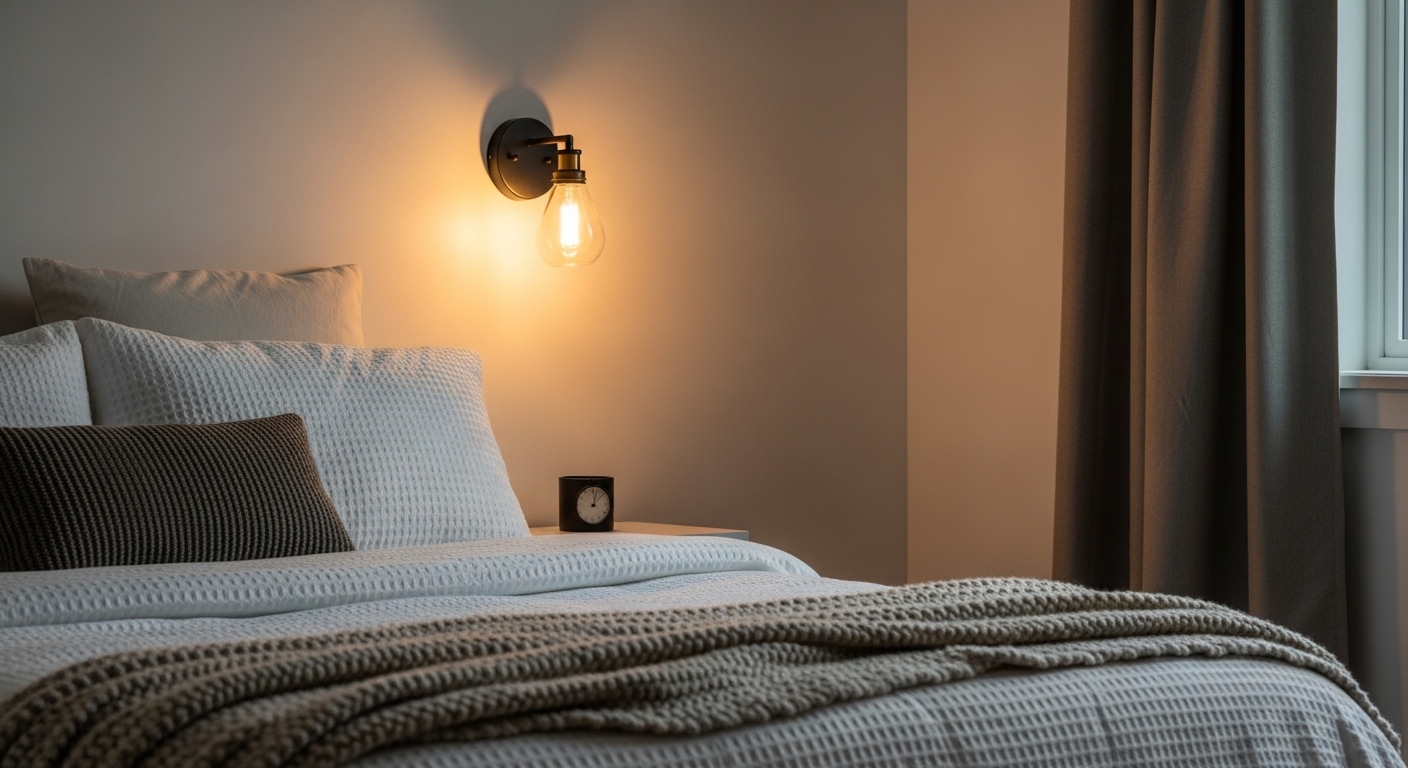
Not around the headboard. I know. Every photo shows them around the headboard, and in a photo they're lovely, and in a bedroom they're at eye level from the bed, they show every wire, and they light your face from below when you're trying to read. The placement that works is a single run along the top of the wall opposite the bed, at the ceiling line, on a dimmer, so that from the pillow you see a soft line of light and nothing else. Pair it with a plug-in sconce beside the bed for reading and the room has a top layer and a task layer, which is the whole of my renter bedroom lighting setup. If you rent a studio, the run goes on the wall that isn't the sleeping wall, for the same reason.
The layering rule: string lights are not a lamp
This is the one that separates the hotel courtyard from the dorm. String lights need other light sources to look intentional. On their own, they're the only thing lit, your eye goes straight to the wires, and the room looks like you forgot to buy lamps. Paired with a wall sconce below them and a floor lamp in the corner, they become decoration, a third layer on top of the functional light. In my living room the run along the top of the sofa wall sits above a plug-in sconce at reading height, and the string lights only go on once the sconce and the floor lamp are already on. The whole layering system is in my three-layer lighting post, and the plug-in fixtures that make layer two possible in a rental are in the plug-in sconce guide; string lights are strictly layer three.
The other half of this rule: never let string lights be the only light in a room you actually use. They're 5 to 10 lumens a bulb. Twenty-five of them is one dim lamp. Fine for atmosphere, useless for finding your keys.
Wall types, and where hooks fail
Painted drywall: fine. Plaster, which most pre-war New York apartments have: fine if the paint is sound, but plaster walls are often cold and slightly damp in winter, and adhesive holds worse below about 50°F, so hang in a warm room and give the hooks a full day. Brick: adhesive hooks don't hold on bare brick; use the brick clips that grip the top and bottom of a single brick with no adhesive at all, about $10 for a pack of eight, and they've held two strands on my friend's exposed wall for three years. Tile and glass: adhesive hooks hold best of all, which is why the bathroom is the one room where string lights are easy and the one room where they never look right. Wallpaper: don't. The hooks come off with the paper.
Ceilings deserve their own warning. Hooks on a ceiling are fighting gravity directly, not shear, and the rated weight roughly halves. If you want a swag from the ceiling, hook the strand to the wall an inch below the ceiling line instead; from the sofa nobody can tell.
How many string lights does a room need?
Less than you bought. A 25-foot strand with 25 bulbs covers one wall of a normal apartment living room with a gentle swag. Two strands cover a small balcony ceiling. I have never needed a third indoors, and every time I've tried, the room tipped from "warm" into "wedding tent." If the strand is too long, don't loop the excess into a ball behind the sofa; buy the right length, or hide the extra along the top of a bookcase in a straight line where it reads as deliberate.
What I did in each apartment, and what went wrong
Apartment one, a studio in Philadelphia: one strand across the whole ceiling diagonally. Looked like a net. Took it down in a week. Apartment two, Queens: a straight run along the top of the bedroom wall, on flat paint, hooks fell off with paint attached, see above. Apartment three, a Brooklyn one-bedroom: the balcony zigzag, two strands of G50s, best thing about that apartment and the reason I got the security deposit back after leaving them for the next tenant. Current apartment: the single run above the sofa, G40s at 2700K, on a dimmer, paired with the sconce. It's the setup I'd tell a friend to copy, and the whole thing was $58 including hooks.
The failure I'd warn about most isn't the hooks, it's the outlet. String lights on a cheap timer plug in a shared outlet with a space heater tripped the breaker in my building twice one January. Put them on their own outlet or a smart plug with no heater on the same circuit. And put them on a schedule: mine come on at sunset and go off at midnight, and I have not touched the switch since March, which is the kind of low-effort design decision that makes a rental feel like a home instead of a project.
Balcony and fire escape: what's allowed
Balcony, yes, with outdoor-rated strands and a covered outlet, hung from hooks on the underside of the balcony above or from a tension pole if there's nothing to hook to. Fire escape, no, in New York and in most cities: nothing can be attached to or obstruct a fire escape, string lights included, and it's one of the few things a building will actually enforce. I mention it because it comes up every December.
Taking them down without a trace
Unplug, lift the strand off the hooks, coil it around a piece of cardboard so it doesn't tangle in the box. For the hooks, pull the adhesive tab straight down, slowly, parallel to the wall, never out toward you. If a tab breaks, warm the hook with a hair dryer for 20 seconds and floss behind it with dental floss. Six apartments' worth of hooks removed this way, one strip of paint lost, and that one was the flat paint that was going to come off no matter what.
Shop this post: wall sconces to pair with string lights and plug-in wall sconces