Open shelving in a small kitchen works when you treat it as a display with storage behind it, not storage that happens to be visible, and the whole method fits in four rules: three items per cluster, one color story, the heavy stuff low and the pretty stuff at eye level, and a light under every shelf. When I moved into my 480 square feet in Brooklyn, the two open shelves above the counter looked like the world's most depressing garage sale. Every mismatched mug, every takeout container I was "going to reuse," a bag of rice with a clip on it. It took me two years and, I'd estimate, 40 YouTube videos to figure out the system. Now people ask which designer did my kitchen. The answer is me, a $27 LED strip, and restraint.
Why open shelves look cluttered in a small kitchen
Because a small kitchen has nowhere else to put things, so the shelves end up holding the overflow, and overflow is by definition the stuff that didn't fit anywhere. In a big kitchen, open shelves are optional and hold the twelve nicest objects you own. In a small one they hold the coffee, the spices, the cereal, and the blender, and the eye can't find a pattern. The fix isn't more shelves. It's deciding, ruthlessly, that the open shelves are the twelve nicest objects and everything else lives in a cabinet, a drawer, or a bin under the sink. I got rid of 23 mugs to make this work. I have four now. Nobody has ever needed a fifth.
The three-item rule
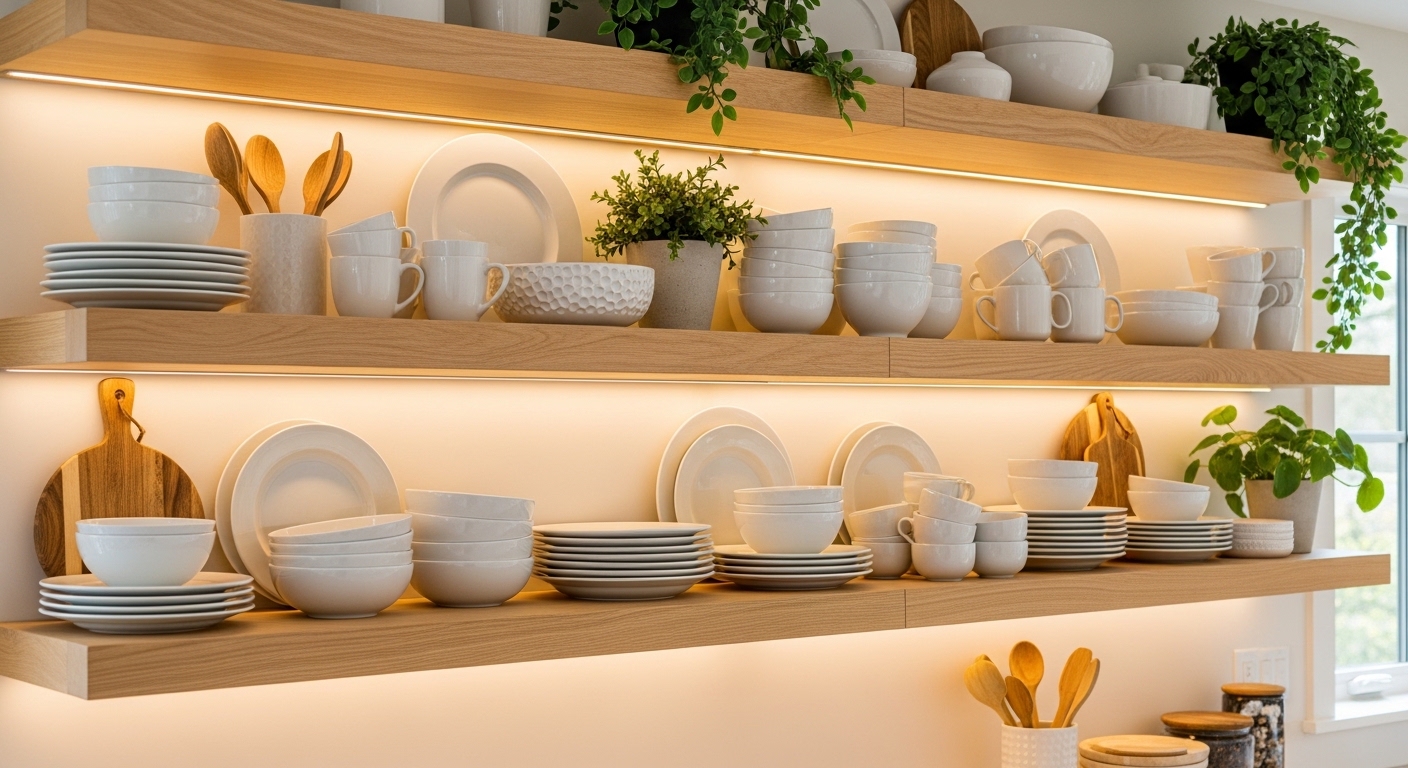
Never more than three different kinds of thing in any visual cluster. A stack of white plates, a small plant, a wooden cutting board leaning behind them. That's three. Stop there. Leave four to six inches of empty shelf before the next cluster starts, and put two or three clusters on a 36-inch shelf, never four. The empty space is doing the work; it's what lets the eye read each cluster as a composition instead of a row. This is the same principle as white space in a layout, which is my day job, and it holds in every medium I've tried it in. If you find yourself squeezing a fourth thing in "because it's cute," it goes in the cabinet.
Stacks count as one item. Six white bowls stacked are one object; six white bowls spread out are six. Stack everything you can. Group everything else in a tray or a basket, which turns five small things into one. Odd numbers of clusters look better than even ones for reasons I can't fully explain and have stopped fighting; two shelves with three clusters on the top and two on the bottom is the arrangement that finally stuck.
The color edit
Pull everything off the shelves. All of it, onto the counter. Then put back only the things that share a color story. Mine is white, cream, and natural wood, with exactly one terracotta pot for contrast. The blue mug went to my sister. The red kettle went in the cabinet, where it makes tea just as well. The logic is that a small kitchen has maybe 15 square feet of shelf in your sightline, and if that 15 square feet has eight colors on it, the room reads as busy no matter how tidy it is. Two neutrals plus wood plus one accent. That's the palette. Groceries with packaging (cereal, pasta, coffee) go into plain glass jars or matte canisters, or they go in the cabinet; the printed box is the single fastest way to undo the whole thing.
What should you not put on open kitchen shelves?
Anything you use once a month, because it collects grease and dust and you'll be washing it before you use it. Anything in its original packaging. Small appliances, unless they're the good-looking kind and you have one, not three. Cookbooks, which warp above a stove. Plastic anything. The coffee maker, in most small kitchens, because it's big and it's usually black and it eats a cluster on its own. And the heavy cast-iron pan on the top shelf, which I tried, and which I took down the day I had to get on the counter to reach it. The top shelf, above about 70 inches, is for light things you rarely touch: a pitcher, a stack of linen napkins, one plant that likes it up there. And nothing you'd be sad to see fall, because in an old building with a subway line underneath, things on high shelves migrate toward the edge about a millimeter a week. I learned this from a bowl.
How high should open shelves be, and what goes where
If you're a renter you probably didn't choose, but for what it's worth: the lowest shelf about 18 to 20 inches above the counter so you can still work under it, shelves 12 to 15 inches apart, and nothing above 72 inches unless you own a step stool you like. Everyday plates, bowls, and glasses on the lowest shelf at the end closest to the sink and dishwasher, so unloading is one reach. Mugs and the coffee things above the kettle. The middle shelf, at eye level, is the "pretty" shelf: it's the one that shows in every photo and the one where the three-item rule matters most. The top shelf is for the light, rare, tall things.
The lighting hack, which is the real secret
This is the part that made the difference, and it's the part no styling post mentions. I mounted an LED strip under each shelf, tucked against the back edge so you see the glow and not the strip. The light spills down onto the shelf below and onto the counter and makes the whole kitchen feel like the bar at a restaurant you can't afford. It cost about $30 for a 6-foot 2700K strip with adhesive backing and a plug, plus a $12 plug-in dimmer, and it took an hour, most of which was hiding the cord down the corner behind the shelf bracket. Warm white, 2700K, always; a 4000K strip makes white plates look like a dentist's office. The strip is on a smart plug with the rest of my counter lighting, so one tap and the kitchen is lit from three places instead of the single ceiling fixture that came with the lease.
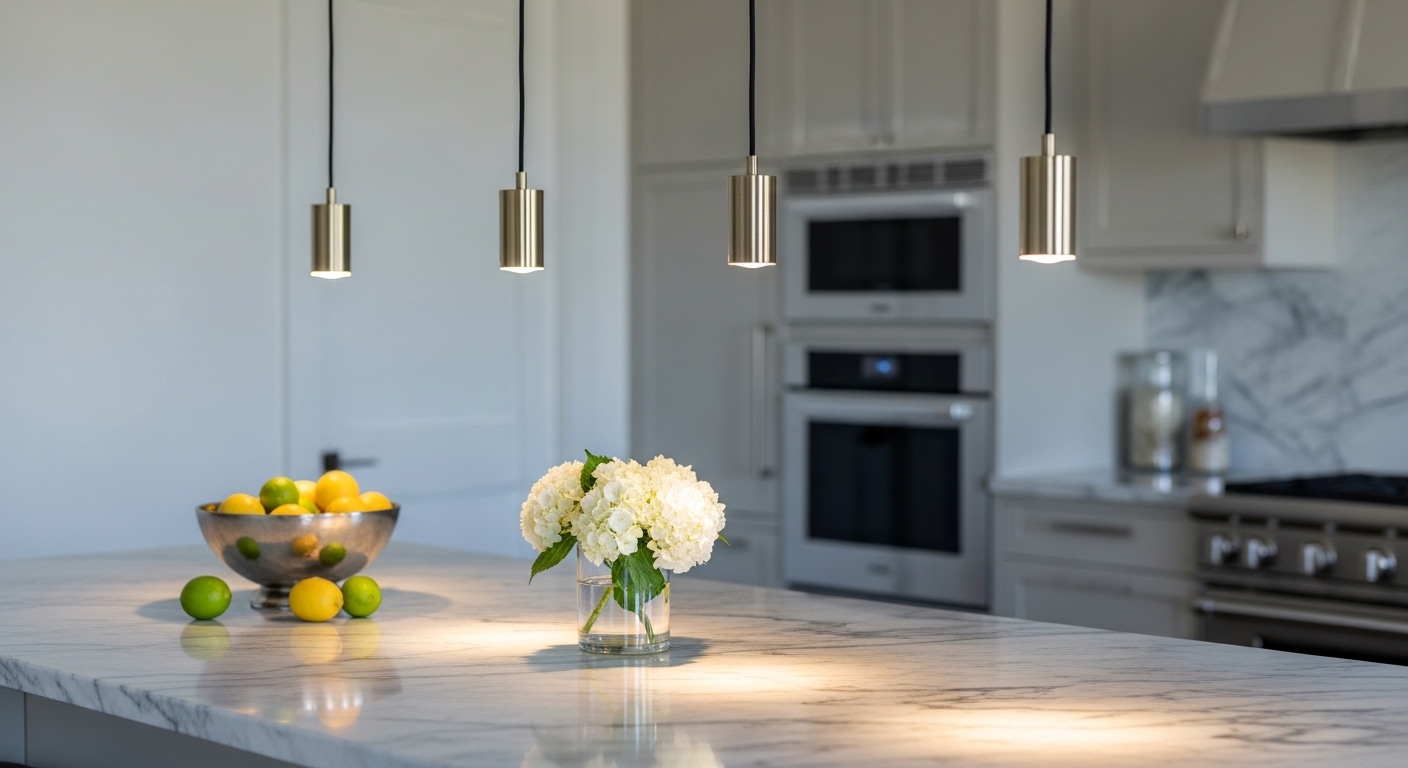
If your kitchen has a pendant over the counter or the sink, the shelf strip is the layer below it, and the two together are the whole answer to a dark rental kitchen; I wrote up the pendant half in the rental kitchen pendant post. Renter notes: the adhesive strip comes off with a hair dryer and leaves nothing on a painted or laminate shelf; on raw wood it can leave a mark, so run a strip of painter's tape first and stick the LED to that. If there's no outlet near the shelves, a rechargeable stick-on light bar under each shelf gets you most of the effect for $20 a shelf and a charge every three weeks.
Styling open shelves on a budget: what I'd buy first
If the shelves are empty and you have $100, in this order: a 6-foot 2700K LED strip and a plug-in dimmer ($40), which changes the room more than any object; a set of six plain white dinner plates and six bowls from a restaurant-supply store ($30, and they survive a dishwasher better than the pretty ones); one wooden cutting board you'd actually use ($15); and one plant in a terracotta pot ($10). That's the whole shelf, and it's the shelf in every photo people send me asking where I bought things. The glass jars, the linen napkins and the pitcher came later, one at a time, from thrift stores, which is the only way to buy things for open shelves: slowly, so each one has to earn its spot. The tray under the mugs is a $4 thrift find and the single most useful object on the wall, because it turns "four mugs" into "one thing."
What I wouldn't spend on: matching canister sets (see version two), anything labeled "farmhouse," and hooks for hanging mugs under the shelf, which look charming for a week and then make every mug swing when you close a cabinet.
My shelves, object by object
Bottom shelf, left to right: a stack of eight white dinner plates, a stack of six bowls on top, six glasses in two rows, then a gap, then the four mugs on a small wooden tray with the coffee canister behind. Top shelf: a white pitcher, a stack of four linen napkins with a wooden board leaning behind them, a gap, the terracotta pot with a pothos that's survived three winters, a gap, two glass jars of pasta and rice. That's everything. Twelve visible objects if you count the stacks as one. The blender, the toaster, the spices, the other 19 mugs and the cereal are in the two cabinets and the cart under the window, and the cart is another post: how I zone a tiny apartment.
Open shelving versus upper cabinets in a small kitchen
People ask whether they should take the cabinet doors off, which is the renter's version of "installing" open shelving. My answer, after living with both: take off one set of doors, the pair nearest the sink, and leave the rest. One open bay gives you the look and the easy reach for everyday dishes; a whole wall of open cabinets gives you a wall of things to keep tidy and a lot of grease on your glassware. Doors come off with a screwdriver in five minutes; put the screws in a bag taped inside the cabinet and the doors under the bed, and they go back on at move-out. Ask before you do it if your lease is fussy, but I've never had a landlord mind, and one thanked me because the hinges had been squeaking for years.
If you already have open shelves and hate them, the reverse works too: a $25 tension rod and a linen curtain across the lowest shelf hides the overflow and gives the eye a soft block of one color. It's not as good as editing, but it's better than a shelf of cereal boxes.
A two-hour reset for shelves that have drifted
Mine drift. Everyone's do. Every couple of months a spare mug appears and a jar of something joins the plant, and the shelf starts creeping back toward garage sale. The reset is the same every time and takes about two hours including dishes: everything off, wipe the shelves, wash the objects, put back only the color story, count the clusters (two or three per shelf, three things per cluster), check the gaps, turn the strip lights on, and look at it from the doorway, which is where guests see it from and where I never stand. Whatever is still bothering me from the doorway goes in a cabinet. It's a graphic design habit: you don't judge a layout from three inches away.
What went wrong before it went right
Version one, year one: everything on display, including the box of granola. Version two: I bought matching white canisters for everything and the shelves looked like a store display, which is the opposite problem; too uniform reads as staged. Version three, a year in: I added the wood and the plant and took half of the canisters away, and that's when it started to look like a person's kitchen. The lesson I'd pass on is that "styled" isn't "matching." It's two neutrals, one natural material, one living thing, and gaps. The other thing I got wrong for a long time was dusting. Open shelves in a small kitchen with a gas stove need wiping every two weeks, and the fewer objects you have up there, the less that hurts.
Shop this post: kitchen ceiling lights and small pendant lights