Kitchen counter lighting in a rental comes down to two plug-in layers: an adhesive LED strip under the upper cabinets for the counter, plugged into the outlet that's inside the cabinet above it, and a plug-in pendant over the corner you prep in for the mood; the strip does the work, the pendant does the feeling, and together they cost under $100 and take an afternoon. My rental kitchen has one overhead light in the center of the ceiling, which means that standing at the counter my own body casts a shadow on the cutting board, and I cooked in my own shadow for three years before fixing it in an afternoon. This post is the shadow problem and why ceiling lights can't solve it, the strips and how to choose and mount them, the outlet inside the cabinet, the temperature for a counter, the pendant and its height, the stove and the sink, the switch and the dimmer, the kitchen with no upper cabinets, the open shelf lamp, the bulbs, what to skip, hiding cords, the landlord question, mistakes, what it cost, and why my food photos stopped looking like they were taken in a bunker.
Why the ceiling light can't light the counter
The fixture is in the middle of the ceiling and the counters are at the walls, so the light comes from behind anyone standing at a counter and the body blocks it. Every cutting board in every rental kitchen with one ceiling light is in the cook's shadow, and the fix is not a brighter ceiling light, which makes a brighter shadow, but a light in front of the cook, under the cabinets, between the eyes and the board. It's a geometry problem and geometry doesn't care about lumens.
The strips: choosing them
A plug-in LED strip in an aluminum channel with a frosted cover, 3000K, about 300 lumens per foot, with a dimmer on the cord or an inline switch; the bare tape strips without a channel show as a row of dots reflected in the counter and the channel fixes that for $8 a foot. Warm white, 3000K, and not the 6000K "daylight" the strips default to, which makes the counter a morgue and the food grey. Two runs, one under each bank of uppers, 4 feet and 3 feet in my kitchen, joined with a connector. The kit with the channel, the cover, the connectors and the plug was $28 and the second run's channel $12 more.
Mounting them under the cabinets
Under the front edge of the upper cabinet's bottom, not the back, so the light lands on the counter's front where the board is and not on the backsplash. The channel sticks with its own adhesive or two small screws into the cabinet's bottom, which is the landlord's cabinet and which I've done both ways; the adhesive holds on a clean, dry, degreased cabinet bottom, and a kitchen cabinet bottom is never degreased until you wipe it with alcohol. Twenty minutes for both runs, and the counter is lit from front to back with no shadow at all.
The outlet inside the cabinet
There's always one; look carefully. Most kitchens have an outlet inside the upper cabinet over the counter, for a microwave or a range hood that isn't there, and the strip's plug goes to it with the cord running up the inside of the cabinet's corner through a notch. If there isn't one, the cord runs along the underside of the cabinet in the channel to the nearest counter outlet, with the plug taking one socket and a small cord cover on the wall for the 8 inches between. Mine was inside the cabinet, and the cord is invisible.
The pendant for the mood
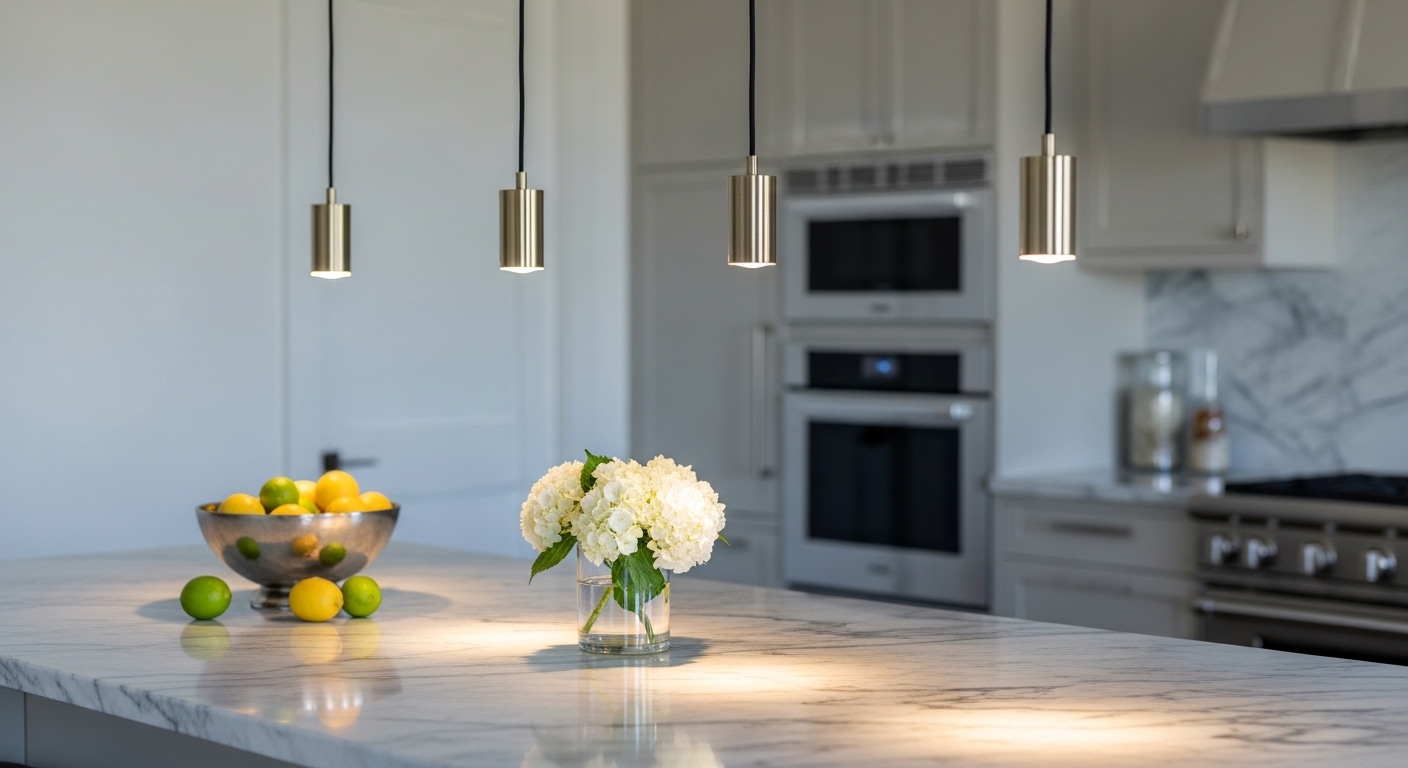
A plug-in pendant over the corner of the counter I use for prep, on a swag hook in the ceiling, cord to the wall and down a channel to the counter outlet, on a plug-in dimmer. It's not functional lighting; the strips handle that. It's aesthetic, and it makes that corner feel like a destination rather than a surface. Hung with its bottom at 30 inches above the counter, so it's over the board and under my eyeline standing, with a shaded fixture that hides the bulb and a 2700K bulb at 450 lumens, and at 40 percent in the evening it's the only light on in the kitchen. The rental pendant post is the swag hook in detail.
The stove and the sink
The range hood's light, if there is one, is usually a bad cool bulb and gets a 3000K one; if there's no hood, a rechargeable puck light stuck to the underside of the cabinet over the stove, which changed my cooking because I could see the color of a sear for the first time. The sink under a window has daylight until four and the strip after; a sink under a cabinet gets the strip. Three task points, board, stove, sink, and the strips cover two of them and the puck the third, all for under $50.
The switch and the dimmer
The strips on a smart plug inside the cabinet, so "kitchen on" is a phrase or a button by the door, and off at eleven by schedule. The pendant on a plug-in dimmer at the counter outlet, because it's the mood light and lives at 40 percent. Two controls, and they're never on together for long: strips for cooking, pendant for everything else, and the ceiling light for the floor once a week. The rental kitchen's one switch stays where it is and gets used less than it did.
Kitchens with no upper cabinets, and the open shelf
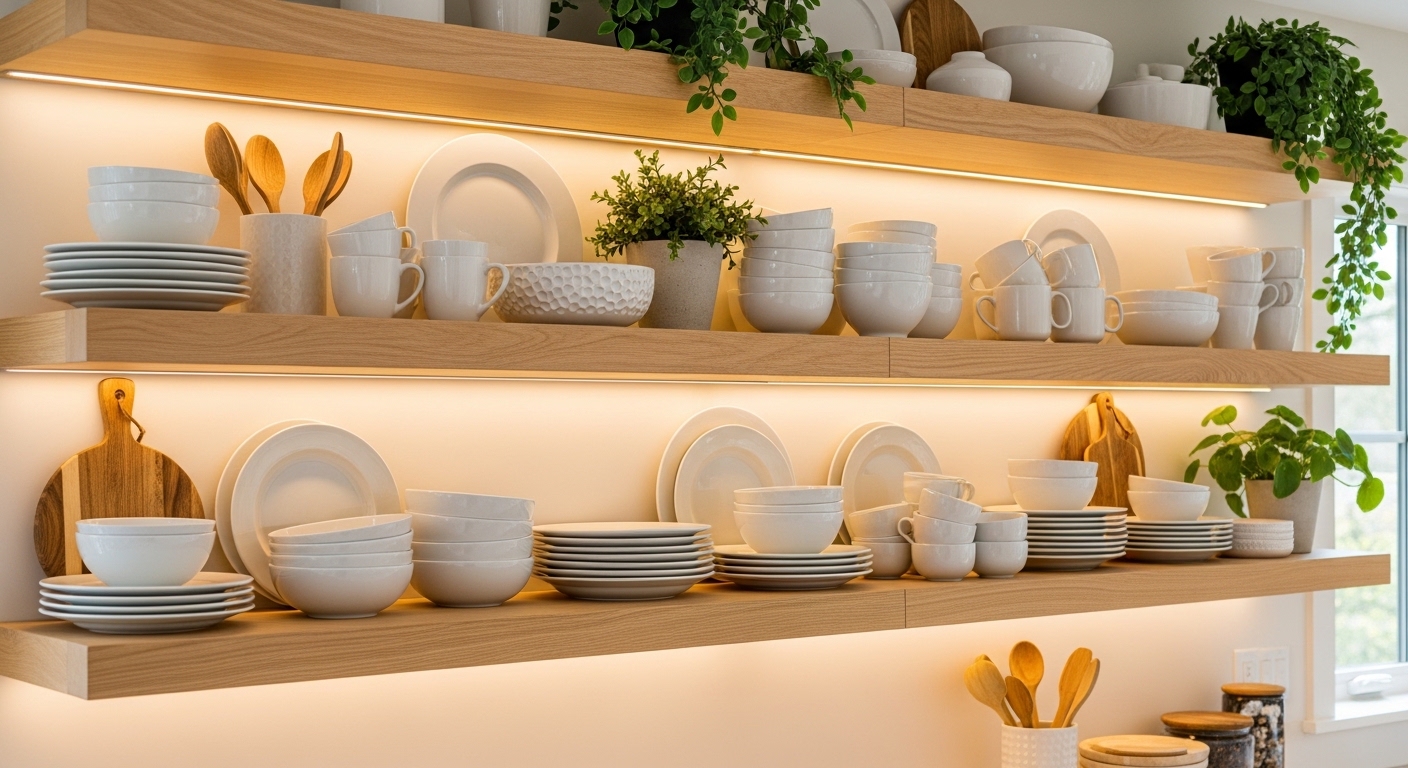
Without uppers, the strip goes under the lowest open shelf, or in the channel along the back of the counter against the backsplash pointed forward, which lights the board from behind the board rather than from above and is second-best but works. My open shelf has a small lamp on it at the end, a $24 ceramic one with a 2700K bulb, which is the third layer and the one that makes the kitchen look like a room at night; the open shelving post is the shelf. The lamp on the shelf is the trick nobody expects in a kitchen, and it's the light that's on when I'm not cooking.
Bulbs and temperatures for a counter
3000K with CRI 90 on the counter, because the food has to look like food and a knife has to be visible; 2700K in the pendant and the shelf lamp, because that's where you sit and look. Never the two in the same sightline at the same time, which they aren't: the strips are under the cabinets and the pendant is over the corner, and the strips go off when the board is clean. The one bulb I'd tell anyone to change first is the ceiling light's, from whatever the landlord left to 2700K, which is $4 and makes the kitchen bearable while the rest arrives.
What to skip
Battery puck lights under the cabinets as the main counter light, which are dim, need batteries monthly, and are for the stove only. Color-changing strips, which will be bright blue exactly once. Strips without a channel, dots. A brighter ceiling bulb, brighter shadow. A clamp lamp on the cabinet edge, which I did for a month, and which is a lamp in a kitchen. And a second pendant, because a rental kitchen has one corner worth a pendant and the second one makes it a bar.
The evening kitchen, since the strips are off by then
After the board is clean the strips go off, the pendant drops to 40 and the shelf lamp is on, and the kitchen is a warm corner seen from the sofa 12 feet away instead of a bright box. In a 480-square-foot apartment the kitchen is in the living room's view all evening, and the pendant and the lamp are what make it part of the room rather than the room's work station; it's the same idea as the three layers everywhere else, with the strips as the one layer that's only for the task.
Hiding the cords
The strip's cord inside the cabinet or in the channel. The pendant's cord along the ceiling to the wall in a paintable channel, down the corner, to the outlet; the channel is $8 and paint takes it. The lamp's cord behind the shelf. A rental kitchen with three plug-in lights and no visible cord is a kitchen that looks wired, and the channels are the $20 that make the difference between "I put up some lights" and "it was like this."
The landlord question
Nothing here is wired, nothing is screwed into a wall, and the two screws in the cabinet bottom are inside a cabinet. The swag hook is one screw in the ceiling into a joist, which is a picture hook's worth of hole. Everything comes down in an hour and comes to the next apartment, which is what the arc lamp and the sconces have done through four apartments. My landlord has seen the kitchen and said it was nice, which is the best review a rental modification can get.
How much light a counter needs
About 500 lux on the board for a knife, which is roughly what 300 lumens per foot of strip gives at counter height 18 inches below the cabinet. Less and you're squinting at the parsley; more and the counter is a stage. The ceiling light in a rental kitchen gives 100 to 150 lux on the counter with the shadow on top of that, which is why it always feels dark even when it's bright. The pendant adds nothing useful to the board and everything to the room, and the lamp on the shelf adds 200 lumens of warmth and no task light at all, which is its job.
Counter lighting for the renter who doesn't cook
Skip the puck at the stove and the second strip, and do one strip under the cabinet where the coffee happens and the pendant over it. That's the kitchen for someone whose cooking is a kettle and a toaster, and it's $70. The full version is for people with a sourdough starter with a name; the cook's version has the stove and the extra points. Both start with the strip, because the shadow is the same whether you're chopping onions or slicing a bagel.
Mistakes
Three years of cooking in my own shadow, thinking a kitchen was just dark. The bare tape strip for a month, dots in the counter. A 6000K strip from the kit's default bulb, a morgue for a week. The clamp lamp. And the pendant hung at 38 inches, which lit the wall and not the board; 30 was the number.
What it cost
The strip kit with channel and plug, $28, plus $12 of extra channel. The puck light, $14. The plug-in pendant, $58, and the swag hook and cord channel, $12. The plug-in dimmer, $12. The shelf lamp, $24. The smart plug, $10. About $170 for a kitchen with three lit task points and a mood, and the first $40, the strips, is the part that ended the shadow.
In one paragraph
A 3000K LED strip in a channel under the front edge of the upper cabinets, plugged into the outlet inside the cabinet, on a smart plug; a plug-in pendant at 30 inches over the prep corner on a swag hook and a dimmer, 2700K; a rechargeable puck over the stove; a lamp on the shelf. Cords in channels. Under $170, an afternoon, no landlord, and no more shadow on the board.
Why the photos stopped looking like a bunker
Because the counter is lit from the front at 3000K with the board in the middle of the light, and because the pendant makes the corner a place, and because the ceiling light is off. The two together, task light below and ambient pendant above, cost under $100 and made my kitchen look designed. The bread looks like bread now, and Greg, the sourdough starter, has never looked better.
Shop this post: plug-in pendant lights and kitchen pendant lighting