Kitchen lighting for renters who cook is one rule and three fixtures: light the counter from in front of you, never from behind, with an LED strip under the upper cabinets at 3000K, a plug-in pendant over the prep end, and a lamp on the open shelf for after, and the landlord's ceiling light off. I bake sourdough weekly, feed a starter named Greg, and cook most nights in a rental kitchen that's a single 8-foot wall with one ceiling fixture behind where I stand, and for the first year I chopped onions in my own shadow. This post is the shadow problem and why every rental kitchen has it, the strip and how it mounts without a screw, the pendant over the prep zone, the shelf lamp for after dinner, the color temperature for food, the stove and the hood light, the sink, the levels and the timers, the baking corner, the strip's outlet and the extension inside the cabinet, what a cook needs that a non-cook doesn't, the kitchen that's also the living room, mistakes, and the cost.
The shadow problem
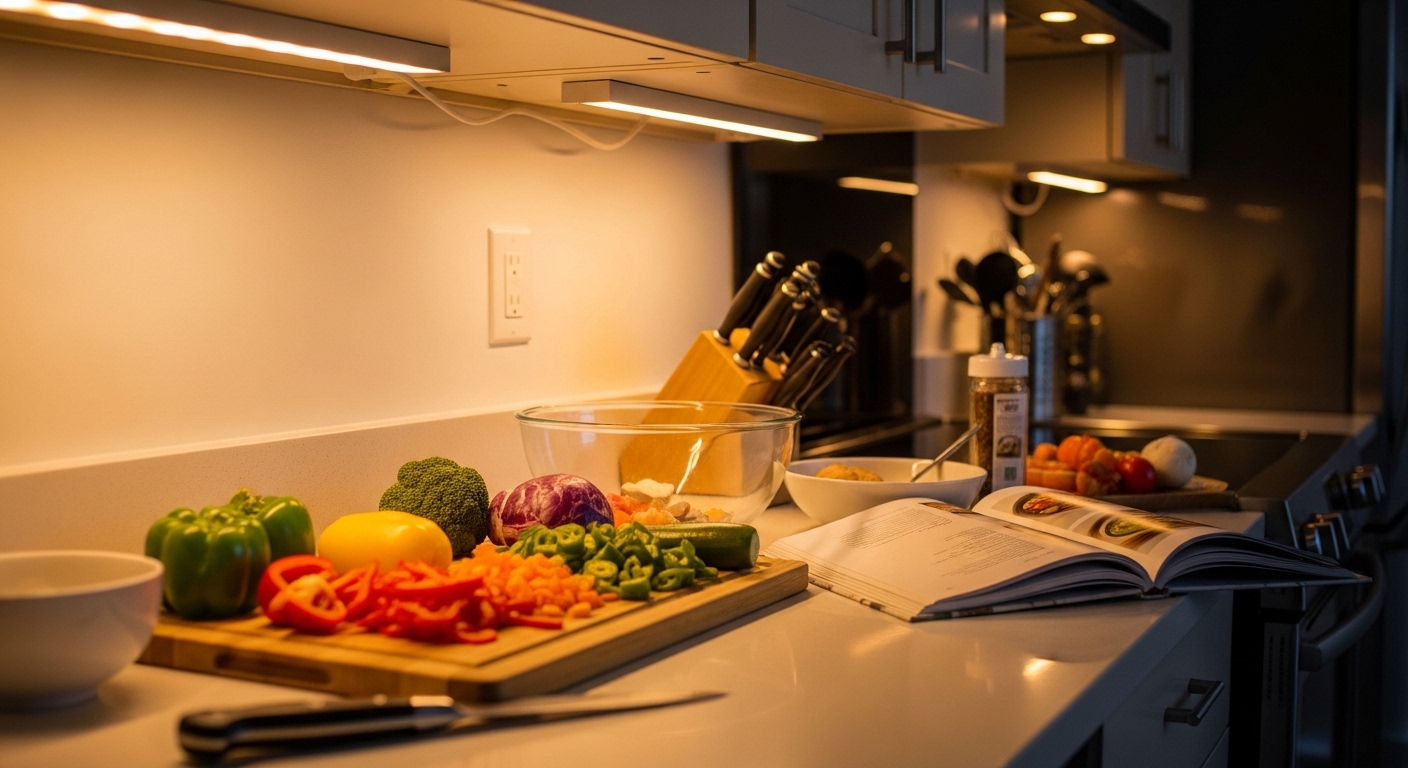
A rental kitchen's ceiling light is in the middle of the ceiling, and the counter is against the wall, so when you stand at the counter you stand between the light and the board, and your shadow is exactly where the knife is. It's why people with a bright kitchen say it's dark: the light is on and the work surface isn't lit. The fix is light that comes from in front of the cook and from below eye level, which is under the cabinets, and it's the observation in the observations post that's most obviously true once someone says it.
The strip under the cabinets
A 3000K LED strip, 8 feet, in an aluminum channel with a frosted diffuser, stuck to the underside of the upper cabinets at the front edge, angled back toward the wall so the light hits the counter and not your eyes; 90-plus CRI so a tomato is red, and a smart plug so it's on a schedule. The strip is the only light I need to cook by, and it's the one that took a year to think of. It mounts with the channel's adhesive, and the cord runs inside the cabinet to the outlet, which most rental kitchens have above the counter. The counter post is the mounting.
The pendant over the prep end
A plug-in pendant on a swag hook over the counter's end where the board lives, at 30 inches above the counter, 2700K, on a dimmer: it's the second light on the board from the other side, so a tall pot doesn't cast a shadow across it, and it's the light that makes the kitchen a room when the strip is off. The swag hook is the one hole, in a joist, and the cord swags to the wall and down to the outlet in a channel. The pendant is the difference between a kitchen that's lit and one that's a place.
The lamp on the shelf
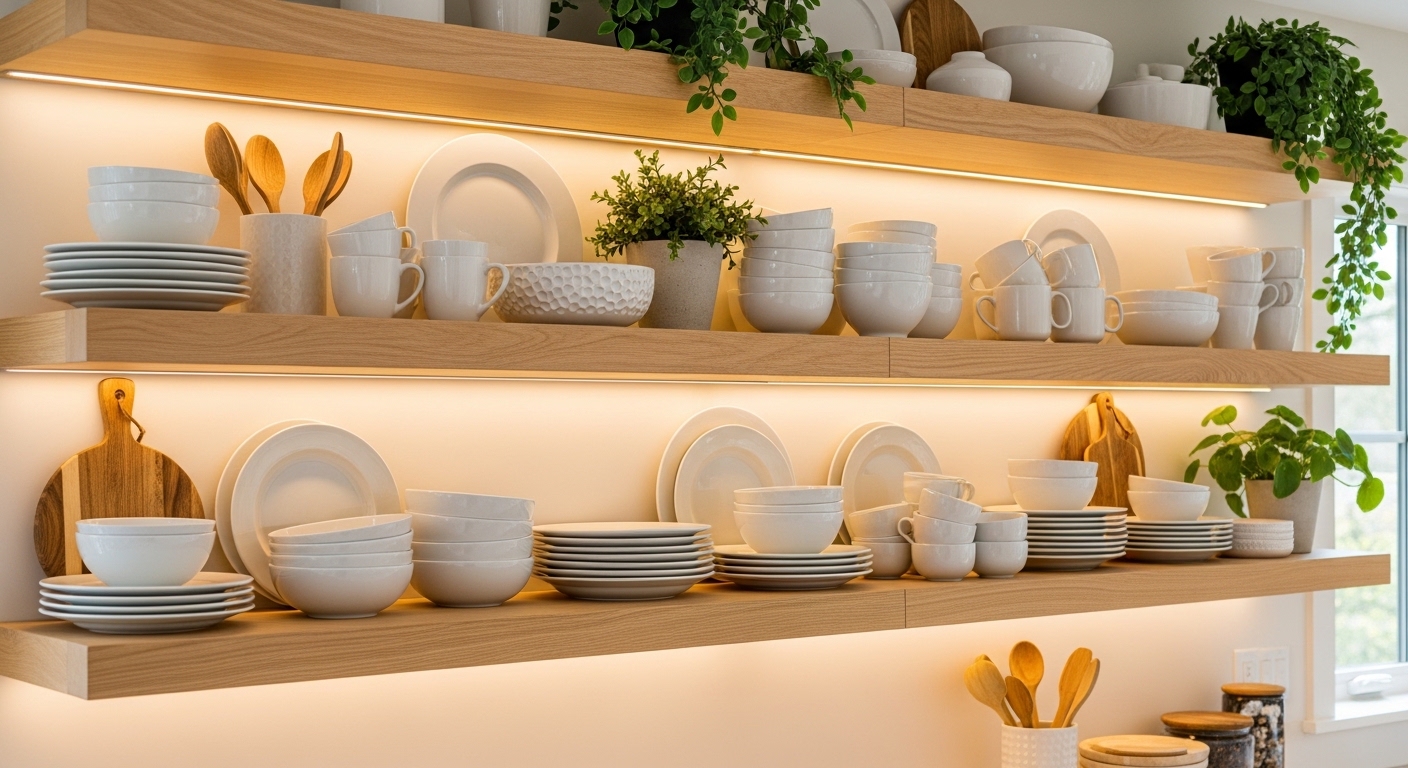
A rechargeable lamp on the open shelf above the counter's far end, 2700K, on after the strip goes off, which is the kitchen's after-dinner light and the light Greg the starter sits under; it's the lowest and warmest light in the kitchen and it's on from the dishes until bed. A kitchen with only task light is a kitchen that's closed after dinner, and the shelf lamp is what keeps it open. It charges on a USB cable once a month.
Color temperature for food
3000K on the strip, because food under 2700K is a brown photograph and food under 4000K is a hospital tray; 3000K is the color that shows a sear as brown and a herb as green. The pendant and the shelf lamp at 2700K, because they're the eating and the after, and the strip is the cooking. High CRI, 90 or more, matters more in the kitchen than anywhere, because the kitchen is the only room where the color of a thing tells you whether it's done.
The stove and the hood
The range hood light, if there is one, gets a 3000K bulb, which is the only bulb swap in the kitchen and the one nobody does; it lights the pan from the front and it's the light for a sauce. If there's no hood, a rechargeable puck on the underside of the cabinet above the stove, on a motion sensor. The stove is the one place the strip doesn't reach and the one place a shadow matters most, because a shadow on a pan is a burned pan.
The sink
The sink is usually under the window and lit by the window by day and by nothing at night; the strip's last foot reaches it if the strip runs the whole cabinet, and if it doesn't, a small puck under the cabinet's edge over the sink. Washing up in the dark is the kitchen's second shadow problem, and it's fixed by the same strip run 2 feet longer.
The levels and the timers
The strip at 100 percent for cooking and 30 for the evening, on a smart plug that brings it on at 5 and off at 9. The pendant at 40 for dinner and off after. The shelf lamp on from 9 to midnight. The ceiling light never, with tape on the switch. The kitchen has three settings, cooking, eating and after, and the switches are the plugs; the layers post is the same three heights in the living room.
The baking corner
Sourdough needs the counter's far end for the bench, the board and the scale, and it needs the strip's brightest foot over it, because scoring a loaf in a shadow is the difference between an ear and a tear. The proofing basket lives on the shelf under the lamp, which is a warm spot in winter, and the oven's own light is the only landlord fixture in the kitchen I use. A baker's kitchen needs the strip more than a cook's does, because a cook can see a pan and a baker has to see a surface.
The strip's outlet, and the extension inside the cabinet
Most rental kitchens have one outlet above the counter for the toaster and the kettle, and the strip's plug takes one of its sockets; a flat 3-foot extension inside the cabinet, out a notch in the back, runs the strip's transformer to the outlet with nothing on the wall. A smart plug in the outlet, the extension into it, the strip into that, and the counter's outlet still has one socket for the kettle. No hole, no wire on the backsplash, and the strip's cord is invisible unless you open the cabinet.
What a cook needs that a non-cook doesn't
Light on the board from two directions, so a knife and a pot don't shadow it. Light on the pan. A CRI that shows brown from burned. A strip that's bright enough at 100 percent and dim enough at 30 to eat by. And a light that stays on after the cooking, because a cook's kitchen is where the evening happens. A non-cook's kitchen is fine with a strip at 30 and the ceiling light for the microwave; a cook's kitchen has three fixtures and three settings and the ceiling light off.
The kitchen that's also the living room
In a 480-square-foot apartment the kitchen is a wall of the living room, and the kitchen's lights are the living room's fourth pool: the strip off after dinner so the kitchen becomes a wall of cabinets, the shelf lamp on so it's a warm wall, and the pendant over the table that's also the desk. A kitchen that stays at 100 percent after dinner is a living room with a kitchen in it; a kitchen that drops to the shelf lamp is a living room with a warm corner. The apartment tour is the wall.
The kitchen at three times
Seven in the morning: the strip at 100 for coffee and Greg's feeding, off after. Six in the evening: the strip at 100, the hood light on, the pendant at 40, the board under two lights and the pan under one. Nine: the strip at 30, then off, the pendant off, the shelf lamp on, the dishes done under the last foot of the strip, and the kitchen a warm wall until bed. Three settings that cost $130 and that the landlord's ceiling light, which is one setting, never gets to be.
The galley kitchen, and the kitchen with no upper cabinets
A galley with counters on both sides needs two strips, one under each run, and the pendant over the end where the two meet; the shadow problem is doubled because the cook turns their back on one counter to use the other. A kitchen with open shelves and no upper cabinets, which the studio had, has nowhere to hide a strip, and the answer is a strip under the lowest shelf's front edge, or a plug-in wall sconce on the wall above the counter at 60 inches, pointed down, which is the sconce doing the strip's job. The rule holds in both: from the front, below eye level, and never from the ceiling behind you.
What the strip does for the rest of the apartment
A kitchen that's a wall of the living room, lit from under its cabinets at 30 percent after dinner, is the living room's fourth pool and the one that makes the room read as wider, because the eye goes to the lit counter and reads the room's edge as the counter's back wall. At 100 percent the strip is a kitchen; at 30 it's a lit shelf in the living room, and it's the setting the strip is at most. A cook buys the strip for the board and keeps it for the living room, which is a thing I didn't expect.
Cleaning the strip, and what it's survived
The diffuser wiped monthly with a damp cloth, because a kitchen strip collects a film that yellows the light. The channel's adhesive has held three years over a stove, and a bacon splatter is the only thing that's landed on it. It's rated for the heat under a cabinet, which a bare strip without a channel isn't, and the channel is the $12 that makes a $26 strip last. Three years, one strip, one cleaning a month, and it moved to this apartment on its second set of adhesive.
Mistakes
A year of the ceiling light and the shadow. A 4000K strip, first, and a kitchen that looked like a lab for a month. The strip mounted at the cabinet's back edge, lighting the backsplash and not the counter. The pendant at 24 inches, in the way of every pot. And no shelf lamp for two years, and a kitchen that was closed at 9 pm and a living room with a dark wall.
In one paragraph
A 3000K strip under the cabinets at the front edge, on a smart plug, cord inside the cabinet. A plug-in pendant on a swag hook over the prep end at 30 inches. A rechargeable lamp on the shelf for after. A 3000K bulb in the hood. Cooking at 100, eating at 40, after at the shelf lamp, and the ceiling light off with tape on the switch. Light from in front, never from behind, and the onion in the light and not the shadow.
What it cost
The strip, channel and diffuser, $38. The smart plug, $10. The extension, $6. The pendant, $70, and the swag hook, $9. The shelf lamp, $48. The hood bulb, $6. About $190 for a kitchen that's lit for cooking in a rental that was lit for a microwave, and $54 of it, the strip and its plug and cord, is the part that fixed the shadow.
Shop this post: kitchen pendant lighting and plug-in pendant lights, the pendant over the prep end